.svg)

Your guide to the Commonwealth Home Support Programme (and what it will look like in the near future)
Read this article to find out how the Commonwealth Home Support Programme (CHSP) helps older Australians stay independent at home and how to apply.
Author: Sensible Care

Summary: The Commonwealth Home Support Programme (CHSP) is a government program. It provides basic help to older Australians so they can continue living at home. It provides help with daily tasks such as cleaning, personal care, food, transportation, and social activities, as well as some basic medical care. The CHSP should transition into the Support at Home program no earlier than 1 July 2027. Sensible Care can help you understand and adjust to this change when the time comes.
The Commonwealth Home Support Programme (CHSP) offers light, practical help so you can stay safe, comfortable, and connected at home.
This is an entry-level, government-funded support program. It's part of the broader Australian Commonwealth aged care system.
The CHSP aims to help older Australians live independently at home and stay connected to their community.
This guide explains what this program is, who it is for, and how to apply.
The Commonwealth Home Support Programme at a glance
- Who: People aged 65+ (or 50+ for Aboriginal and Torres Strait Islander people, and some people who are homeless or at risk).
- What: Low‑level, short‑term, and ongoing supports like personal care, meals, transport, social support, and help around the house.
- How to start: Register with My Aged Care and request an assessment.
- Costs: Providers may ask for a client contribution; fees vary by provider and service, and must be agreed upon before services start.
- Recent changes: The CHSP will transition into Support at Home no earlier than 1 July 2027.
What is the aim of the CHSP, and who is it for?
The Commonwealth Home Support Programme (CHSP) is a government-funded service that gives you a little extra help at home.
It's for older Australians who can mostly manage on their own, but find some everyday tasks harder than they used to.
The CHSP has three main aims:
- To help you live safely at home for as long as possible.
- To delay or avoid residential care until it becomes a better, safer option.
- To support carers with respite and practical help.
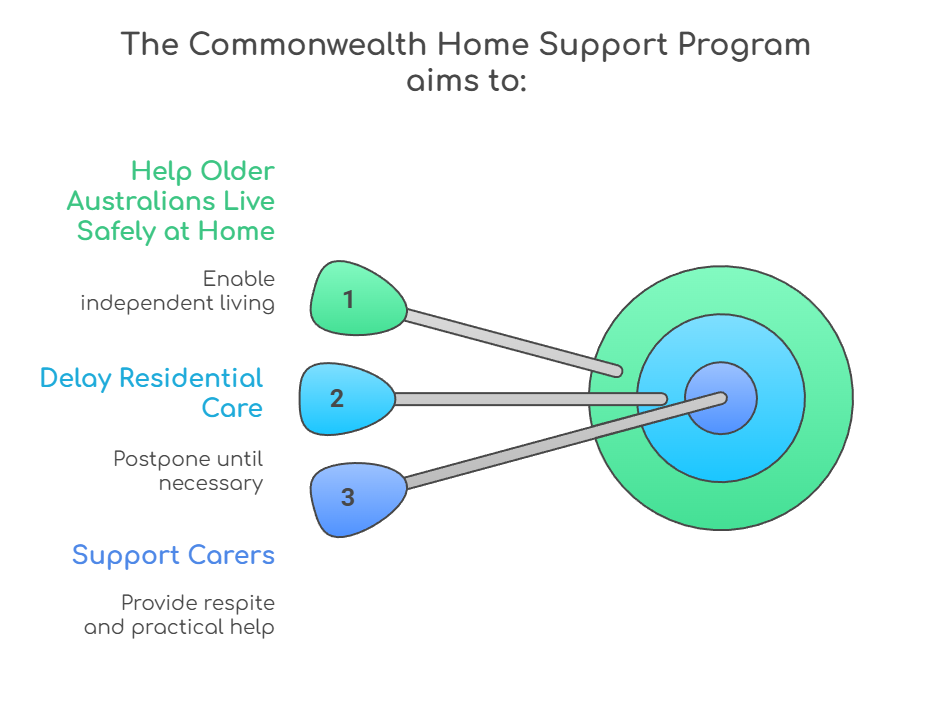
Note that the CHSP is for older people who need a little help, not full-time care. It suits people who are mostly independent but need support with daily tasks.
The CHSP might be for you, if you:
- Can live at home, but need help with cleaning, shopping, or personal care.
- Need transport, social support, or basic nursing from time to time.
- Are not ready, or not eligible, for a Commonwealth aged care home support package or other high-level supports.
Are you eligible for the Commonwealth Home Support Programme?
When talking about CHSP eligibility, two things are important:
- Your age and residency status
- The type of care and support you need
Age and residency criteria
You may be eligible for the CHSP if you are:
- Aged 65 years or older, or
- Aboriginal or Torres Strait Islander, and aged 50 or older, or
- Aged 50 or older and homeless or at risk of homelessness.
In exceptional cases, some younger people may get help. These cases go through special pathways, so it is best to check with My Aged Care.
Types of care needs
The CHSP is for people with low-level care needs. You may:
- Struggle with cleaning, laundry, or cooking
- Feel unsafe showering or moving around the house alone
- Need help getting to appointments, shops, or social activities
You do not need to know medical terms for your needs. The assessor will ask simple questions about your daily life, your health, and your safety at home.
What services does the CHSP cover?
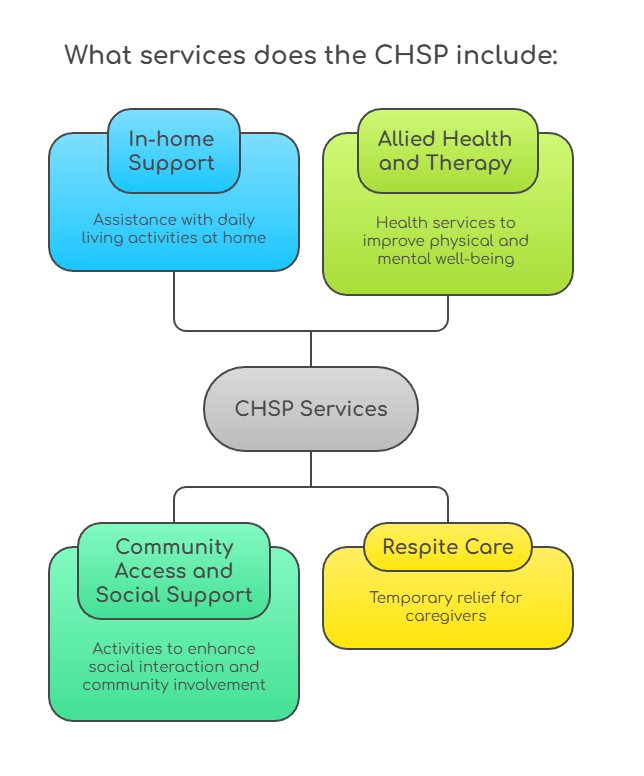
Services vary by region, provider, and funding. However, most areas offer support in these main groups:
- In-home support
- Community access and social support
- Allied health and therapy
- Respite care
In-home support
In-home support includes:
- Help with household errands, such as cleaning, laundry, and basic chores.
- Personal care, including showering, dressing, grooming, and help with movement.
- Meal support, such as delivering meals or helping with meal preparation at home.
- Home maintenance and modifications, such as minor repairs, gardening, gutter cleaning, and safety modifications
These services keep your home safe and tidy, while also supporting your personal dignity.
Community access and social support
Staying social is important for your mental health. The CHSP offers:
- Transport to appointments, shopping, and social outings.
- Social support, either one-to-one or in small group activities.
- Community programs, including exercise groups, craft, and other activities.
These services help you stay connected and reduce feelings of loneliness or isolation.
Allied health and therapy services
In some areas, the Commonwealth Home Support Programme can also fund:
- Allied health, which covers physiotherapy, occupational therapy, and podiatry.
- Basic community nursing, including wound care and medication support.
Not every provider offers these services. They depend on local CHSP services and contracts.
Respite care options
The CHSP can help support carers as well. Respite may include:
- Short in-home visits to give your carer a break.
- Centre-based day respite with activities, food, and supervision.
- Other short-term arrangements, where available.
Respite aims to protect the health and well-being of carers. It also keeps the caring arrangement safe and sustainable.
How to apply?
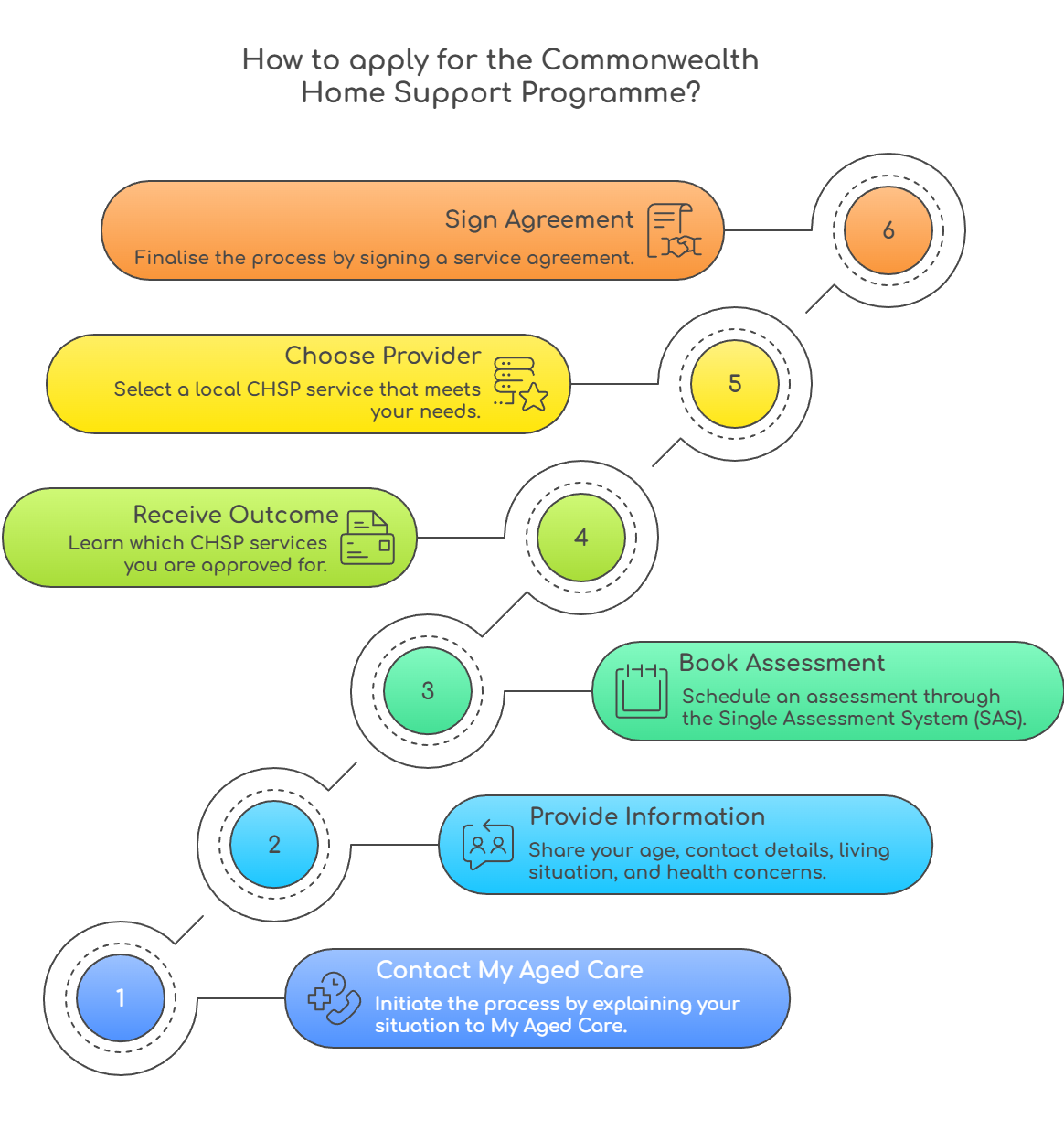
If you are eligible for the Commonwealth Home Support Programme, here's how you can apply:
- Contact My Aged Care and briefly explain your situation.
- Provide basic information, including your age, contact details, living situation, and any health or safety concerns.
- Book an assessment, usually conducted through the Single Assessment System at your home or via phone/video call for CHSP support.
- Receive your assessment outcome, which explains which CHSP services you are approved for and whether you need a higher-level assessment.
- Choose a provider by contacting local CHSP services in your area and asking about their support, availability, and fees.
- Sign a Service Agreement that clearly lists your services, visit times, and costs, and only start services once you understand and agree.
The assessment process (Single Assessment System)
Assessments use the Integrated Assessment Tool, which gathers information about your situation in a friendly and practical way. The assessor will:
- Talk with you about your daily routines and what is challenging now.
- Assess your home environment, including potential safety risks.
- Ask about your health, medications, and support network.
You can have a family member, friend, or carer with you. This can help you feel more comfortable and remember details.
Costs and client contributions
The CHSP is part of the Commonwealth aged care funding, often called CHSP funding.
The Australian Government pays most of the cost of your services, but expects you to pay a contribution if you can afford it.
This differs from some Commonwealth aged care packages, where funding levels and budgets are more formal and structured.
Your provider sets the fees for each service and must discuss and agree on these with you before your care starts.
Simple visits, such as domestic help or transport, usually involve a small contribution per visit. More complex work, such as home modifications, costs more and may require quotes.
You should receive a clear Service Agreement that explains the fee schedule, any standardised client contribution policy, and how fee increases are handled.
If your needs change
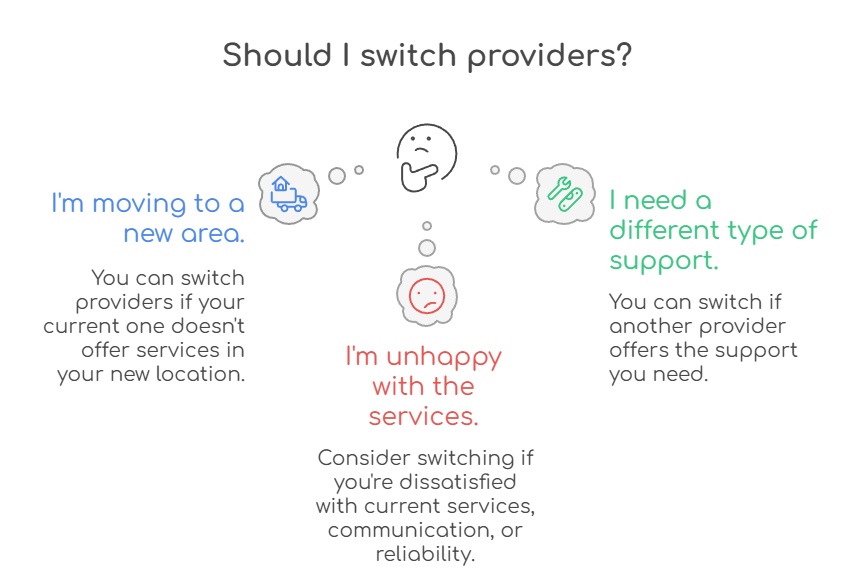
You are not locked into one CHSP provider forever. You can change providers if your situation, location, or preferences change.
You may choose to move to a new provider if:
- You move to a different area, and your current provider does not work there.
- You are unhappy with your current services, communication, or reliability.
- You need different types of support, and another provider is better able to offer them.
If you want to change, start by talking to your current provider. They can explain notice periods, booked visits, and how to end or transfer your services.
You can also speak with My Aged Care if you need help finding other CHSP providers in your area.
Your assessment outcome can usually be used with a new provider, so you do not have to start from scratch.
You can also upgrade your support as your needs grow. This might mean more hours, more complex help, or a different kind of funding.
Recent and upcoming changes to the CHSP
The aged care system has already started changing. On 1 November 2025, the new Aged Care Act 2024 came into effect. Home Care Packages and Short-Term Restorative Care merged into the new Support at Home program.
The CHSP is now the only in-home aged care program still operating separately, under the updated CHSP 2025–27 Manual. All CHSP clients must have a current aged care assessment to keep receiving services.
Looking further ahead, more change is on the way. The Commonwealth Home Support Programme (CHSP) is not a permanent programme. It is planned to transition into the Support at Home program no earlier than 1 July 2027.
The government has extended the CHSP while it finishes designing and rolling out Support at Home. So, for now, you can keep using CHSP services under the current arrangements.
Over time, CHSP services will be brought under the new Support at Home system.
The aim is to have one main in-home aged care program instead of separate schemes and funding streams.
If you already receive CHSP support, you will not be cut off suddenly. You can expect:
- Advance information about changes to your programme and funding.
- Updated agreements that explain what stays the same and what is new.
- Help from My Aged Care and your provider to understand your options.
When the change happens, your support should move with you, rather than stop.
If you are unsure about what this will mean for you, please contact Sensible Care for a clear and straightforward explanation.
FAQ
Do I have to be an Australian citizen or permanent resident?
You do not need to be an Australian citizen or permanent resident to access CHSP services. As of November 2025, the programme guidelines confirm that residency status requirements have been removed. However, it's best to check with My Aged Care about your specific situation.
How much does the CHSP cost?
The Australian Government pays most of the cost through CHSP funding, but expects you to pay a contribution if you can afford it. Your provider sets the fees, explains them before services start, and lists them clearly in your Service Agreement.
What is the difference between the CHSP and the Support at Home program?
The CHSP is entry-level support, usually a few hours' help with everyday tasks. People with higher or more complex needs are supported through the Support at Home program, which replaced the Home Care Packages program on 1 November 2025. The CHSP remains separate for now and will join Support at Home no earlier than 1 July 2027.
What happens if my needs change or get more complex?
If your needs increase, your provider or GP may suggest a new My Aged Care assessment. You might receive more CHSP support or move to a higher-level option through the Support at Home program.
Will the CHSP be replaced by the Support at Home program?
The CHSP is planned to transition into the Support at Home program no earlier than 1 July 2027. You will continue to receive support during this change. Your provider, My Aged Care, as well as services like Sensible Care, can help you understand what it means for you.
Ready to talk about your next steps?
The Commonwealth Home Support Programme is often the first step into aged care support. It can give you the help you need now, while keeping your options open for the future.
If you are still unsure about what the CHSP is or how it fits into aged care, you are not alone. Many people feel the same.
Reach out to us at Sensible Care to talk through your situation. We can help you understand your options, prepare for My Aged Care, and select CHSP services that suit your lifestyle.

Take the Next Step in Care
Download our Info Kit or speak to one of our friendly team members today.


Explore More Helpful Reads
More stories, guides, and updates to support you and your family.

.webp)


Need Help Getting Started?
Reach out on your terms, pick a time that suits you and let’s talk about how we can help.


.webp)