.svg)

Support at Home inclusions and exclusions: What you can (and can't) use your funding for
Here's your guide to Support at Home inclusions and exclusions, which will help you learn how to use your aged care budget with more confidence.
Author: Sensible Care

Support at Home funds care and support that keep you safe and independent at home. However, these support services must also meet your assessed needs. Funding does not cover everyday bills, luxuries, or cosmetic renovations. Some items that seem "grey" may be approved when there is strong clinical evidence, clear goals, and the necessary documentation.
Funding rules for in-home aged care might seem confusing, especially with the recent rollout of the Support at Home program.
Support at Home should help you stay safe and independent at home, but budget rules are strict, with the addition of some "grey" areas.
In this guide, we'll break down the main inclusions, common exclusions, and grey areas, so you can use your budget effectively.
Quick recap: What is Support at Home?
Support at Home is Australia's new model for ongoing in-home aged care.
From 1 November 2025, it replaced older programs, including Home Care Packages and the Short-Term Restorative Care program.
It brings services together under one system, so support feels more coordinated, flexible, and easier to understand for you and your family.
The program funds care that helps you live safely and independently at home for as long as possible.
It focuses on assessed care needs rather than general living costs, luxuries, and everyday household expenses.
What do Support at Home inclusions and exclusions mean?
An inclusion is an expense that Support at Home can fund when you genuinely need it. For Support at Home to grant funding for something, it must:
- Meet an assessed need
- Appear in your care plan
- Be approved by your provider and assessor
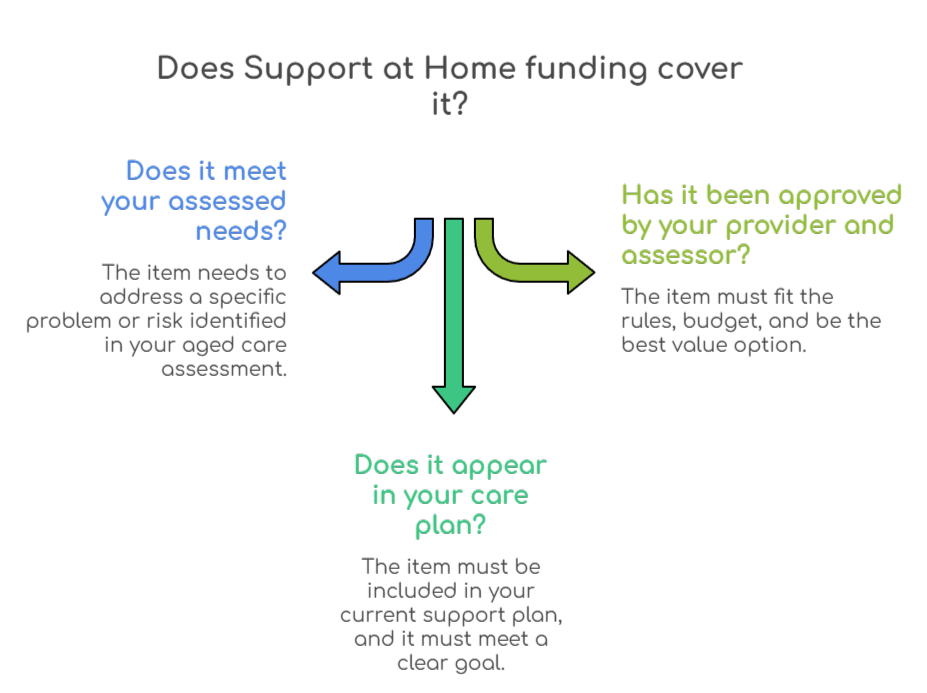
This means you usually need an assessment, clear goals, and sometimes clinical evidence. This can be a report from an occupational therapist or physiotherapist, for example.
Your provider should then match your needs to the program rules and check that the item fits within your budget.
An exclusion is something the program will not fund, or will only fund in very specific circumstances.
These services or items typically do not directly relate to safety, health, or independence. They might already be covered by Medicare, the PBS, or another scheme.
The same rules applied to Home Care Package inclusions and exclusions. Only now, they're clearer and stricter.
Key inclusions: What is usually funded by Support at Home?
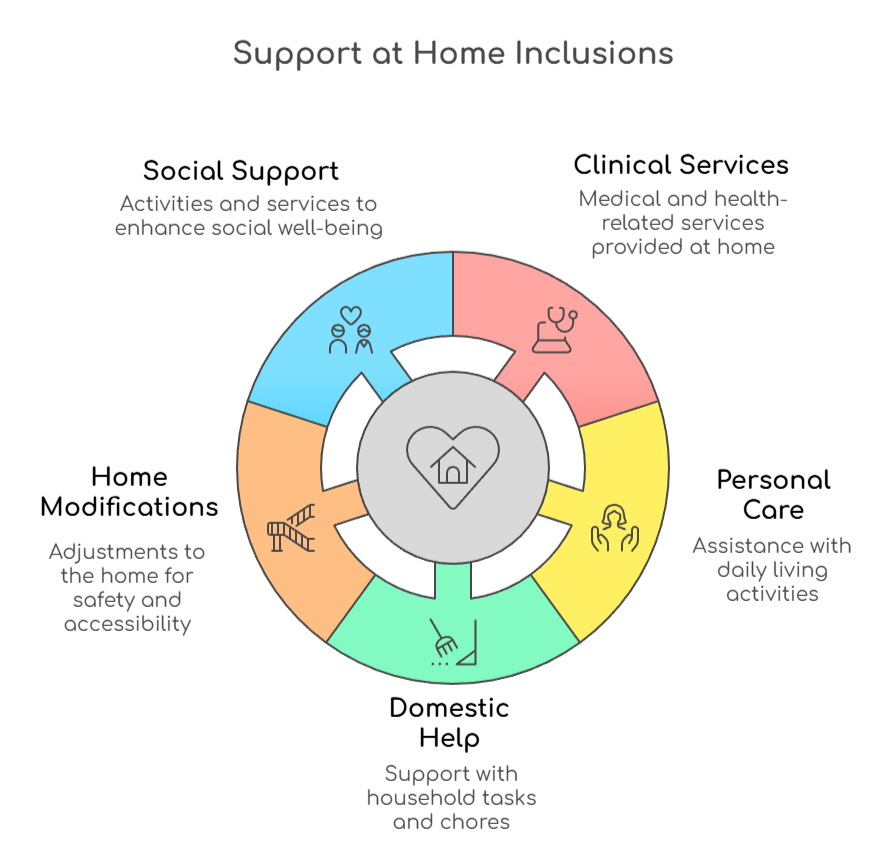
Support at Home will typically fund supports that are clearly linked to your aged care needs and goals. These services usually fall under these categories:
- Clinical and allied health services
- Personal care and independence support
- Domestic help and everyday living support
- Home modifications for safety and access
- Social and well-being support
Clinical and allied health services
Clinical care is often included when a nurse, GP, or allied health professional recommends it. It usually supports a clear health goal, such as preventing falls or avoiding hospitalisation.
These services can include:
- Nursing
- Wound care
- Monitoring of chronic conditions
- Help with medicines where clinically required
- Pain management and symptom monitoring
Clinical care may be short term, like after a hospital stay, or ongoing for complex health needs. Your provider will usually review it regularly and adjust it if your condition changes.
Allied health support may also be funded when it helps you stay active, safe, and independent. It can include:
- Physiotherapy
- Occupational therapy
- Podiatry
- Speech pathology
Why are these services funded? - Clinical and allied health care help prevent problems, manage conditions, and avoid hospital stays. They keep you safer, stronger, and living at home for longer.
Personal care and independence support
Personal care focuses on everyday tasks that keep you clean, comfortable, and safe. It steps in when these tasks have become hard or exhausting to manage alone.
Personal care can include:
- Showering
- Bathing
- Grooming
- Dressing
- Toileting and continence support
You may also receive help with transfers, mobility, supervision for safety, and short-term carer respite.
Why are these services funded? - Personal care supports your basic dignity, safety, and health every day. Without it, many people would need to move into residential care much earlier than necessary.
Domestic help and everyday living support
Domestic help covers household tasks that you can no longer perform safely or reliably on your own. This may include:
- Cleaning
- Laundry
- Changing bed linen
- Other basic home upkeep
You might also receive help preparing meals, including special therapeutic diets when clinically required. Support workers can help with shopping or buy items on your behalf when you cannot go yourself.
Transport to medical appointments, allied health visits, and approved social activities can also be funded. This might involve a support worker driving you, or travelling with you on public transport.
Why are these services funded? - Domestic help and everyday support keep your home safe, clean, and workable, which directly protects your health and quality of life.
Home modifications for safety and access
Home modifications aim to reduce risk and improve access so you can stay at home. This might include installing:
- Grab rails
- Handrails
- Small ramps
- Non-slip treatments on steps or floors
- Accessible showers
- Shower chairs
- Raised toilet seats
Larger modifications usually require strong clinical evidence, an occupational therapy assessment, and detailed quotes.
Why are these expenses funded? - Home modifications fix hazards at the source, reduce falls and injuries, and make it realistic for you to keep living safely at home.
Assistive technology and equipment
Assistive technology, or AT, includes equipment that makes daily life safer and more manageable. This might include:
- Walkers
- Wheelchairs
- Bed rails and transfer poles
- Pressure-care mattresses or cushions
- Monitoring systems
- Everyday living aids
Most AT needs an allied health recommendation so the right product is chosen for your situation.
Why are these expenses funded? - Assistive technology boosts independence, reduces risk and carer strain, and helps you stay safely at home for longer.
Social and well-being supports
Support at Home recognises that social connection is part of staying well, not just a "nice extra." You may receive support for:
- Companionship
- Group activities
- Community-based programs
- Support to continue hobbies
The aim is to reduce isolation, support your roles and interests, and keep you connected with others.
These services must align with your goals and be clearly outlined in your support plan.
Why are these expenses funded? - Staying connected protects your mood, memory, and motivation.
Common exclusions: What is usually not funded by Support at Home?
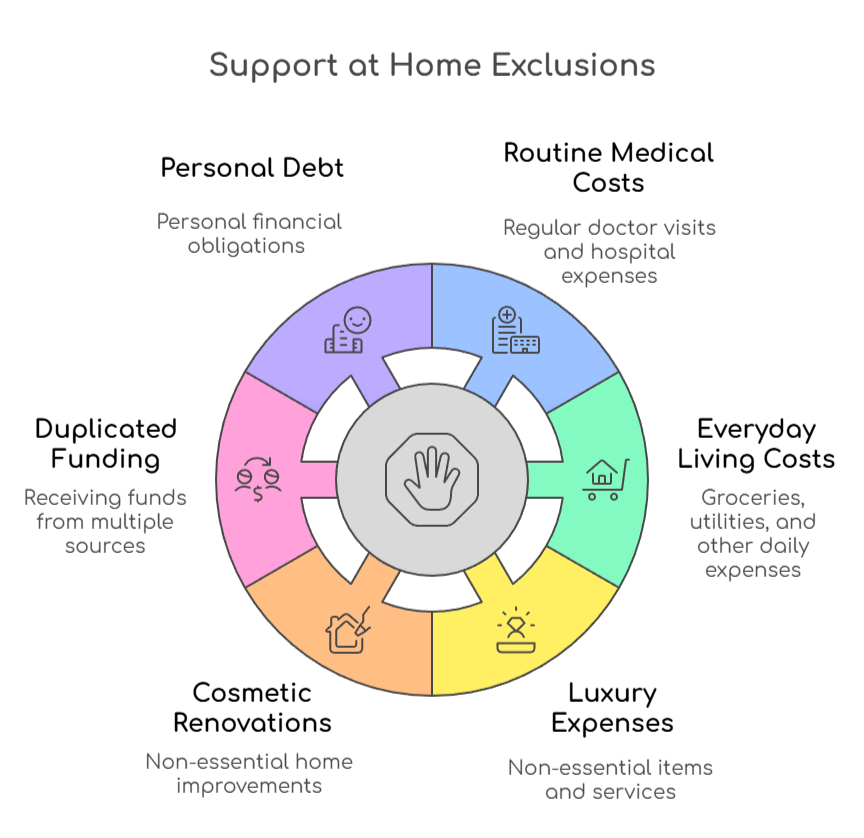
Support at Home does not pay for everything you might want or need. Some costs belong to other systems or are part of general life expenses, and they include:
- Routine medical and hospital costs
- Everyday living costs
- Luxury, lifestyle expenses
- Cosmetic and non-essential home renovations
- Duplicated funding
- Personal debt and financial obligations
Routine medical and hospital costs
Support at Home does not replace Medicare, the PBS, or private health insurance. It focuses on in-home aged care, not general health system costs.
Support at Home usually does not pay for:
- GP and specialist consultation fees
- Planned or emergency hospital stays
- Day surgery or outpatient procedures
- Ambulance costs
- Most prescription medicines and over-the-counter drugs
You may still receive help to organise appointments or transport, but not to pay the medical bill itself.
Why are these expenses NOT funded? - These costs belong to the mainstream health system, not the aged care budget.
Everyday living costs
Support at Home does not cover basic day-to-day living expenses. It's there to fund care and support, not your entire cost of living.
It does not fund:
- Groceries and general food shopping
- Rent or mortgage payments
- Council rates, body corporate fees, or land tax
- Electricity, gas, water, or phone bills
- Internet services, streaming services, or pay TV
Why are these expenses NOT funded? - Everyday bills are part of normal household responsibilities.
Luxury and lifestyle expenses
Support at Home funding cannot be used for personal lifestyle extras or hobbies that sit outside your care goals. These may be enjoyable, but they are not core aged care supports.
So, Support at Home does not cover:
- Holidays, cruises, or leisure travel
- Club or gym memberships not linked to a clinical program
- Sports fees, tickets, or general entertainment costs
- Streaming subscriptions, cinemas, concerts, or events
- Gambling, including lotteries, pokies, or online betting
- Alcohol, tobacco, or vaping products
- Fashion items
- Cosmetic beauty products or salon treatments
Why are these expenses NOT funded? - The program must prioritise essential care, not lifestyle extras, so limited funds go to safety, health, and independence first.
Cosmetic and non-essential home renovations
Support at Home funds function and safety, not cosmetic improvements or property upgrades. It helps you move around safely, rather than updating your home's style.
Support at Home does not fund:
- Decorative bathroom or kitchen renovations
- New tiles, bench tops, or splashback chosen for appearance
- Fresh paint, feature walls, or designer fittings
- New flooring or carpet chosen purely for style
- Landscaping that is mainly for looks or property value
Why are these expenses NOT funded? - Cosmetic renovations increase comfort and property value. They do not directly deliver aged care outcomes, so they sit outside the program's purpose.
Duplicated funding
Support at Home will not usually fund something already covered by another program. The aim is to avoid "double dipping" and make sure each scheme pays for its own responsibilities.
Duplication can happen with:
- NDIS supports
- Department of Veterans' Affairs programs
- State or territory equipment schemes and home-modification programs
- Local council services, such as community transport or home help
- Hospital discharge programs that already provide short-term support
If another scheme is responsible, that scheme should be used first, or used alongside Support at Home.
Your provider should help you sort out who funds what, and in what order.
Why are these expenses NOT funded? - Paying twice for the same support wastes public money, so the program only steps in when there is a genuine gap, not an overlap.
Personal debt and financial obligations
Personal finances sit outside the remit of Support at Home. The program funds care and support, not general financial management or personal debt.
Support at Home does not pay for:
- Loan or credit card repayments
- Personal debts or arrears
- Fines, penalties, or infringements
- Private legal costs
- Insurance premiums, such as home or car insurance
- Funeral bonds, funeral insurance, or pre-paid funeral plans
You remain responsible for managing these obligations.
Why are these expenses NOT funded? - Personal debts and financial products are not aged care services.
Important nuances and exceptions
The rules have clear lines, but there is also some flexibility when risks are high. In certain cases, strong clinical evidence can shift an item from "no" to "yes."
These are some examples:
Clinical justification can change the outcome
Sometimes, an item that is usually excluded can be funded. This occurs when a clinician demonstrates that it is essential for your health, safety, or independence.
A clinician should clearly explain the risks, benefits, and why this item is necessary.
EXAMPLE: You usually buy your own recliner chairs, so they are an exclusion. But if an OT shows you need a specialised recliner with pressure relief to prevent skin breakdown and hospital admissions, Support at Home may consider funding it.
Assistive technology and home modification guidance
There are national lists and guidelines for assistive technology and home modifications.
These documents outline which items can be funded, and what conditions or limits apply. Items are grouped by cost, risk, and complexity, which affects how they are approved.
Higher-cost or more complex items usually need detailed reports, quotes, and stronger clinical evidence.
Your OT or provider can use these guidelines to support your request and set realistic expectations.
EXAMPLE: You ask for a stair lift so you can reach your upstairs bedroom. Your OT checks the national AT and home modification guidance, confirms it is a listed high-cost item, and prepares a detailed report and quotes to support your request.
Funding levels, caps, and tiers
Your supports must fit within your assigned funding level and any caps. Your assessment places you into a classification based on the type and amount of support you need.
That classification influences the total budget available for your services and equipment.
Different types of support, like clinical care or home modifications, may have separate limits or rules.
Your provider should explain these limits in plain language and help you prioritise within them.
EXAMPLE: You would like extra cleaning hours and a new ramp at your front door. Your provider shows you that funding is tight, so together you decide to prioritise the ramp for safety and keep cleaning at the current level.
How Sensible Care can support you
The Support at Home rules are detailed, and they will continue to evolve.
At Sensible Care, we help you understand what is likely to be included and what is not. We work with assessors and clinicians to capture your needs clearly and link them to practical supports.
Our team helps you balance clinical care, personal care, domestic support, and social connection.
We can coordinate quotes, organise suppliers, and support applications for assistive technology or home modifications.
If something important is declined, we help you understand why and explore your options.
If you are ever unsure whether something is an inclusion or an exclusion, just ask us.
Together, we can make your Support at Home funding work smarter, so you can stay safe, comfortable, and independent at home.

Take the Next Step in Care
Download our Info Kit or speak to one of our friendly team members today.


Explore More Helpful Reads
More stories, guides, and updates to support you and your family.




Need Help Getting Started?
Reach out on your terms, pick a time that suits you and let’s talk about how we can help.


.webp)