.svg)

How much does home nursing care cost?
Read on to learn about 2025 home nursing care costs in Australia, what affects prices, and how funding programs like Support at Home can reduce your bill.
Author: Sensible Care

Private in‑home nursing commonly costs about $100 to $179+ per hour for a registered nurse (RN). Enrolled nurses and personal care workers are often less expensive ($50 to $120 per hour). Live-in or 24/7 private nursing can cost $600 to $700+ per day. Government-funded programs (like Support at Home) can substantially reduce out-of-pocket costs for eligible individuals.
Home nursing lets you receive professional care at home instead of in a hospital or residential care. It can be a safer, more comfortable, and more flexible option.
However, home nursing can also be expensive, and prices vary significantly between providers. Understanding typical costs in Australia and how funding works helps you plan with confidence.
Your exact cost of in-home care will depend on your funding, location, and how many hours of care you need each week. This also applies to home nursing care costs.
In this guide, Sensible Care explains what home nursing costs in 2025, what affects the price, and how government funding can reduce your out-of-pocket costs.
Quick answer: How much does in-home nursing care cost?
In 2025, typical private prices for home nursing in Australia look like this:
What is home nursing care?
Home nursing care means a qualified nurse comes to your home to provide health care, not just cleaning or companionship. It sits between hospital care and everyday home support.
This might include a visit from:
- Registered nurses (RNs): They manage complex care, including wound care, IV therapy, catheter care, medication reviews, and palliative care.
- Enrolled nurses (ENs): They provide many nursing tasks under RN supervision, often at a lower hourly rate than an RN.
- Support workers / personal care workers: They help with showering, dressing, toileting, meals, and housework, but they are not trained nurses.
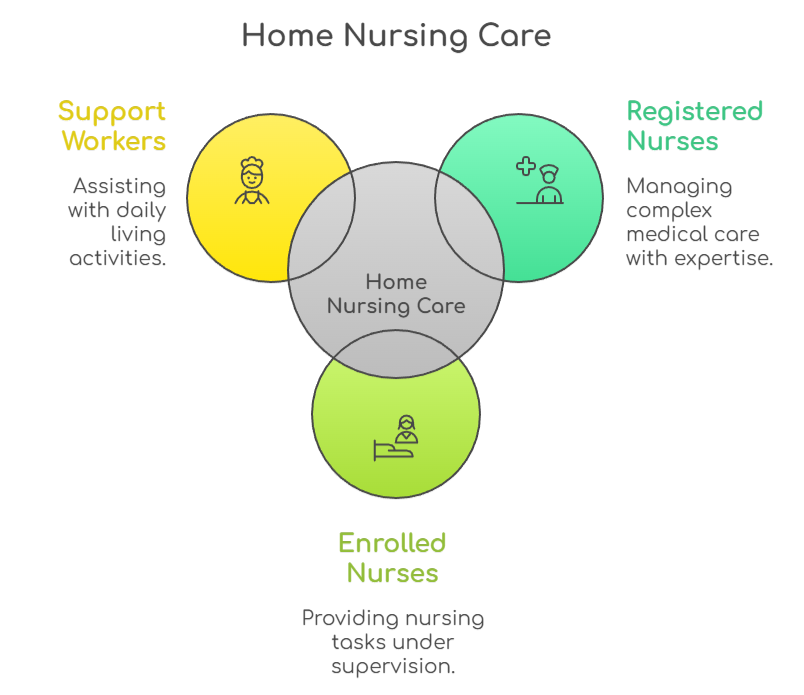
Many people use a mix of these roles. For example, an RN might visit fortnightly to review your wounds and medications. Meanwhile, a support worker comes most days to help with showering and meal preparation.
Home nursing can be short-term, such as for a few weeks after surgery. It can also be long-term for ongoing support for a chronic condition.
Reliable providers adjust your mix of staff and visit times as your needs change.
What is the typical cost of in-home nursing care?
Hourly nursing rates
For private in-home nursing visits in Australia, you will usually come across these prices:
- Registered nurse (RN): about $100–$189+ per hour for weekday visits, with higher rates for very complex care.
- Enrolled nurse: about $80–$140 per hour, with prices differing between metro, regional, and remote areas.
- Support worker: about $50–$70 per hour for personal care, respite, or domestic help.
Most agencies set a minimum visit time, often one hour, even if the practical task is shorter. This is because the rate includes travel, paperwork, and clinical handover, not just the time at your bedside.
If you only need a quick task, such as a simple injection, the per-visit cost can feel high. It's worth asking whether the nurse can complete several tasks in that visit, so you get more value from that time.
Live-in and 24/7 nursing
Some people need round-the-clock clinical support. This is especially the case during very complex palliative care or high-risk disability care. In those situations, families sometimes arrange live-in or 24-hour nursing.
Typical costs look like:
- Live-in or 24/7 nursing: from around $600–$800+ per day, based on a rostering model that covers 24-hour care.
- Costs increase if you need more than one nurse on shift, frequent breaks, or a mix of RNs and ENs across the day and night.
Very few families can pay for this level of care privately over the long term. Most times, it's funded through aged care packages, NDIS plans, or DVA funding, sometimes topped up with out-of-pocket payments.
If you are considering 24/7 care, ask providers to show you two or three different roster options, with total weekly and monthly costs. This helps you see whether the model is affordable and sustainable.
How government funding changes your costs
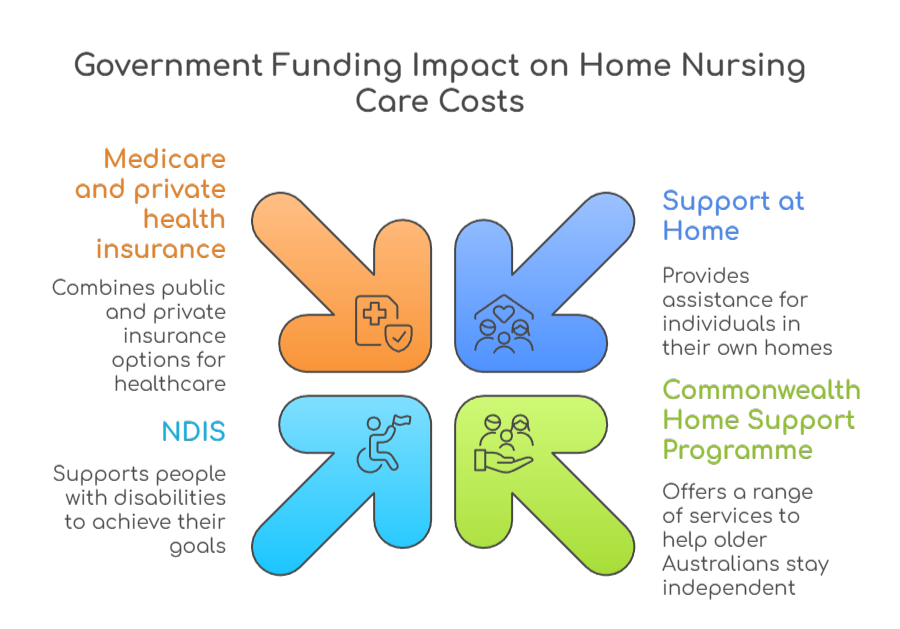
Government programs can dramatically reduce what you pay out of pocket if you are eligible. The main systems support older people and people with disabilities.
These programs include:
- Support at Home
- The Commonwealth Home Support Programme
- The NDIS
- Medicare and private health insurance
Support at Home (replacing Home Care Packages)
From 1 November 2025, the Support at Home program is replacing Home Care Packages and the Short-Term Restorative Care Programme.
The goal is to make in-home aged care simpler, more flexible, and easier to understand.
Support at Home brings several in-home aged care programs together into one system, with different funding levels based on your needs.
This program provides a budget you can use for:
- Clinical care
- Independence support
- Everyday living services
Note that there are different rules for how much you pay personally.
Under the model described by the Australian Government, clinical care, including nursing, is treated as an essential health need.
It's fully funded within your Support at Home budget. Services like cleaning or gardening may have co-payments based on your income.
Note that clinical care isn't means-tested, but it still draws down your Support at Home budget. If you need services beyond that budget, you may have to self-fund the extra hours.
Providers still publish hourly price lists for RNs, ENs, and support workers.
When you use your Support at Home budget, the hourly rate is charged to your funding, not directly to your bank account, except for any required co-payments.
If you are over 65 and need help at home, it's usually best to start with My Aged Care, rather than paying privately.
They can arrange an assessment and advise whether Support at Home is suitable for you.
Commonwealth Home Support Programme (CHSP)
The Commonwealth Home Support Programme (CHSP) offers entry-level support. It's for older Australians with low to moderate needs. It focuses on simple services that help you stay independent at home.
Under current reforms, the CHSP will transition into Support at Home no earlier than 1 July 2027. Until then, it will continue as a separate programme.
For nursing and health tasks, the CHSP can sometimes fund:
- Short visits for basic wound checks
- Follow-up nursing after a hospital stay
- Low-intensity monitoring or education
With the CHSP, the government pays most of the cost, and you pay a small client contribution, set by each provider.
The CHSP is often cheaper than private nursing, but not every area offers the same services, so you may face waitlists or limited visit times.
NDIS funding for nursing care
If you are an NDIS participant, some nursing supports can be funded through your plan, instead of being paid privately.
Prices follow the official NDIS Pricing Arrangements and Price Limits. This sets maximum hourly rates, travel rules, and extra charges.
Nursing supports may be included as disability-related health supports when they are directly linked to your disability.
Your planner or Local Area Coordinator can help you decide which tasks are reasonable and necessary.
Important points to ask about include:
- Which nursing tasks can be funded by the NDIS
- How many hours of nursing are approved in your plan
- Whether the provider charges up to the NDIS maximum, or offers lower rates
If your needs are mainly disability-related, always ask whether they belong in your NDIS plan, Support at Home budget, or another funding stream.
Placing supports in the right system can make a big difference to your out-of-pocket costs.
Medicare and private health insurance
Medicare rarely covers routine private home nursing visits. However, it may support some post-acute, palliative, or GP-organised community nursing programs.
These programs might be run by your local hospital or health service, rather than a private home care agency. They can be a good option if you need short-term clinical follow-up, but they may not provide long-term daily care.
Some private health insurance products include short-term home nursing after a hospital stay.
Always check:
- Whether home nursing is included in your specific policy
- How many days or visits are covered
- Any waiting periods, exclusions, or benefit limits
Ask your health fund for written confirmation if you plan to rely on home nursing benefits. This reduces surprises if the hospital stay or recovery period is longer than expected.
What affects the final bill?
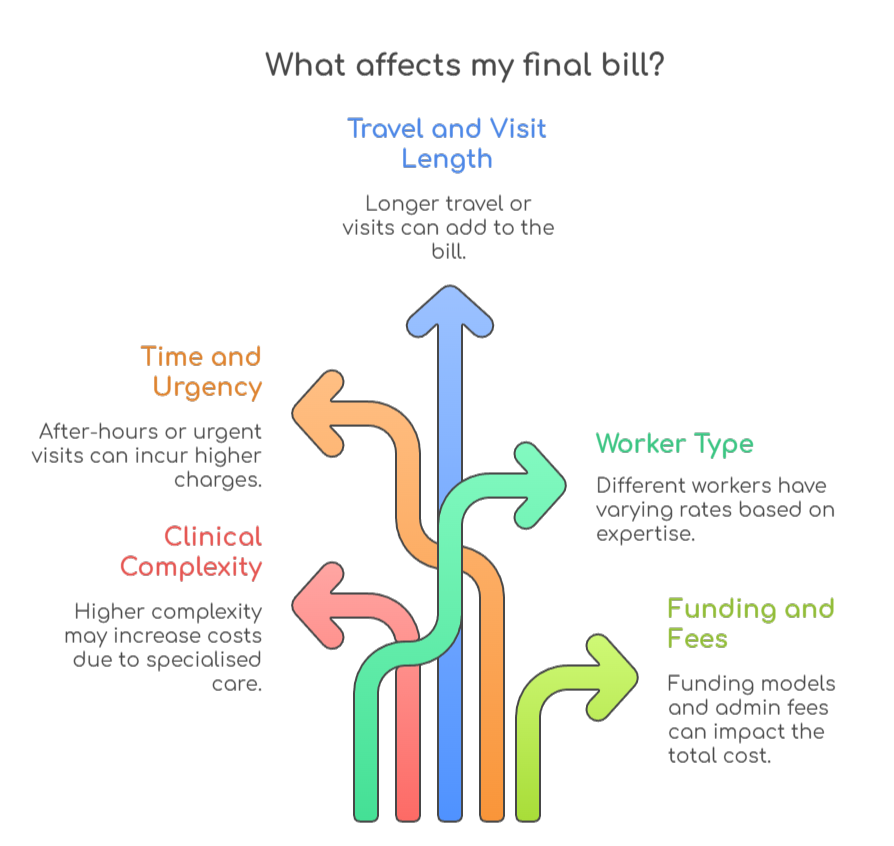
Several factors affect the final amount you pay, even if the hourly rate looks simple on paper. They include:
- Clinical complexity
- Time of day, day of week, and urgency
- Travel time and visit length
- Type of worker
- Funding model and admin fees
Clinical complexity
The more complex your clinical needs, the more likely you are to need an RN, longer visits, or more frequent reviews. This naturally increases your total cost.
Tasks that increase complexity include:
- Advanced wound management or negative pressure dressings
- IV medications or infusions
- Care for tracheostomies, ventilators, or feeding tubes
- Intensive palliative care, including symptom management
Sometimes, a nurse can train you or a family member to safely handle simple aspects of your care, such as basic observations. However, complex procedures must always be performed by a suitably qualified nurse.
Time of day, day of week, and urgency
Most providers use a tiered rate structure based on when care is delivered. This reflects the higher cost of staffing evenings, nights, and public holidays.
Costs are usually higher for:
- Evening or overnight visits
- Weekends and public holidays
- Short-notice or urgent call-outs
If your needs are predictable and not urgent, try to schedule visits during standard business hours. This can significantly lower your weekly spend, especially if you need several visits each week.
Travel time and visit length
Travel is a real cost for providers, especially in regional or rural areas. They may build travel into the hourly rate or charge it as a separate item.
Common patterns include:
- A minimum visit length, such as one hour, even for short tasks
- Extra charges for long travel distances, tolls, or parking
- Higher costs in remote areas, where staff must travel further between clients
You can sometimes reduce travel costs by grouping tasks into fewer, longer visits instead of many short visits. Ask the provider whether this would change the rate or just the total time booked.
Type of worker
You will pay different rates for an RN, an EN, and a support worker. Using the right level of staff for each task is one of the easiest ways to control costs without reducing safety.
A common model might be:
- An RN develops your care plan, checks medications, and reviews complex issues.
- An EN handles regular wound care, catheter care, or other routine clinical tasks.
- A support worker provides daily personal care, basic monitoring, and household help.
Ask your provider to clearly explain which tasks must be done by an RN, and which can safely be done by others. You should never feel that you are paying RN rates for tasks that do not need that level of training.
Funding model and admin fees
When care is funded through Support at Home, CHSP, or NDIS, you may not see a simple "hourly rate" on your invoice. Instead, you will see a mix of care charges, management fees, and admin costs.
Things to watch for include:
- Care management and package management fees in aged care packages
- Plan management fees and provider service charges in NDIS plans
- Set-up, exit, or review fees that are taken from your funding
If you self-manage your budget, you may be able to choose providers with lower admin fees or negotiate different mixes of staff. However, self-management also means more responsibility for rosters, invoices, and quality checks.
How Sensible Care can support you
Every person's situation is different, and there is no single "right" answer. The best home nursing plan reflects your health needs, goals, family support, and budget.
Sensible Care can help you:
- Understand your options under Support at Home
- Build a care plan that uses the right mix of RNs, ENs, and support workers
- Compare different visit patterns and show the real weekly or monthly cost
- Adjust your support as your health, independence, or funding changes over time
If you are unsure where to start, begin with a simple step.
Reach out for a conversation about what care you need, what matters most to you, and who can help pay for it. From there, it becomes much easier to create home nursing support that is safe, sustainable, and truly centred on you and your family.
Contact Sensible Care for more information.

Take the Next Step in Care
Download our Info Kit or speak to one of our friendly team members today.


Explore More Helpful Reads
More stories, guides, and updates to support you and your family.


.webp)

Need Help Getting Started?
Reach out on your terms, pick a time that suits you and let’s talk about how we can help.


.webp)