.svg)

What is reminiscence therapy and how does it help older Australians?
Reminiscence therapy uses guided recall of memories to lift mood, ease depression, and support older Australians and people with dementia.
Author: Sensible Care
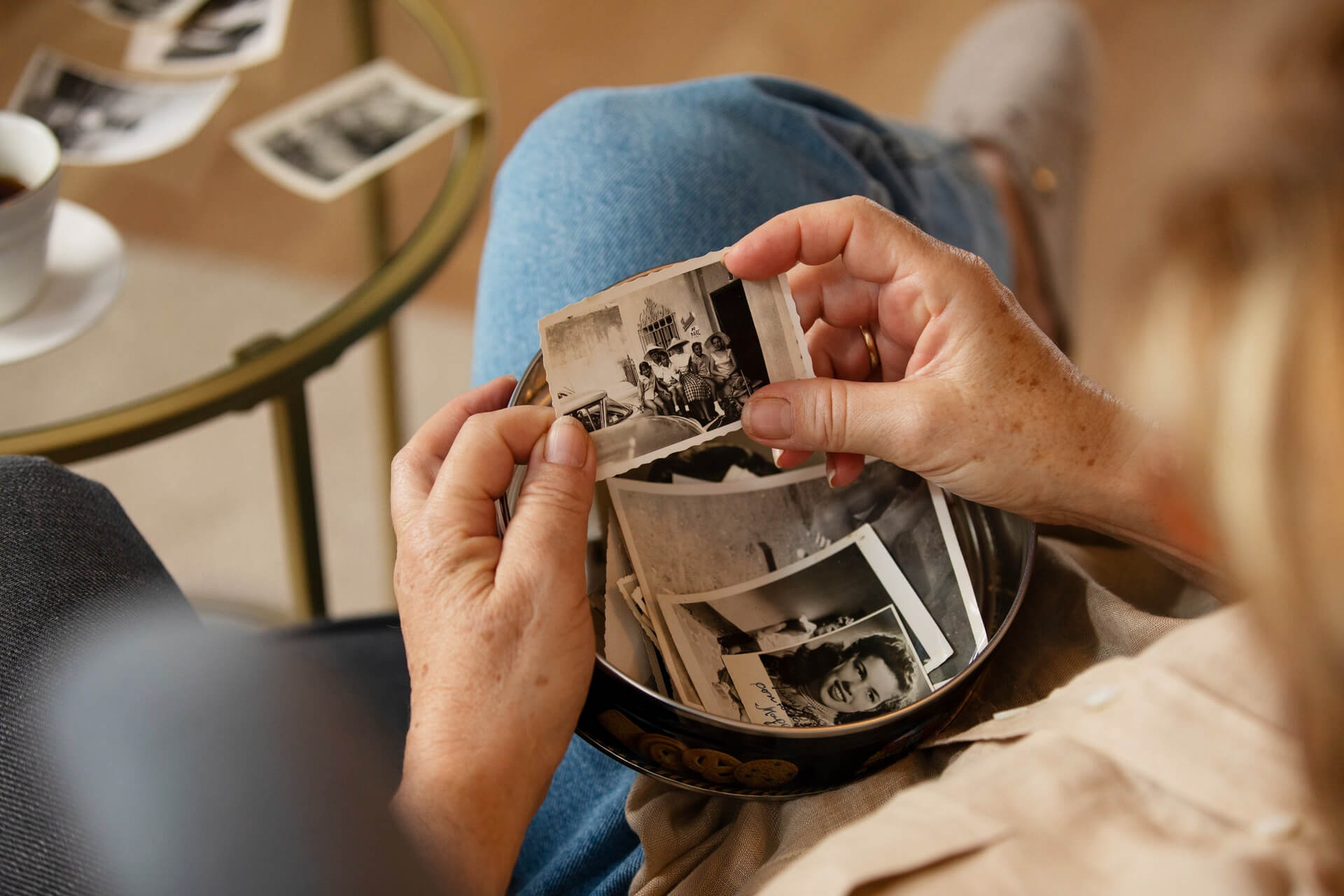
Reminiscence therapy uses guided recall of personal memories through photos, music, objects, and stories. The goal is better mood, a stronger sense of identity, and closer social bonds for older adults and people with dementia. The evidence is strongest for reducing depression and improving life satisfaction. It also helps with communication, self-esteem, and loneliness. It takes three main forms: simple reminiscence, life review, and life story work. It's delivered across residential aged care, home care, and NDIS-funded programs.
Reminiscence therapy is a structured, goal-directed intervention. It uses guided recall of personal memories, supported by photos, music, objects, or stories. It aims to improve mood, strengthen identity, and support social connection in older adults.
It's not the same as casually chatting about the past. It involves planned sessions with defined goals, trained facilitators, and measurable outcomes.
In Australia, 446,500 people are estimated to be living with dementia in 2026. That figure is projected to reach 812,500 by 2054.
Reminiscence therapy is a widely used non-pharmacological tool for supporting people with dementia. It also supports people with other conditions that affect mental health and wellbeing in later life.
How does reminiscence therapy work?
Reminiscence therapy draws on long-term autobiographical memories. These memories are often better preserved than short-term memory in dementia. This supports a sense of self, reduces distress, and encourages communication.
A facilitator guides the person through structured recall using prompts. The prompts used are usually personal and culturally meaningful.
Dementia tends to affect recent memory first. Memories from early adulthood — a favourite song, a wedding, a first job — are often still accessible. Reminiscence therapy uses those preserved memories as a bridge to emotional connection.
The three main forms of reminiscence therapy
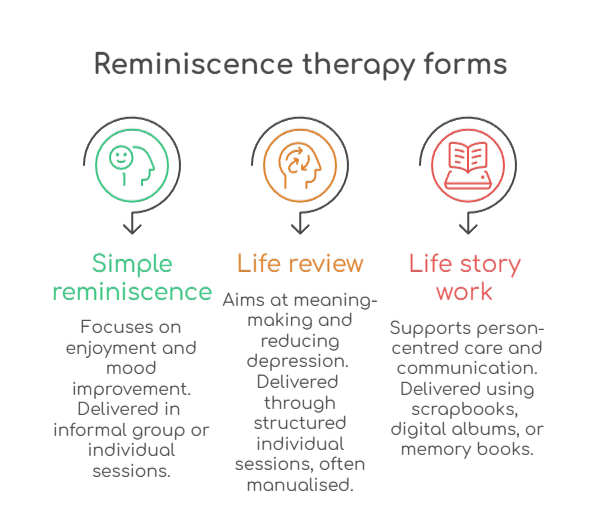
Reminiscence therapy takes three distinct forms. These include simple reminiscence, life review, and life story work. Each suits different goals and settings.
Simple reminiscence focuses on enjoyable memories, like achievements, relationships, and favourite places. It's typically used in group settings to lift mood and build social connection.
Life review is more structured and therapeutic. It guides a person chronologically through their life. This includes both positive and difficult experiences.
The goal is to bring memories together into a clear and meaningful story. It's particularly suited to reducing depression. Structured protocols are designed specifically for this goal.
Life story work produces a tangible record, a scrapbook, digital album, or memory book, for use by care staff and family. It can personalise everyday interactions long after the formal sessions have ended.
What prompts are used?
Common reminiscence prompts can be anything familiar to the person. This can include old photographs, music, familiar scents, and objects related to a previous occupation.
Themed discussion topics such as school days, holidays, or family traditions are also widely used. Prompts must be chosen in partnership with the person. They can also be tailored to their cultural background, language, and preferences.
What does the evidence say about reminiscence therapy?
Reminiscence therapy has meaningful evidence behind it. It works especially well for reducing depression and improving the quality of life in older adults and people with dementia. The benefits are real but modest; it's not a cure for dementia, and it does not stop cognitive decline.
Evidence for people living with dementia
An important piece of evidence is the 2018 Cochrane review of reminiscence therapy for dementia. It's the most comprehensive synthesis available. It included 22 studies involving 1,972 people with dementia.
The review found positive effects on quality of life, cognition and mood, along with communication benefits. In care home settings, reminiscence therapy showed a quality-of-life benefit post-treatment.
Individual reminiscence sessions were linked to a reduction in depression scores. However, the clinical importance of this reduction was described as uncertain.
Evidence for depression and life satisfaction
Another crucial systematic review is the 2023 Frontiers in Psychiatry meta-analysis. It included 27 studies and 1,755 older adults.
The analysis found that reminiscence therapy significantly reduces depression. It also found that it has a significant effect on life satisfaction.
Life satisfaction improved most when interventions lasted more than eight weeks. Depression improvements were not dependent on intervention duration.
The 2023 Behavioral Sciences (Basel) meta-analysis also looked at the effects of reminiscence therapy. It found that individual sessions had a more significant impact on quality of life than group sessions. The effects on life satisfaction remained statistically significant 12 weeks after it ended.
A 2025 umbrella review by Jiao et al. consisted of 21 systematic reviews. The meta-analyses covered 246 randomised controlled trials and 18,177 participants. It found that reminiscence therapy is linked to improvements in:
- Self-esteem
- Communication
- Functional activities
- Loneliness
But there were no significant effects on overall wellbeing, agitation, or apathy.
Who can benefit from reminiscence therapy?
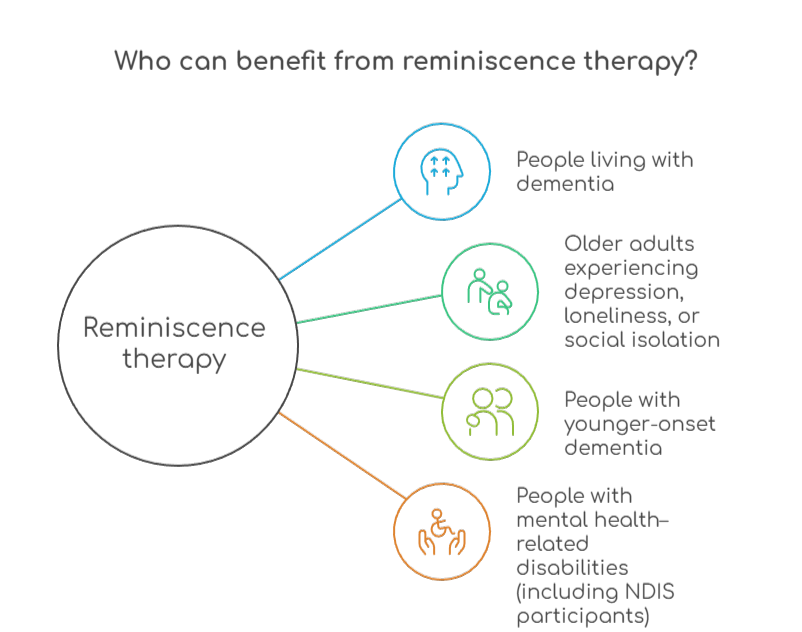
Reminiscence therapy benefits people living with dementia, but it isn't limited to them. It can also be used by older adults experiencing depression, loneliness, or social isolation. It's increasingly used to support people with mental health–related disabilities. This includes NDIS participants.
People living with dementia
Reminiscence therapy is most commonly used with people living with dementia. This includes Alzheimer's disease.
Alzheimer's disease accounts for approximately 70% of all dementia cases. More than two-thirds of Australian aged care residents have moderate to severe cognitive impairment.
Even people with significant memory loss can benefit. Music, scent, and familiar objects can evoke emotional responses and non-verbal communication. For example, a smile, a hum, a look of recognition, even when a person's verbal communication is limited.
Reminiscence is not a memory test. Facilitators do not correct misremembered details. The goal is connection and meaning, not accuracy.
Older adults without dementia
Reminiscence therapy also benefits cognitively healthy older adults. The 2023 Frontiers in Psychiatry meta-analysis confirmed significant effects on both depression and life satisfaction. These benefits don't apply only to those living with dementia, but also to older adults in general.
Group reminiscence, in particular, played a significant role in improving life satisfaction.
People with younger-onset dementia
According to Dementia Australia, an estimated 29,000 Australians are living with younger-onset dementia in 2026.
This 2023 article by Loi et al. looked at how younger-onset dementia is diagnosed and managed. It found that people with younger-onset dementia regularly report:
- Loss of identity
- Role changes
- Feelings of hopelessness
- Social exclusion
Reminiscence therapy can also be used for this group. It then focuses on much more than childhood memories. Career achievements, parenting, community roles, and future aspirations can all be helpful.
NDIS participants with psychosocial disabilities
Reminiscence therapy fits within recovery-oriented practice for NDIS participants with psychosocial disabilities. It supports identity, self-esteem, and social participation, all of which are central NDIS goals.
It can be framed as capacity-building therapeutic support. But it has to be linked to a participant's plan goals and delivered or supervised by a qualified professional.
What are the benefits of reminiscence therapy?
Reminiscence therapy delivers benefits across emotional, cognitive, social, and relational domains. The clearest and most consistent evidence is for depression and life satisfaction. Cognitive gains are present but modest, and findings for agitation, apathy, and overall wellbeing are mixed.
Key sources:
- Woods et al., Cochrane Database of Systematic Reviews, 2018
- Jiao et al., umbrella review, BMC Geriatrics, 2025
- Zhong et al., Behavioral Sciences (Basel), 2023
- Frontiers in Psychiatry, 2023
Beyond the numbers, reminiscence affirms who a person has been and still is. It counters the loss of identity that often accompanies dementia, disability, or ageing.
Group reminiscence creates opportunities for shared storytelling and peer validation. Finding common ground in experiences strengthens connection and reduces isolation.
Life story work adds a tangible record of a person's history, preferences, and values. It lets family members and support workers shape everyday interactions around the person.
Is reminiscence therapy safe?
Reminiscence therapy is generally safe and well-tolerated. The Cochrane review found no evidence of harm to people with dementia across 22 studies.
Adverse events in the broader literature are rare and typically mild. They include transient sadness or emotionality when difficult memories arise.
In the Cochrane review, carers who took part in group sessions had slightly higher anxiety scores afterwards. However, it's unclear how much this matters in practice. This may come from the emotional strain of comparing the past and present. Where carers are involved, it helps to offer preparation and debriefing support.
Reminiscence does not always surface only pleasant memories. Conversations about family life, migration, loss, or work can bring up grief or regret. Skilled facilitation is essential to keep sessions safe and beneficial.
Practical reminiscence activities for families and carers
You don't need to be a clinician to bring reminiscence into everyday life. Simple activities can be run safely at home by family and carers. The aim is connection and enjoyment, not testing memory, so there's no wrong answer and no need to get the facts "right".
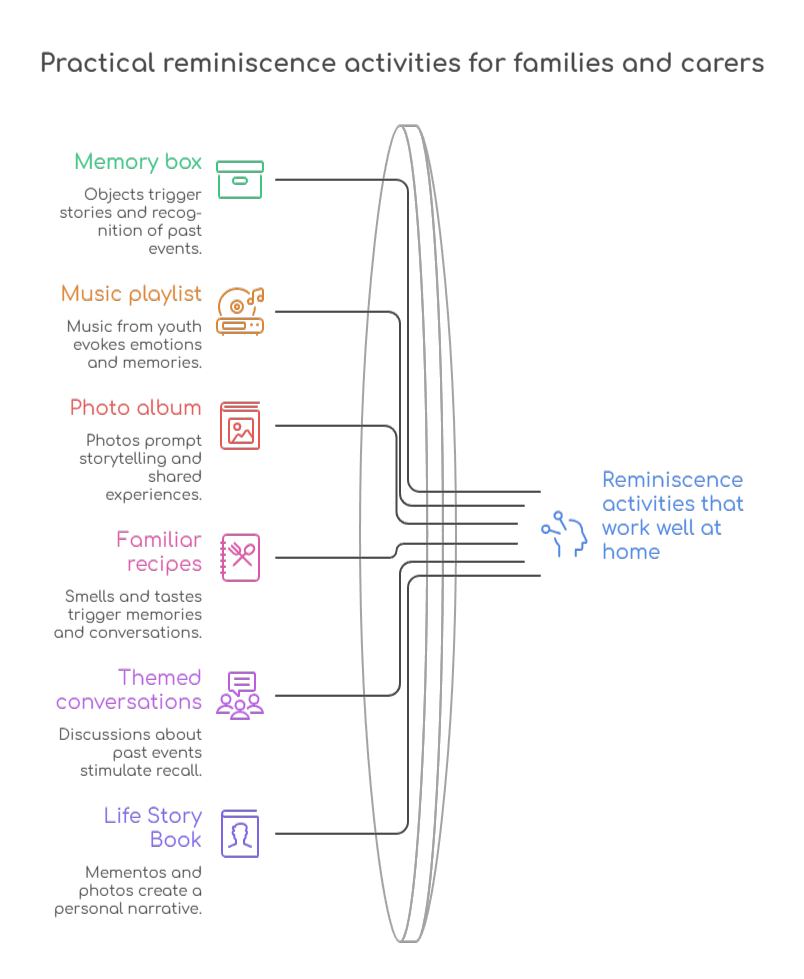
A few reminiscence activities work well at home:
- Build a memory box of meaningful objects — a medal, a tool from an old trade, a football scarf — to spark stories and recognition.
- Make a playlist from their youth; it's recommended to play music from a person's late teens and twenties.
- Look through photos together with open prompts like "Tell me about this day" rather than "Do you remember who this is?"
- Cook a familiar recipe; smell and taste are strong triggers, and it pairs sensory prompts with storytelling.
- Use themed conversations — school days, first job, weddings, holidays, a migration journey.
- Create a life story book of photos and mementos that also helps others connect with the person later.
A few principles keep it safe and enjoyable:
- Follow their lead.
- Keep sessions to 20–35 minutes.
- Don't correct names or dates.
- Be ready to acknowledge difficult feelings without pushing them away.
- Choose prompts with the person, reflecting their culture, language, and preferences.
If the goal shifts from enjoyment towards treating depression or trauma, that's the point to involve a professional. A psychologist, social worker, or counsellor can help through a life review approach.
How is reminiscence therapy delivered in Australia?
Reminiscence therapy is delivered across residential aged care, home care, and NDIS-funded community programs. How it's run, how often, and by whom depends on the setting and goal.
In residential aged care
Reminiscence therapy in residential aged care is delivered as:
- Group sessions
- Individual one-to-one sessions
- Informally through everyday interactions
It's facilitated by lifestyle staff, occupational therapists, or care workers.
According to Alzheimer's Research Australia, 30% of Australians over the age of 85 have dementia. More than two-thirds of aged care residents have moderate to severe cognitive impairment.
This makes reminiscence therapy broadly relevant across most residential facilities. It works well alongside life story documentation. A resident's life story book gives every staff member a foundation for meaningful interaction.
A 2021 trial by Saredakis et al. found that VR-delivered reminiscence therapy was feasible in residential aged care. However, no significant reduction in apathy was observed compared to standard methods.
How support workers run a reminiscence session
In aged care and home care, support workers and lifestyle staff deliver much of the day-to-day reminiscence work. A structured session follows a simple shape rather than an open-ended chat.
A typical session runs 30–35 minutes, at least weekly. It's built around a documented goal such as reducing depression or supporting communication:
- Prepare — review the person's life story book and choose a theme and prompts suited to their background.
- Open gently — settle the person and introduce the theme with a warm, open prompt.
- Explore with prompts — use objects, photos, music or scents, ask open questions, and follow the person's interest.
- Watch and respond — validate difficult feelings, redirect if a topic overwhelms, and value non-verbal responses like a hum or a smile.
- Close and record — wind down positively and note what worked in the person's life story documentation, so all staff can build on it.
Linking each session to a documented care-plan goal keeps it a therapeutic support, not just a social visit. Under Support at Home or NDIS funding, it's also what supports the funding claim.
In home care
Home care is a strong environment for reminiscence therapy.
The 2023 Frontiers in Psychiatry systematic review looked at home care settings for reminiscence therapy. It found that community settings have a bigger effect on depression than residential ones. A person's own home contains naturally meaningful prompts - their own photos, music, furniture, and memorabilia.
Under Support at Home, reminiscence sessions can be delivered by allied health professionals. They can also be delivered by trained support workers and incorporated as part of a person's care plan goals.
They are most effective when linked to documented goals. For example, reducing depression, maintaining social connection or supporting communication. Scheduling them as unstructured social visits reduces their therapeutic impact.
Under the NDIS
Reminiscence therapy can be framed as a capacity-building support under the NDIS. This applies to NDIS participants with younger-onset dementia or psychosocial disability.
When a registered allied health professional delivers it, it can be claimed under therapeutic supports. When delivered in a group or community setting, it may sit within social and community participation. Clear links to the participant's plan goals are essential for any funding claim.
Over 27% of young-onset dementia NDIS participants waited longer than six months to receive their plan (Cations et al., 2022). Early engagement with a provider who understands NDIS access pathways for this group is important.
How many sessions are needed?
According to this 2023 article by Zhong et al., six to eight sessions enhance life satisfaction most effectively. No significant additional improvement was observed beyond eight sessions.
For depression, intervention duration did not significantly affect outcomes. This was concluded in the 2023 Frontiers in Psychiatry review. This means shorter programmes can still produce meaningful mood improvements.
According to this 2022 review by Cammisuli et al., sessions are commonly delivered at least once a week for 30–35 minutes. In many reviewed protocols, they last over 12 weeks.
How does reminiscence therapy fit with other dementia care approaches?
Reminiscence therapy is one part of a broader non-pharmacological approach to dementia care. It's not a stand-alone solution.
The UK National Institute for Health and Care Excellence lists it alongside:
- Exercise
- Aromatherapy
- Art
- Gardening
- Baking
- Music therapy
- Mindfulness
- Animal-assisted therapy
All of these are recommended as activities that promote wellbeing in dementia.
A 2023 review by Guzzon et al. looked at the cost-effectiveness of dementia care approaches. It found multicomponent interventions for these groups offer the best value for money.
Reminiscence therapy pairs particularly well with music therapy. Music can rapidly evoke autobiographical memories. This is sometimes even possible in people with advanced dementia who rarely speak.
Building sessions around meaningful music is a practical and evidence-aligned approach. This may include songs from a person's twenties or culturally significant music.
Reminiscence therapy: small moments, real connection
Reminiscence therapy is a simple idea with real depth. It helps guide people through meaningful memories. Older adults and those with dementia can feel more connected and less alone.
The evidence is strongest for easing depression and improving life satisfaction. Communication, self-esteem, and loneliness are the additional benefits.
It won't cure dementia or stop cognitive decline, but that was never the point. Its value is in affirming who a person is, and in giving families and carers a way to connect that doesn't rely on memory.
At Sensible Care, we believe good care starts with knowing the person, not just their diagnosis. Our teams use reminiscence-based approaches to help people feel heard, valued, and connected. If you're exploring Support at Home, get in touch today to find out how we can support meaningful connection in later life.

Take the Next Step in Care
Download our Info Kit or speak to one of our friendly team members today.


Explore More Helpful Reads
More stories, guides, and updates to support you and your family.




Need Help Getting Started?
Reach out on your terms, pick a time that suits you and let’s talk about how we can help.


.webp)