.svg)

Everything you need to know about the Support at Home program in 2026
Support at Home program 2026 explained: Learn what's changing, who it affects, and action steps for families and former package holders.
Author: Sensible Care

The Support at Home program is Australia's main in-home aged care program in 2026. It replaced Home Care Packages (HCP) and Short-Term Restorative Care on 1 November 2025. In 2026, the biggest changes are quarterly budgets across eight classification levels, clearer pricing with price caps, and income-tested contributions for some supports.
The Support at Home program is a major Home Care Package reform for older Australians who want to continue living at home.
Support at Home replaced the old Home Care Package system. It includes eight new funding classifications, quarterly budgets, published pricing, and updated contribution rules.
If you're a former package holder or supporting an older loved one, this guide explains what's changing and what to do next.
We'll talk about the timeline, the Support at Home aged care reform details, transitioning from Home Care Packages, and practical action steps.
Key takeaways
- Support at Home replaced Home Care Packages on 1 November 2025.
- There are now eight classification levels (up from four under Home Care Packages).
- Ongoing funding is split into four quarterly budgets, released in July, October, January, and April.
- 10% of each quarterly budget is deducted for care management, so your usable budget is the remaining 90%.
- Clinical supports require no participant contribution. Independence and everyday living services require contributions based on income and assets.
- Providers must publish prices, so comparing value matters more than it did under the old program.
- Unspent Home Care Package funds (held as at 31 October 2025) are retained under Support at Home.
- Price caps apply to each service from 1 July 2026.
Timeline of Support at Home implementation
As a new program for in-home aged care, Support at Home is already operating in 2026. This timeline is about key dates that shape how the program works now.
What has already happened
- Support at Home replaced Home Care Packages and Short-Term Restorative Care on 1 November 2025.
- The program uses a priority system to allocate funding, which can affect wait times.
- Participants who were waiting for a Home Care Package were moved to the Support at Home Priority System.
What to look out for in 2026
Support at Home budgets for ongoing services are released at the start of each quarter. The quarters start in July, October, January, and April.
If you enter care mid-quarter, your first budget is calculated from your start date to the quarter’s end.
From 1 July 2026, price caps will apply to each service in the Support at Home service list. Providers can still set their own prices, but they cannot exceed the cap.
Until then, providers set prices freely, so your budget's buying power could fluctuate if hourly rates rise.
What is coming later
The Commonwealth Home Support Program (CHSP) is planned to transition to Support at Home no earlier than 1 July 2027. This date matters for families using CHSP-style entry supports today.
The government has not yet confirmed what contribution protections (if any) will apply to CHSP clients at transition.
Support at Home classification levels explained
One of the most significant changes is the move from four Home Care Package levels to eight Support at Home classifications.
Each classification provides a defined quarterly and annual budget based on your assessed care needs.
The table below shows the funding for each of the eight ongoing service classifications:
| Classification | Quarterly budget | Annual amount |
|---|---|---|
| 1 | $2,682.75 | $10,731.00 |
| 2 | $4,008.61 | $16,034.45 |
| 3 | $5,491.43 | $21,965.70 |
| 4 | $7,424.10 | $29,696.40 |
| 5 | $9,924.35 | $39,697.40 |
| 6 | $12,028.58 | $48,114.30 |
| 7 | $14,537.04 | $58,148.15 |
| 8 | $19,526.59 | $78,106.35 |
These amounts include the 10% allocated for care management. Amounts are effective from 1 November 2025 and are indexed on 1 July each year.
The eight classifications allow for more precise matching of funding to care needs.
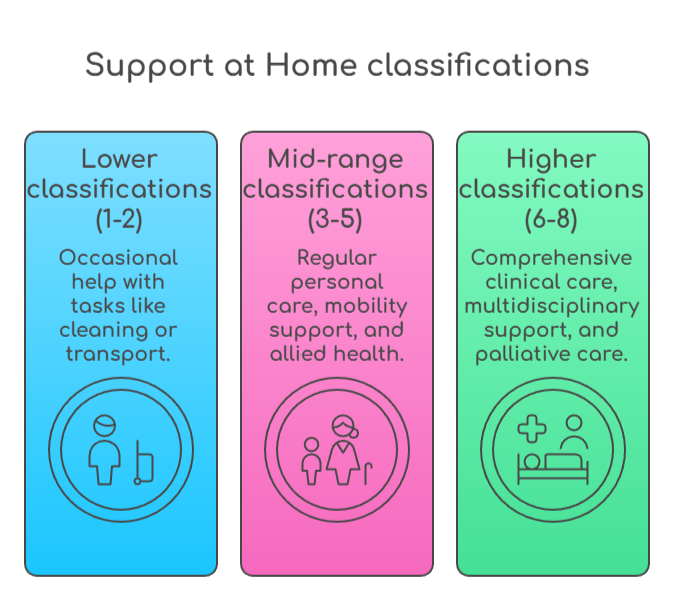
- Lower classifications (1–2) suit people who are mostly independent and need occasional help with tasks like cleaning or transport.
- Mid-range classifications (3–5) cover regular personal care, mobility support, and allied health.
- Higher classifications (6–8) fund comprehensive clinical care, daily multidisciplinary support, and palliative care at home.
Your classification is determined by an aged care assessor. If your needs change over time, you can be reassessed for a higher classification.
Major reforms and what's changing from Home Care Packages
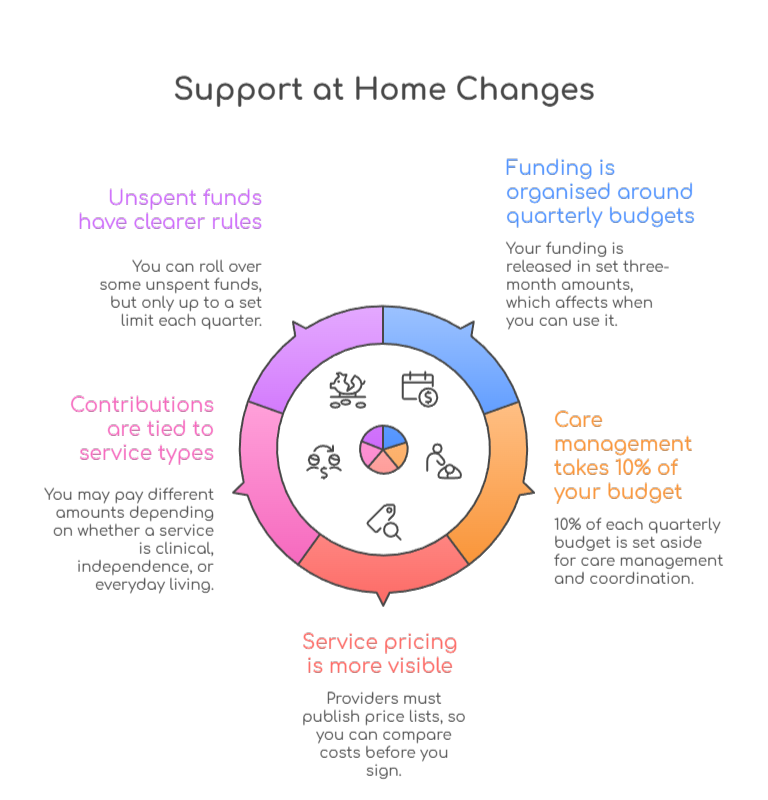
These are the most important Home Care Package reform changes:
- Funding is organised around quarterly budgets.
- Care management takes 10% of your budget.
- Service pricing is more visible.
- Contributions are tied to service types.
- Unspent funds have clearer rules.
Funding is organised around quarterly budgets
Ongoing Support at Home funding is split into four budgets each year. Each budget covers three months.
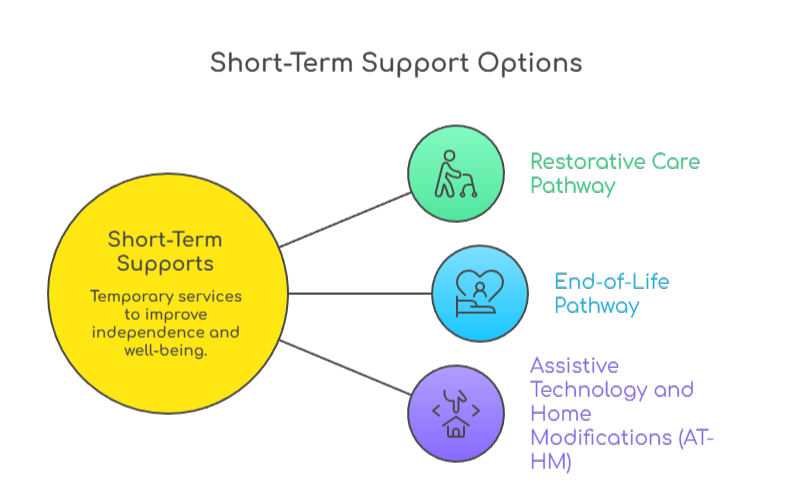
These are the short-term supports you can use with your Support at Home budget:
- Restorative Care Pathway
- End-of-Life Pathway
- Assistive Technology and Home Modifications (AT-HM)
Each Pathway has a different funding timeframe.
The Restorative Care Pathway offers up to $6,000 per episode for up to 16 weeks. Some eligible participants can be approved for an additional $6,000 unit (up to ~$12,000) during the episode.
Note that people can access up to two non-consecutive episodes, with at least three months between episodes. They cannot receive more than two units in 12 months.
The End-of-Life Pathway offers around $25,000 over 12 weeks for people with three months or less to live. Remaining funds can be used for up to 16 weeks total.
The AT-HM scheme offers separate, upfront funding valid for 12 months in most cases, allocated by tier.
Care management takes 10% of your budget
For ongoing services, 10% of your quarterly budget is automatically deducted for care management.
Care management covers activities like developing and reviewing your care plan and coordinating the services delivered to you.
This means your usable budget for services is the remaining 90%.
For example, on Classification 4, your quarterly budget is $7,424.10. But approximately $742.41 goes to care management, leaving around $6,681.69 for services.
Some participants may also receive a care management supplement for specific needs.
For the Restorative Care and End-of-Life pathways, your provider claims care management against the relevant funding account instead.
Service pricing is more visible
Under Support at Home, providers set prices, and you should compare before you choose. Charges come out of your quarterly budget.
All providers must publish their full price list of services online, on both My Aged Care and their own website.
This supports like-for-like comparisons. Providers must also agree on the prices they will charge each participant before services begin.
From 1 July 2026, price caps apply to each service in the service list.
Contributions are tied to service types
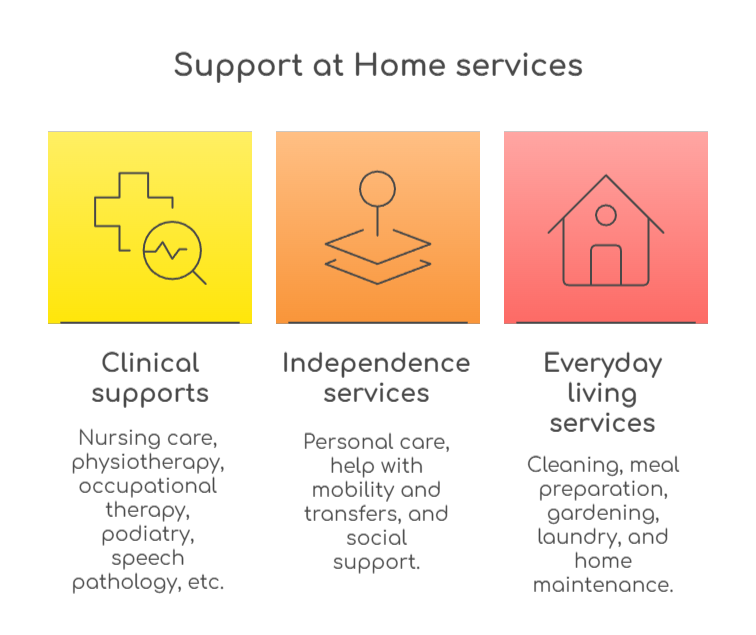
Support at Home separates services into clinical, independence, and everyday living categories.
The category affects what you may need to pay, and your contribution rate is based on your income and assets.
| Income and assets assessment outcome | Clinical supports | Independence supports | Everyday living supports |
|---|---|---|---|
| Full pensioner | 0% | 5% | 17.5% |
| Part pensioner / self-funded CSHC holder | 0% | 5%–50% (tapered) | 17.5%–80% (tapered) |
| Self-funded non-CSHC holder / means not disclosed | 0% | 50% | 80% |
Clinical supports include nursing and physiotherapy. These are always fully government-funded.
Independence services include personal care, and products and equipment under the AT-HM scheme.
Everyday living services include domestic help and gardening, and attract the highest contributions.
If you don't provide your income and assets information to Services Australia, you will be given a "means not disclosed" status. Your contributions will be set at the maximum rate.
If you are facing genuine financial hardship, you can apply for a fee reduction supplement.
Unspent funds have clearer rules
Unspent quarterly funds can roll over, but only up to a limit. The rollover amount is the higher of $1,000 or 10% of your quarterly budget.
Amounts above the rollover cap don’t carry over and won’t be available in the next quarter.
This is designed to stop very large balances from building up and to encourage the timely use of available support.
Transition arrangements for existing recipients
The Support at Home transition was designed to protect continuity of care. But the protections you receive depend on when you were assessed.
Transitioned classifications and equivalent funding
People approved for Home Care Packages on or before 31 October 2025 moved into transitioned classifications. These are intended to be equivalent to the prior Home Care Package funding level.
| Old HCP level | Support at Home classification | Quarterly budget | Annual amount |
|---|---|---|---|
| Level 1 | Transitioned HCP Level 1 | $2,746.63 | $10,986.50 |
| Level 2 | Transitioned HCP Level 2 | $4,829.86 | $19,319.45 |
| Level 3 | Transitioned HCP Level 3 | $10,513.83 | $42,055.30 |
| Level 4 | Transitioned HCP Level 4 | $15,939.55 | $63,758.20 |
These transitioned funding amounts are indexed on 1 July each year.
If you are reassessed for higher care needs, you will move to one of the eight new ongoing service classifications.
Your unspent Home Care Package funds are retained
If you had unspent Home Care Package funds as of 31 October 2025, you retain them under Support at Home. They are held in a separate budget from your quarterly budget, and no carryover limit applies to these funds.
Important: if you need assistive technology or home modifications, your provider must use your unspent HCP funds first. For ongoing services, your new quarterly budget must be used up first before drawing on retained HCP funds.
These funds will be transferred if you change to a new provider.
“No worse off” protections may apply
The "no worse off" principle only applies to people who were receiving or approved for a Home Care Package on or before 12 September 2024. These are called grandfathered participants.
It also includes people who were on the National Priority System or assessed as eligible at that date.
This protection means:
- If you previously paid no income-tested care fee under HCP, you will never be asked to pay Support at Home contributions.
- If you previously paid an income-tested care fee, you will pay the same or less under Support at Home.
The Home Care Package lifetime cap of $88,935 remains, and any contributions already paid under HCP count towards it. It is indexed twice a year, every 20 March and 20 September.
Who is NOT covered: People assessed as eligible for a Home Care Package between 12 September 2024 and 31 October 2025 are classified as "transitional participants." The no worse off principle does not apply to them. They pay standard contribution rates based on their income and assets, just like new entrants.
New entrants (assessed on or after 1 November 2025) also pay standard contribution rates. They have a higher lifetime cap of $140,652.80 (indexed) for non-clinical services.
Action steps for families and current package holders
In 2026, good outcomes usually come from confirming budgets, comparing prices, and reviewing the support plan when needs change.
If you had already received Support at Home services
Start with clarity on your classification, budget, and prices. Then check how contributions apply to the services you actually use.
Here is what you can do:
- Ask which classification you are on and what your quarterly budget is.
- Confirm how much of your budget goes to care management (10%), so you know your usable amount.
- Ask for the provider's current published price list and save a copy for reference.
- Confirm which of your services are clinical, independence, and everyday living. This determines your contribution rates.
- Track rollover carefully, because it is capped at $1,000 or 10% of your quarterly budget.
- Avoid overspends. Your account cannot go into a negative balance.
If you are helping a parent, partner, or friend
Families do best when they reduce surprises. That means shared visibility on pricing, budgets, and plan changes.
Here are some steps you can take:
- Keep the support plan, monthly statements, and service agreement in one folder.
- Use the Support at Home fee estimator to model likely contributions in 2026.
- Compare providers using published prices on My Aged Care's Find a Provider tool, and ask questions before signing.
- Check whether "no worse off" applies by confirming the assessment date. Only those assessed on or before 12 September 2024 qualify. People assessed between that date and 31 October 2025 pay standard rates.
- Plan for price caps from 1 July 2026 when reviewing service mixes.
- Factor in the 10% care management deduction when calculating how many service hours the budget will cover.
If you are new to Support at Home in 2026
New participants should focus on the basics: your classification, quarterly budget timing, provider prices, and contribution rates.
If funding is delayed, you may receive interim funding at 60% of your total classification while waiting for full allocation.
Here is what you can do:
- Ask when your quarterly budget starts, and whether it is pro-rated for a mid-quarter entry.
- Confirm which services are approved in your plan before committing to a provider.
- Ask for a written quote using the provider's published prices.
- Run a fee estimate using the Support at Home fee estimator before locking in higher-cost everyday living services.
- If you need equipment or home modifications, confirm your AT-HM funding tier. This is separate from your ongoing budget.
FAQ
What is the Support at Home program in 2026?
It's the Australian Government's main program for in-home aged care in 2026. It replaced Home Care Packages on 1 November 2025 and introduced eight classification levels with quarterly budgets.
How does the Support at Home budget work?
Ongoing funding is split into four quarterly budgets, released in July, October, January, and April. 10% of each budget is deducted for care management. Unspent quarterly funds roll over up to $1,000 or 10% of the budget.
How many classification levels are there in Support at Home?
There are eight ongoing service classifications, ranging from $10,731 per year (Classification 1) to $78,106 per year (Classification 8). There are also four transitioned HCP levels for people who moved from the old system.
Do I pay for nursing under Support at Home?
No. Clinical supports such as nursing and physiotherapy have no participant contribution, regardless of your income or assets.
Does "no worse off" apply to everyone?
No. It only applies to people who were receiving or approved for a Home Care Package on or before 12 September 2024. People assessed between 12 September 2024 and 31 October 2025 (transitional participants) pay standard rates. New entrants assessed after 1 November 2025 also pay standard rates.
What if I can't afford to pay my contributions?
If you are facing genuine financial hardship, you can apply for a fee reduction supplement. If eligible, the government will cover some or all of your aged care costs.
Understanding the Support at Home changes in 2026
Support at Home is now the main Australian Government program for in-home aged care in 2026. It uses quarterly budgets, published prices, and service-based contributions for some supports.
If you already had a Home Care Package, your transition should keep services steady, but you still need to check budgets, prices, and contributions. If you are new, focus on your classification, your quarterly start date, and your likely costs.
If you want help understanding your plan, comparing providers, or planning costs, Sensible Care can guide you through these changes.
Just reach out to us, and we'd be happy to answer any questions.
These amounts are set by the Australian Government and change at least twice a year. Check health.gov.au for the current amounts before you make a decision.

Take the Next Step in Care
Download our Info Kit or speak to one of our friendly team members today.


Explore More Helpful Reads
More stories, guides, and updates to support you and your family.




Need Help Getting Started?
Reach out on your terms, pick a time that suits you and let’s talk about how we can help.


.webp)