.svg)

The complete Support at Home service list
Read on to get the complete Support at Home service list, including what's funded, what's excluded, and practical tips to make the most of your budget.
Author: Sensible Care

The Support at Home service list defines what in-home aged care funding covers. Funded services include nursing, allied health, personal care, domestic help, and in some cases, assistive technology and home modifications. Funding usually excludes everyday living costs, like groceries, tickets, memberships, and rent. Approval depends on your assessed needs and support plan.
Support at Home helps you live safely at home. To achieve this goal, this government-funded aged care program is designed to cover various expenses. However, while some services are covered, others are not.
Contrary to what you might assume, your aged care budget doesn't cover everything, like rent and groceries. It's only for approved services that meet your assessed needs and support plan.
If you're not sure what those services might be, this Support at Home service list article is for you. We'll talk about what's usually included and excluded, and where the boundaries sit.
How the Support at Home service list works
The government uses a defined service list to show what funding can be used for. It includes:
- 3 contribution categories
- 14 service types
- 49 services
Each of the 14 service types is organised within a contribution category, and each of the 49 services can be found within a service type.
Each service type has in scope (allowed) and out of scope (not allowed) activities. That's why two people can have the same service but different approvals.
The Support at Home Service list at a glance
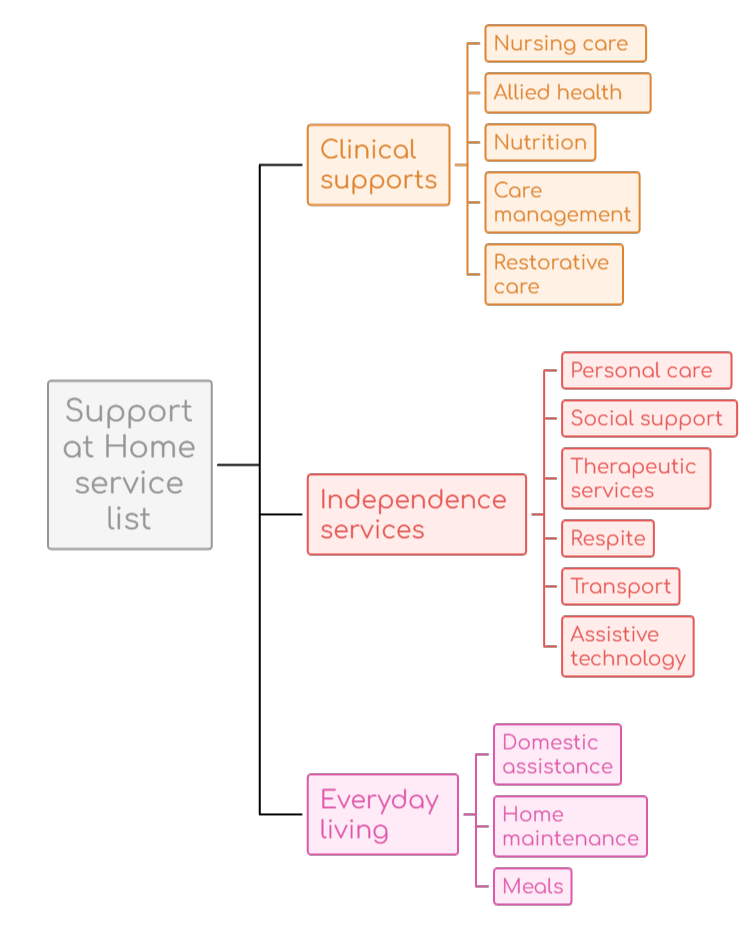
Here is the full service list, grouped into these three categories:
Clinical supports (health and nursing)
- Nursing care
- Allied health and other therapeutic services
- Nutrition (prescribed nutrition)
- Care management
- Restorative care management
Independence services
- Personal care
- Social support and community engagement
- Therapeutic services for independent living
- Respite
- Transport
- Assistive technology and home modifications
Everyday living
- Domestic assistance
- Home maintenance and repairs
- Meals
Clinical supports
Clinical supports are health-related services delivered by qualified professionals. Participants do not pay contributions for clinical supports.
Nursing care
Nursing care supports health needs that require clinical skills. It can be short-term after an illness or ongoing for complex needs.
Commonly funded nursing services include:
- Health assessments, monitoring, and treatment support
- Wound care, dressing changes, and skin checks
- Support with medicines, when clinically needed
- Catheter care and similar clinical tasks
Usually not funded under Support at Home:
- GP appointments and hospital care (these are covered elsewhere)
- The cost of medicines and medical products you buy yourself
Pharmaceuticals you'd normally buy yourself aren't funded. But some specialised nursing consumables may be funded if you're approved.
Allied health and other therapeutic services
Allied health refers to health professionals who are not doctors or nurses. These services focus on movement, safety, communication, and daily living skills.
Common allied health services include:
- Physiotherapy (mobility, strength, pain)
- Occupational therapy (home safety and daily living skills)
- Podiatry
- Speech pathology (swallowing and communication)
- Dietetics
- Psychology, counselling, or mental health support
- Exercise physiology
Allied health is most effective when it is goal-based. A clear goal also makes approval easier.
Nutrition
Prescribed nutrition supports medically necessary nutrition needs. It's typically used when there is a clinical reason, not general preference.
May include:
- Prescribed nutrition products and related support
- Education on safe eating, when linked to assessed needs
Usually not included:
- General groceries and everyday food costs
- Non-prescribed supplements, unless clinically justified
Funding usually covers the service and clinical support. It usually doesn't cover general household food bills.
Care management
Care management is the coordination that makes services run smoothly. It keeps your support organised, monitored, and reviewed.
Care management can include:
- Planning and scheduling services
- Coordinating different providers
- Monitoring outcomes and adjusting your plan
- Supporting paperwork, quotes, and reviews
Good care management reduces wasted visits and missed services. It also helps you track costs before your budget is stretched.
Restorative care management
Restorative care management supports short-term "get back on your feet" care. It's usually used after an illness, injury, or a hospital stay.
Restorative care focuses on:
- Improving strength, balance, and daily function
- Reducing reliance on ongoing supports
- Building skills that support independence
Independence services
Independence services support daily living, participation, and safety at home. These services often form the core of weekly routines.
Personal care
Personal care supports essential daily tasks when they are no longer safe or manageable alone. It protects dignity, hygiene, and safety.
Personal care commonly includes:
- Showering, bathing, and grooming support
- Dressing, toileting, and continence support
- Transfers, mobility support, and supervision for safety
- Help with taking medicines safely (support, not supply)
Usually not included:
- Beauty services like salon treatments
- The cost of continence products you purchase yourself, unless covered through specific pathways
Quick check: If the task is essential for daily living, it's more likely to fit personal care.
Social support and community engagement
Social support helps you stay connected and active. It can reduce isolation and support routines that protect well-being.
Common supports include:
- Companionship and social visits
- Support to attend community activities
- Help using basic technology when it supports connection
- Cultural support, where relevant
Usually not included:
- Tickets, memberships, or activity fees
- Purchases like phones, tablets, and subscriptions
Therapeutic services for independent living
These services support independence through structured activities and therapies. They can complement allied health and social supports.
May include:
- Activities that support memory, confidence, and routine
- Programs that help you stay engaged and active
- Therapies aimed at functional participation, when appropriate
Funding is more likely when the service links to a clear goal. That goal should relate to independence at home.
Respite
Respite provides short-term relief for family carers. It can be delivered at home or in the community.
Respite can include:
- A support worker staying with the person being cared for
- Short blocks of supervision and practical support
- Help that allows a carer to rest, work, or attend appointments
Usually not included:
- Long-term residential care
- Services that replace permanent living arrangements
Respite is most useful when planned early, not only during a crisis.
Transport
Transport supports access to essential appointments and regular community activities. It may be a driver service or a supported trip.
Transport may include:
- Travel to medical appointments and therapy
- Travel to regular community activities
- Support to use public transport safely, when needed
Usually not included:
- Holiday travel
- Buying a car, paying registration, or covering fuel
- Major travel costs that are not linked to daily living
Assistive technology and home modifications
Assistive technology and home modifications support safety and access. AT-HM (Assistive Technology and Home Modifications) funding is used for equipment and changes to the home.
Common assistive technology examples:
- Walking frames, shower chairs, and wheelchairs
- Transfer aids and safety equipment
- Devices that reduce fall risk and strain
Common home modification examples:
- Grab rails, small ramps, and non-slip surfaces
- Bathroom safety changes, where needed
- Other access changes based on assessment
Higher-cost items usually need clinical evidence and quotes. An occupational therapist's report is often used to support approvals.
Everyday living
Everyday living services support the home environment and daily practical tasks. These supports help keep the home safe, clean, and workable.
Domestic assistance
Domestic assistance supports basic household tasks you can no longer do safely. It's usually focused on essential upkeep, not deep cleaning.
Domestic assistance may include:
- Light cleaning, like vacuuming, mopping, and doing dishes
- Laundry support, like washing, drying, and folding
- Shopping assistance, accompanied or unaccompanied
Usually not included:
- Commercial cleaning, like carpet cleaning and upholstery cleaning
- Pest control and specialised cleaning services
- The cost of groceries and household items purchased
Home maintenance and repairs
Home maintenance focuses on safety-related tasks and minor repairs. It supports safe access and reduces hazards.
May include:
- Minor gardening and lawn mowing for safe access
- Small repairs that reduce risk, like fixing a loose handrail
- Basic upkeep that prevents fall hazards
Usually not included:
- Cosmetic upgrades and renovations
- Major building works
- Landscaping done mainly for appearance or property value
Callout: Safety is the key test. If it removes a hazard, it is easier to justify.
Meals
Meals support focuses on help to prepare or access meals. It can include cooking at home or meal delivery services.
May include:
- Meal preparation in your home
- Meal delivery of prepared meals
- Support aligned with dietary requirements, when needed
Usually not included:
- The cost of ingredients and groceries
- Takeaway food delivery
- Meals for other household members
What's included vs. excluded from funding
The simplest way to think about it is this: Funding is for support and safety, not general living costs.
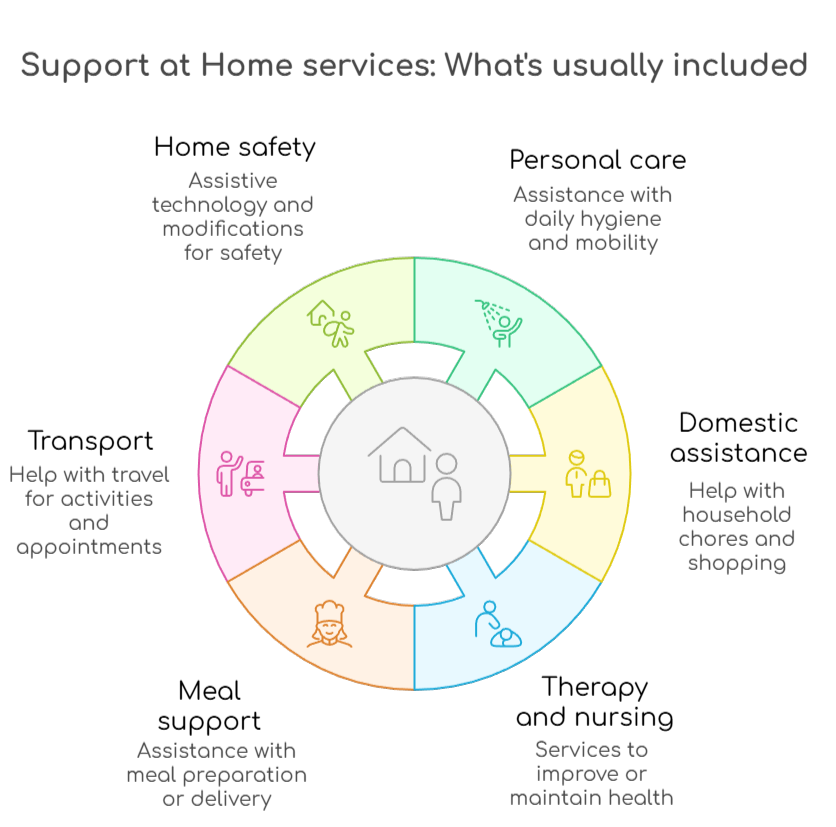
Usually included
- Personal care, like showering support and mobility assistance
- Domestic assistance, like light cleaning, laundry, and shopping
- Therapy and nursing that build or maintain function
- Meals support (preparing meals or delivery of prepared meals)
- Transport for usual activities and appointments
- Home safety items through assistive technology and home modifications
Usually excluded
- Professional carpet cleaning, pest control, or dry cleaning
- The cost of groceries and other items bought while shopping
- Meal ingredients, takeaway delivery, or meals for other household members
- Car purchase, car running costs, licences, flights, or holidays
- Tickets, memberships, or other costs to participate in social activities
The "grey area" that people miss
Some services may seem excluded, but they may be funded when there is a clear safety risk and the right evidence.
A good example is home repairs. Replacing carpets due to wear and tear is out of scope, but repairs may be considered where there is an imminent age-related safety risk, like damaged flooring creating a fall risk.
Practical tip: When something feels borderline, ask, "What risk does this reduce?" Then document it.
What you may pay for (and what you won't)
Support at Home has three contribution categories.
- You pay: usually for independence and everyday living supports, based on income and assets.
- You don't pay: for clinical supports like nursing and physiotherapy.
There is also a lifetime cap on contributions, which is indexed over time. The cap is indexed on 20 March and 20 September each year.
As of the 1 November 2025 schedule, the standard lifetime cap is $135,318.69. Some people protected by the no worse off principle keep the previous Home Care Package cap of $84,571.66.
How to maximise your support allocation
Maximising funding is mostly about planning, not finding loopholes. Use your budget where it reduces risk first, then build comfort and routine.
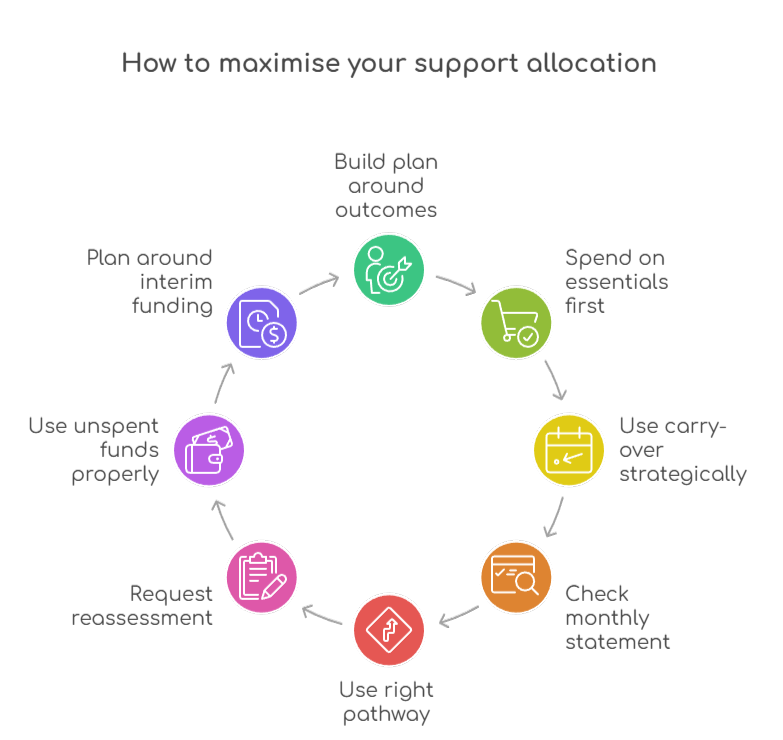
Here are some steps you can take to make the best use of your budget:
- Build your plan around outcomes
- Spend your quarterly budget on essentials first
- Use carry-over strategically
- Check your monthly statement
- Use the right pathway for the job
- Know when to request reassessment
- If you transitioned from Home Care Packages, use unspent funds properly
- Plan around interim funding, if it applies
Build your plan around outcomes
Write goals that are easy to prove, and make sure to keep them practical.
Examples of strong goals:
- Reduce fall risks in the bathroom.
- Maintain strength to transfer safely from bed to chair.
- Keep the home clean enough to prevent infection and falls.
These goals link directly to approved service types like therapy, personal care, and home maintenance.
Spend your quarterly budget on essentials first
Support at Home uses quarterly budgets for ongoing services.
Start with a base routine, which can include:
- Personal care days and times
- Cleaning and laundry frequency
- Meal supports
- Transport needs for appointments
Then add therapy blocks, not random single visits, where possible.
Use carry-over strategically
You can carry over unspent funds for ongoing services, capped at $1,000 or 10% of your quarterly budget (whichever is higher).
Smart uses for carry-over
- Extra support when a carer is away
- A short burst of extra personal care after illness
- One-off safety-focused maintenance, when approved
Check your monthly statement
Your provider must give you an itemised monthly statement showing spending, remaining budget, and contributions.
Do this monthly:
- Confirm services delivered match your plan
- Look for repeated charges you do not understand
- Ask to adjust if a service is not helping
Use the right pathway for the job
Some needs are short-term but intensive.
- Restorative Care Pathway: around $6,000 for up to 16 weeks (aimed at restoring function).
- End-of-Life Pathway: around $25,000 for 12 weeks (urgent support in final months).
- AT-HM scheme: separate funding tiers for equipment and modifications.
If you try to fund these needs from "regular" services, your budget can run out fast.
Know when to request reassessment
If needs increase and the budget no longer fits, you can request reassessment for a higher classification.
Triggers that justify reassessment
- A fall, hospital stay, or new mobility aid
- Rapid decline in continence or cognition
- Carer burnout or loss of informal supports
If you transitioned from Home Care Packages, use unspent funds properly
If you have unspent Home Care Package funds, you keep them under Support at Home. You can use them for approved assistive technology and home modifications. You can also use them for services once your quarterly budget is spent.
Key detail: No carryover limit applies to unspent Home Care Package funds.
Plan around interim funding, if it applies
Some people receive interim funding while waiting for full funding. Interim funding is 60% of the total classification, and the remaining amount is not backdated when it arrives.
Tip: Put your most essential supports into the interim plan first (personal care, safety, and clinical needs).
Where Sensible Care can help
The Support at Home service list is detailed, and small differences in wording can change what gets approved.
Sensible Care helps you turn your assessment and support plan into a clear weekly routine that fits your needs and budget.
We help you choose the right service types, set practical goals, and schedule supports in a way that reduces risk first. We also help you avoid out-of-scope spending by checking what is likely to be funded before services are booked.
If you need equipment or home changes, we can coordinate assessments, quotes, and the required paperwork. If your needs change, we can guide you through reviews or reassessment so your supports stay aligned with your life.
Reach out to us if you have any questions.

Take the Next Step in Care
Download our Info Kit or speak to one of our friendly team members today.


Explore More Helpful Reads
More stories, guides, and updates to support you and your family.




Need Help Getting Started?
Reach out on your terms, pick a time that suits you and let’s talk about how we can help.


.webp)