.svg)

What are the Support at Home categories?
Support at Home categories cover different types of care services. Read this article to understand what support is available and how it's delivered.
Author: Sensible Care
Support at Home categories are the three service groups used to fund and set contributions for in-home aged care. They are clinical supports, independence, and everyday living, and each one affects what you may pay. Support at Home also uses eight program levels (called "classifications") with quarterly budgets, plus extra short-term pathways for specific needs.
Australia's aged care system went through significant changes on 1 November 2025, with the introduction of Support at Home.
The goal is simple: help older Australians stay safe, well, and independent at home for longer.
A key part of the change is the new Support at Home categories. These categories shape how the funding model works, including what the Government covers and what you may need to pay.
In this guide, we break down each category in plain language. Whether you're arranging support for yourself, a parent, or a partner, you'll find some useful information in this article.
Quick overview: What you need to know about the Support at Home program
- Support at Home started on 1 November 2025, replacing Home Care Packages and Short-Term Restorative Care.
- The Support at Home categories are clinical supports, independence, and everyday living.
- Clinical supports have no participant contribution; independence and everyday living usually do.
- The Support at Home funding model is built around eight classifications with a quarterly budget.
- The Commonwealth Home Support Programme (CHSP) continues and will transition no earlier than 1 July 2027.
What are the Support at Home categories?
The Support at Home program groups funded services into three categories, each with its own contribution rules. The categories are:
- Clinical supports
- Independence supports
- Everyday living supports
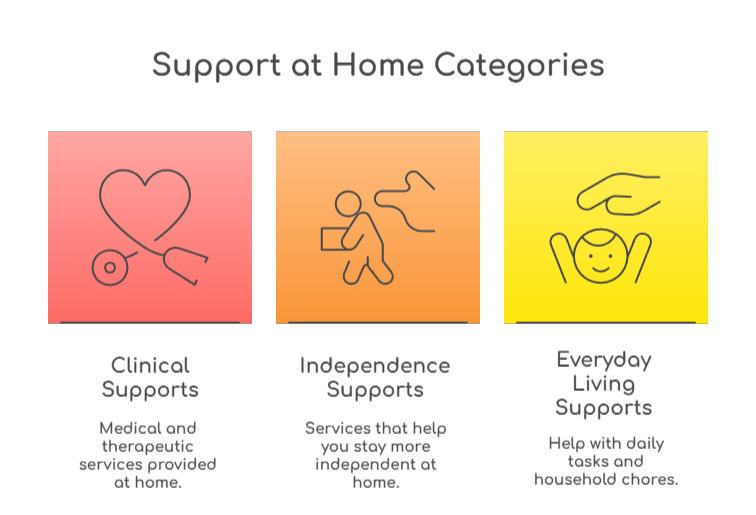
These categories are used across the official service list and fee settings.
Clinical supports category
Clinical supports are health-related services.
These supports are fully funded by the Australian Government for all participants. In other words, you do not pay a contribution for any services under this category.
Clinical care is prioritised as essential health support. It's agreed that medical needs shouldn't create financial barriers for older Australians.
Nursing is a core part of clinical supports and is usually delivered by registered nurses. It can include:
- Assessment and monitoring
- Wound management
- Continence support
- Medication administration
- Palliative care
Clinical support may also include therapy services when they’re prescribed to address a health issue. But if they're a fitness or daily function support, they are considered an independence support.
Independence category: day-to-day personal support
Independence services are supports that help you manage daily life and stay safe at home. People usually contribute to these services based on their income and assets.
This category includes these services and supports:
- Personal care, such as showering, dressing, toileting, and mobility support
- Help to stay socially connected, including community participation supports
- Some assistive technology, depending on what is approved in your plan
- Therapeutic services, which include exercise programs, fall prevention, and strength and balance training
- Independence training, including learning or relearning skills for daily living
- Respite care, which is short-term relief for family carers
- Transport, including help getting to medical appointments, shopping, and social activities
Assistive technology can include approved aids and equipment, such as mobility or bathroom supports.
Larger home modifications, like ramps or bathroom changes, may be funded separately through the Assistive Technology and Home Modifications (AT-HM) scheme.
Independence supports can also include social activities that help you stay connected and engaged. This can include help attending community activities, visiting friends or family, or taking part in social outings.
Everyday living category: help at home
Everyday living covers practical help around the house. It has the highest contribution rates for those who can afford to pay.
Everyday living services often include:
- Domestic support – cleaning, vacuuming, dishes, laundry, changing linen
- Home maintenance – basic repairs, safety checks, and minor maintenance work
- Gardening – lawn mowing, weeding, and garden upkeep for safety and access
- Meal services – meal preparation, help with cooking, and delivered meals
These services are subject to participant contributions, with a lifetime cap of $140,652.80 for non-clinical services.
The contribution amount varies based on your income. Self-funded retirees pay more than pensioners or Commonwealth Seniors Health Card holders.
Where allied health fits under Support at Home
Allied health can feel unclear under Support at Home, because it does not always sit in one place. It can be treated as clinical support in some cases, and as part of independence support in others.
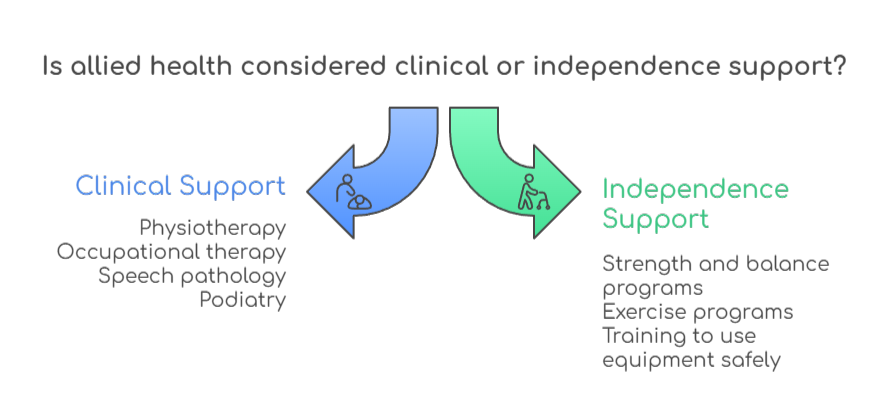
It's more likely to be considered clinical support when it is focused on health treatment. It may also be linked to managing a medical condition or reducing clinical risk.
Examples can include:
- Physiotherapy after a fall to restore safe movement.
- Occupational therapy to manage safety risks at home linked to mobility.
- Speech pathology for swallowing support.
- Podiatry for high-risk foot care linked to diabetes.
Allied health can also sit alongside independence support when the main goal is daily function. In this context, it is often about building skills, confidence, and safe routines, rather than treating a clinical issue.
Examples can include:
- Strength and balance programs to prevent falls.
- Occupational therapy to learn safer ways to shower, cook, or move around the home.
- Exercise programs to improve stamina for daily tasks.
- Training to use equipment safely, like a walker.
In these cases, allied health often works as part of a wider plan. It might sit next to personal care, domestic help, transport, or social support, to help you do more for yourself.
How does Support at Home funding work?
Support at Home uses a funding model where the government pays a subsidy to your provider.
You may pay a contribution for some categories. Your contribution depends on your income, assets, and service category.
Key points to understand about the Support at Home program funding:
- Clinical supports: 0% contribution.
- Independence and everyday living: contribution rates vary, and can be higher for self-funded retirees.
From 1 July 2026, government price caps will limit the maximum hourly prices providers can charge for Support at Home services. Providers can set lower prices if they choose.
There is a lifetime contribution cap, indexed on 20 March and 20 September each year. As of 20 September 2026, the standard cap (for new participants) is $140,652.80.
The "no worse off" cap (for existing Home Care Package recipients approved by 12 September 2024) is $88,934.57. Both figures increase with indexation.
Understanding the eight funding classifications
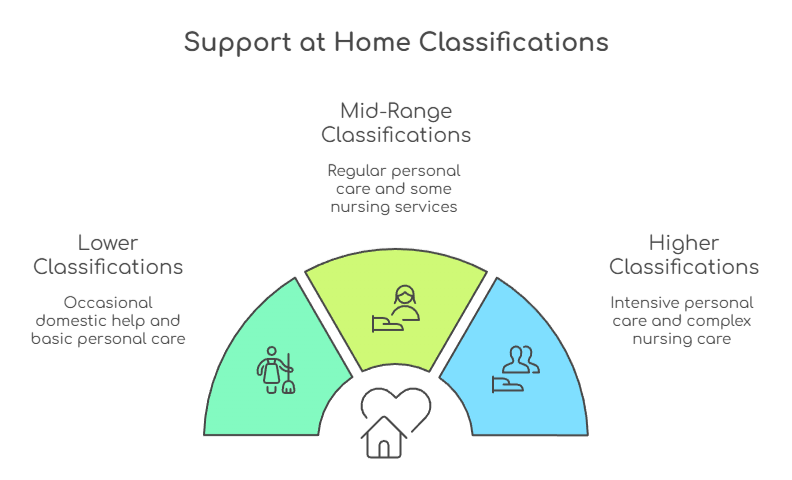
There are eight classifications or funding levels based on your assessed needs. Each has a defined quarterly and annual budget, ensuring you receive appropriate funding for your level of support.
While the exact budget amounts vary, the classifications can be divided into:
- Lower classifications – occasional domestic help, basic personal care, and allied health
- Mid-range classifications – regular personal care, domestic aid, some nursing, and allied health services
- Higher classifications – intensive personal care, daily support, complex nursing care, and 24-hour aid where required
Around 10% of each quarterly budget is set aside for care management, with the remainder available for your direct services.
If you're currently receiving a Home Care Package, you'll transition to Support at Home with equivalent or better funding. The government has committed to a "no worse off" principle for existing clients.
According to the Department of Health, participants approved after 12 September 2024 follow the new standard fee structure. Earlier participants receive transitional protections ensuring the same or lower contributions.
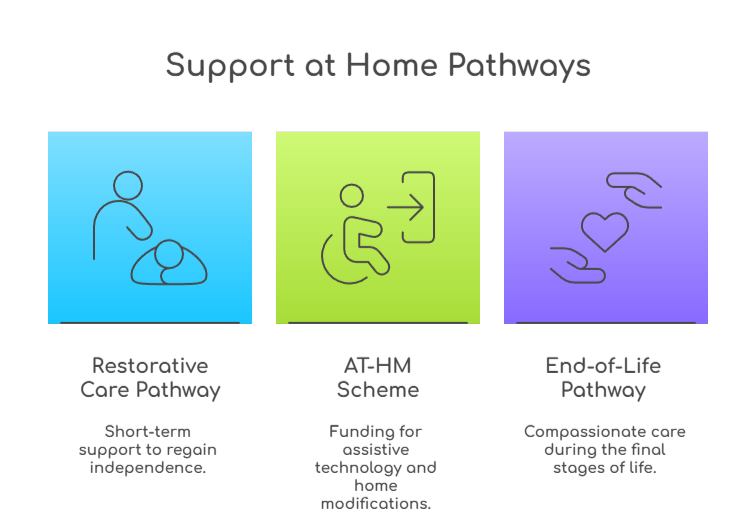
Short-term pathways and extra funding
Support at Home also includes short-term options for specific situations, on top of ongoing support.
These include:
- The Restorative Care Pathway
- Assistive Technology and Home Modifications (AT-HM) Scheme
- End-of-Life Pathway
Restorative Care Pathway
The Restorative Care Pathway provides intensive allied health services to help you regain independence. It's typically up to 12 weeks, with a possible four-week extension in some cases.
The Restorative Care Pathway provides up to $6,000 per episode (16 weeks). Participants may access up to two units within a 12-month period (total ~$12,000).
Contributions are based on the independence and everyday living service categories included in their plan.
It can involve:
- Physiotherapy for strength and mobility
- Occupational therapy for daily living skills
- Dietetics for nutrition and meal planning
- Multidisciplinary team coordination
You can access restorative care alongside your regular Support at Home services. This makes it genuinely additional support rather than a replacement.
Assistive Technology and Home Modifications (AT-HM)
This is separate funding for equipment and home changes, with tiers based on assessed need. It is designed so that equipment and modifications are not forced to compete with everyday services.
The AT-HM scheme can fund:
- Mobility aids (walkers, wheelchairs, scooters)
- Bathroom equipment (shower chairs, rails, raised toilets, etc.)
- Home modifications (ramps, widened doorways, accessible bathrooms, etc.)
- Communication devices
- Pressure care equipment
Funding is separate from your core Support at Home budget, meaning assistive technology and modifications don't eat into your everyday service funding.
End-of-Life Pathway
This pathway supports people diagnosed with 3 months or less to live who want to remain at home.
It provides $25,000 over 12 weeks, with flexibility to access it for up to 16 weeks if funds remain available.
This pathway includes:
- GP and nurse coordination
- Additional nursing care
- Increased personal care
- Respite for family carers
- Equipment and supplies
- 24-hour support if needed
The pathway aims to help older Australians remain at home with comfort and dignity during their final months, surrounded by their family and loved ones.
FAQ
What are the Support at Home categories?
They are clinical supports, independence, and everyday living. Clinical supports have 0% contribution. Contribution rates for independence and everyday living vary by income and assets. Pensioners typically pay 5% and 17.5% respectively, while self-funded retirees without a Commonwealth Seniors Health Card pay 50% and 80%.
Is clinical care fully funded under Support at Home?
Yes. Participants pay no contribution for clinical supports, such as nursing and physiotherapy.
What are the Support at Home program levels?
There are eight ongoing classifications, each with a quarterly budget linked to your assessed needs.
How does Support at Home funding work in practice?
Your provider charges for services, and the Government pays a subsidy. You may pay a contribution for independence and everyday living services.
What is the Support at Home subsidy cap?
There is a lifetime cap on participant contributions, and it is indexed. The schedule from 20 September 2026 lists the cap amounts.
Do I pay for allied health services under Support at Home?
It depends on the type of service. Traditional allied health professionals (physiotherapists, occupational therapists, podiatrists, etc.) are classified as clinical supports and are fully government-funded with 0% contribution.
However, complementary therapeutic services are classified under the independence category. They require participant contributions of 5-50% based on your income and assets.
Understanding Support at Home categories
Support at Home categories matter because they drive your funding, contribution rate, and what services are easiest to prioritise. Clinical supports are fully funded, while independence and everyday living supports are income-tested.
If you want help matching services to your goals and budget, Sensible Care can help you understand your plan, compare provider pricing, and set up supports that fit your routine.
Contact us for more information or a free consultation.
These amounts are set by the Australian Government and change at least twice a year. Check health.gov.au for the current amounts before you make a decision.

Take the Next Step in Care
Download our Info Kit or speak to one of our friendly team members today.


Explore More Helpful Reads
More stories, guides, and updates to support you and your family.




Need Help Getting Started?
Reach out on your terms, pick a time that suits you and let’s talk about how we can help.


.webp)