.svg)

Respite care explained: Types, funding, and how to access support
Learn how respite care works in Australia, including in-home, day, residential, and emergency options, Support at Home funding, costs, and access steps.
Author: Sensible Care

Respite care is short-term support that gives carers a break while their loved one receives care. It can take place at home, a respite centre, or a residential facility. You can access respite care through aged care pathways (including Support at Home) or the NDIS, depending on age, eligibility, and assessed needs. To get started, contact My Aged Care or the NDIS, complete the assessment, and book respite services with an approved respite care provider.
Respite care provides temporary relief for people taking care of loved ones. It can support the carers of someone living with a disability, chronic illness, dementia, or age-related care needs.
Respite care services give you time to rest, recharge, and manage everyday life while your loved one receives safe, professional care.
In Australia, respite care is available through government pathways, including Support at Home and the NDIS. You can also access respite through private providers.
When you understand the main types of respite, how funding works, and how to book support, it becomes much easier to access help.
What is respite care?
Respite care is short-term, temporary care that gives the main carer a break from day-to-day caring responsibilities.
It can be planned in advance or arranged at short notice, depending on your situation and what services are available.
Respite can be booked for a few hours, a few days, or longer.
Some families use it for regular weekly support, while others use it when the carer is unwell, travelling, or feeling close to burnout.
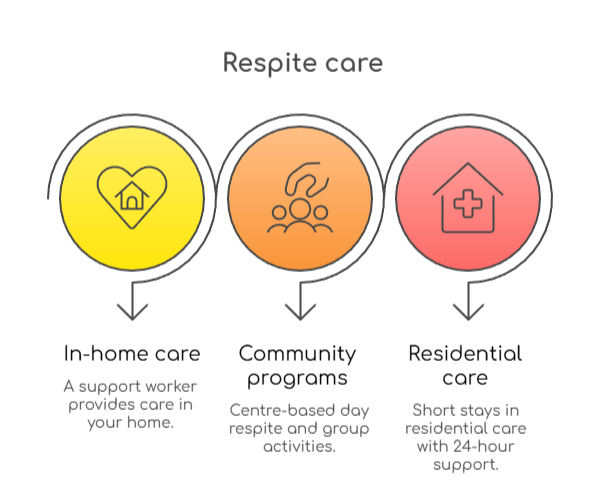
Respite can be delivered in different settings, including:
- In-home respite care, where a support worker provides care in your home
- Community programs, such as centre-based day respite and group activities
- Short stays in residential care, where 24-hour support is available for a set period
The right option depends on the person's care needs, their comfort with new environments, your schedule, and the type of break you need.
Who does respite care benefit?
Respite care supports both the carer and the person receiving care.
Australia has more than 3 million unpaid carers. Access to respite services plays an important role in preventing burnout and keeping caring sustainable.
Benefits for carers
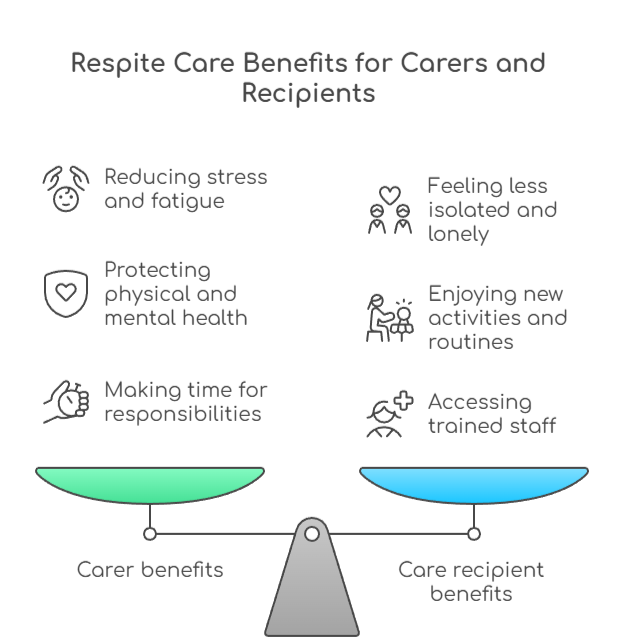
Respite care can support carers by helping them:
- Reduce stress, fatigue, and emotional strain
- Protect their physical and mental health
- Make time for appointments, work, and family responsibilities
- Rest, recharge, and sleep properly
Access to respite care can reduce stress, fatigue, and emotional strain for the caretaker. In turn, this directly impacts their physical and mental health.
It also creates space to attend appointments, keep up with work, and manage other family responsibilities. They can also use this time to simply rest and sleep properly.
Regular breaks can also improve relationships at home. This is because carers return with more patience, energy, and emotional reserves.
Benefits for care recipients
Respite care can support the person receiving care by helping them:
- Feel less isolated and more socially connected
- Enjoy new activities, routines, and social opportunities
- Access trained staff
When the person is receiving respite care, they will feel less lonely and isolated. They will also be able to increase social connections.
This can happen through new activities, new routines, and the chance to meet others. This is especially the case in day programs or group settings.
Respite care provides access to trained staff. These professionals understand personal care needs, dementia support, disability support, and safety requirements.
Changing environments and meeting different carers can also build confidence, independence, and adaptability.
Types of respite care available in Australia
You can choose one type of respite or combine options to fit your needs. Many people start small and build up over time.
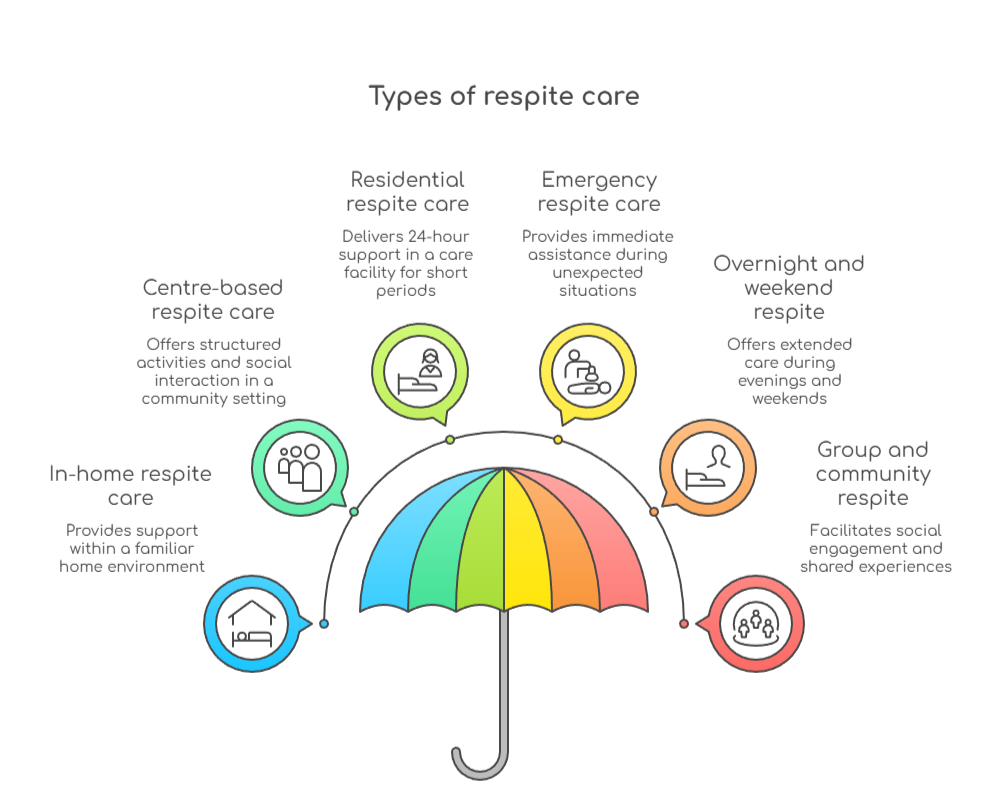
Here are your options:
- In-home respite care
- Centre-based respite care
- Residential respite care
- Emergency respite care
- Overnight and weekend respite
- Group and community respite
In-home respite care
In-home respite care, as the name suggests, means providing respite care in your own home. A support worker comes to your house to provide care while you, the primary carer, take a break.
In-home respite can include:
- Personal care (showering, dressing, and grooming)
- Meal preparation and mealtime support
- Medication prompts or help (where appropriate)
- Mobility support
- Companionship and safety supervision
This option often works well when someone prefers familiar surroundings or has anxiety about new environments. It's also suitable for people who use equipment that is already set up at home.
Centre-based day respite
Centre-based respite is delivered through day programs, often at community centres.
These services are designed to provide structure, activities, meals, and social interaction during the day.
Day programs can be helpful if the person you care for enjoys company and routine. It's also ideal if you need consistent time to work, attend appointments, or manage family tasks.
Some programs may also provide transport, depending on the service.
Residential respite care
Residential respite is a short stay in an aged care home or supported accommodation setting. Here, care is provided 24 hours a day.
Residential respite is often a good fit when a carer:
- Needs a longer break
- Is temporarily unable to provide care (for example, due to illness)
- Needs to travel
During the stay, the person receiving care can access the same kinds of supports as permanent residents. This includes meals, personal care, laundry, and social activities.
Emergency respite
Emergency respite is urgent, unplanned respite arranged during a crisis.
This can include sudden carer illness, hospitalisation, or a family emergency where care cannot continue as usual.
In these situations, it's important to seek help immediately. There might not be enough time to complete every step of a standard assessment process.
Emergency pathways exist, but availability can vary, so early contact is important.
Overnight and weekend respite
Some services offer overnight or weekend support, either in the home, in respite centres, or through short-stay arrangements.
This can be a practical option when you need a longer break than a day program provides, but do not need a longer residential stay.
Group and community respite
Group respite involves social and recreational activities delivered in community settings. This often includes people with similar needs.
These programs can include outings, sports, arts and crafts, and community events. They're particularly common for children and young adults with disability.
Who is eligible for respite care?
Eligibility depends on whether you access respite through aged care pathways, the NDIS, or private arrangements.
Aged care (My Aged Care)
Aged care respite applies to:
- people aged 65 years or older, or
- people aged 50 years or older for Aboriginal and Torres Strait Islander people.
An assessment through My Aged Care is required to confirm needs and eligibility.
Eligible individuals can access up to 63 days of government-subsidised residential respite per financial year.
Extensions of up to 21 days are possible.
NDIS (National Disability Insurance Scheme)
NDIS access generally applies to people under 65 with a permanent and significant disability.
Respite-related supports can be included in an NDIS plan. But this depends on the participant's goals, needs, and budgets.
NDIS planning may cover in-home support, community participation, and short stays. It depends on the plan design and approvals.
How Support at Home funds respite services
Support at Home is Australia's in-home aged care program. It replaced Home Care Packages and Short-Term Restorative Care on 1 November 2025.
Support at Home uses eight funding classifications. Each classification links to a quarterly budget that reflects assessed needs.
Respite delivered at home or in the community can be part of these supports. But it needs to align with the person's assessed needs and service plan.
How it works in practice:
- Your assessment and classification help determine what supports you can access.
- Your classification sets the quarterly budget your provider can use to deliver services.
- Your provider uses that budget to deliver the supports you agree on, including respite.
- Respite can be planned ahead or adjusted as needs change.
Put simply, Support at Home funding is a set budget tied to your assessed needs. Respite is one way that budget can be used when it is part of the agreed plan.
Step-by-step guide to arranging respite care in Australia
Below are practical steps you can follow, whether you need planned respite or urgent support.
Option 1: Arrange respite through My Aged Care (aged care pathway)
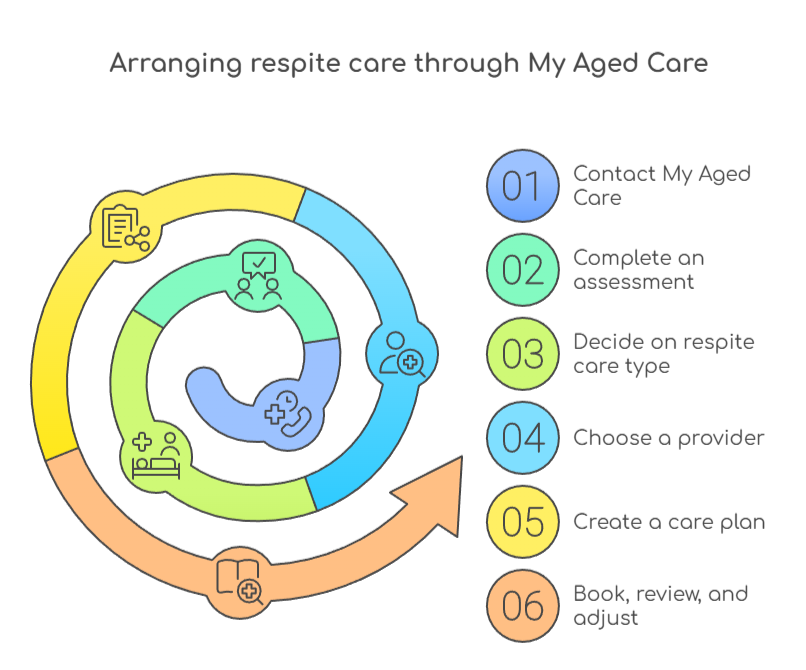
Step 1: Contact My Aged Care
Call 1800 200 422 (Monday to Friday, 8 am to 8 pm local time), or apply online using your Medicare card. My Aged Care is also open on Saturdays from 10 am to 2 pm.
Step 2: Complete an assessment
An assessor will discuss health, daily living needs, current supports, and care goals. This step determines eligibility for respite services and the types of support that may fit your situation.
Step 3: Decide what type of respite you need
Think about what would help most right now. That might be:
- Respite care in the home for a few hours
- A day program once a week
- A short residential stay
- Emergency cover during a crisis
Step 4: Choose a provider and check availability
Once approved, you can book respite care with registered providers in your area. Availability can be limited for residential respite, so booking early helps, especially around holidays.
Step 5: Share a simple care plan
Provide clear information about routines, medications, dietary needs, mobility support, and communication preferences. This helps ensure continuity of care and reduces stress for everyone.
Step 6: Book, review, and adjust
If you are unsure, trial a short booking first, such as a few hours of in-home respite care. A gradual approach can help the person receiving care adjust. It can also make longer respite easier later.
Emergency situations
If you need urgent respite, contact My Aged Care immediately. Call Carer Gateway on 1800 422 737 for emergency support pathways.
Option 2: Arrange respite through the NDIS
Step 1: Check eligibility
Use the NDIS eligibility tool, or call 1800 800 110.
Step 2: Submit an access request
You will need medical reports and evidence of disability. Submitting clear documentation helps support timely decisions.
Step 3: Build respite into your plan
If approved, you will meet with an NDIS planner to develop your plan. Respite-related supports may be included under categories such as help with daily living, community participation, or short-term accommodation.
Step 4: Book services with a provider
Once funded, you can arrange support with registered providers. This includes respite care at home, community-based options, or short stays, depending on your plan.
Option 3: Private respite care
Some people self-fund respite, either for faster access or for extra hours beyond funded services.
Costs vary by location, level of care, and timing. They're often higher in metropolitan areas, for complex needs, or on weekends.
Indicative private rates can include:
- Daily in-home care: $300 to $800 for daytime support
- Overnight or 24-hour care: $500 to $1,500 per day
- Weekly residential respite: $1,200 to $2,500, depending on care intensity and accommodation
Costs and fees for respite care
Aged care residential respite (government-regulated)
Residential respite fees are different from permanent residential aged care fees.
For residential respite, the maximum basic daily fee is set at 85% of the single basic Age Pension. It's updated every March and September.
The basic daily fee covers everyday costs such as meals, laundry, and cleaning.
There are no accommodation costs or means-tested care fees for respite stays. A booking fee may apply, but it is capped, and it may be refundable under certain conditions.
In-home or community respite (aged care short-term care)
For in-home or community respite through aged care, the subsidised rate depends on the services provided and the agreement with your provider. Government subsidies cover most costs for eligible participants.
NDIS funding
NDIS participants can use Core Supports or Capacity Building budgets to cover respite-related supports, depending on what is approved in the plan.
There is no means testing for short-term respite under the NDIS. Access is based on eligibility and plan design.
Tips for choosing respite care
A little planning can make respite smoother and more effective. Here are some tips on choosing respite care:
- Start early: Booking ahead helps, especially during holiday periods.
- Visit facilities: If considering residential respite, tour the site and meet staff first.
- Discuss preferences: Talk with the care recipient about comfort, routines, and worries.
- Check provider credentials: Confirm your respite provider has appropriate qualifications and registrations.
- Trial short stays: Start with a few hours or a day before a longer booking.
- Create a care plan: Share details about routines, medications, dietary needs, and communication styles.
Finding respite care providers in your area
You can start with:
- My Aged Care for aged care respite pathways and local providers
- The NDIS Provider Finder for registered disability providers
- Local councils for community programs
- Carer support organisations, including national and state-based groups
If you are searching for respite care services quickly, it helps to contact different providers. Make sure to ask about wait times, cancellation lists, and emergency options.
Next steps: getting the right respite support
Respite care is not a luxury, but a key support for sustainable caring.
You have options. You can choose in-home respite care, a day program, a short residential stay, or emergency support. The best fit depends on your needs and your loved one's comfort.
If you are feeling stretched, start the process early. Treat respite as part of your long-term care plan, not a last resort.
If you want help organising respite, Sensible Care can guide you through the next step.
We can explain your options, help you understand Support at Home funding, and arrange respite care in your home. If you are interested in our services, feel free to contact us.

Take the Next Step in Care
Download our Info Kit or speak to one of our friendly team members today.


Explore More Helpful Reads
More stories, guides, and updates to support you and your family.




Need Help Getting Started?
Reach out on your terms, pick a time that suits you and let’s talk about how we can help.


.webp)