.svg)

Support at Home classifications: A complete guide for older Australians
This is your guide to understanding Support at Home classifications, how care needs are assessed, how support is grouped, and what it means for you.
Author: Sensible Care

Support at Home has eight funding classifications that match the level of help you need at home. Your classification sets your quarterly Support at Home budget. You can add short-term funding for home modifications, recovery, or end-of-life care. If your needs change, you can ask for a review at any time.
When Support at Home replaced Home Care Packages, it also changed the rules on how services are grouped. Instead of four package levels, Support at Home now uses eight classifications.
Each classification affects how much funding you receive, how your budget is allocated, and what services you can access at home.
This guide explains what Support at Home classifications are, how they work, and what you can do with them.
What are Support at Home classifications?
Support at Home classifications are funding levels. They set how much government funding you can receive to support you at home. This is also known as your Support at Home budget.
Your classification reflects your overall needs. It can include help with daily tasks, personal care, nursing, care coordination, and more.
A classification is not a set number of hours. Instead, your hours depend on what services you choose and how much those services cost.
How are Support at Home classifications assigned?
Your Support at Home classification is decided through a government assessment. This is done through the Single Assessment System.
The Single Assessment System uses the Integrated Assessment Tool, which is a standard set of questions used nationwide. It helps assessors understand what support you need now, and what you may need soon.
Your assessment is based on:
- Your daily activities, such as cooking, showering, and cleaning
- Your health conditions and medications
- Your mobility, balance, and fall risk
- Memory, thinking, and behaviour changes
- Your home setup and safety risks
- Your support network, which may include family, friends, and carers
- Your goals, preferences, and routines
The eight ongoing Support at Home classifications and budgets
If you have been approved for Support at Home from 1 November 2025 onwards, you will usually receive an ongoing classification from 1 to 8.
Each classification comes with a set budget. That budget is paid in four quarterly amounts across the year.
Budgets are indexed each year on 1 July, so the exact figures may change.
These are the current estimated budgets by classification:
- Classification 1: $10,731.00 per year (about $2,682.75 per quarter)
- Classification 2: $16,034.45 per year (about $4,008.61 per quarter)
- Classification 3: $21,965.70 per year (about $5,491.43 per quarter)
- Classification 4: $29,696.40 per year (about $7,424.10 per quarter)
- Classification 5: $39,697.40 per year (about $9,924.35 per quarter)
- Classification 6: $48,114.30 per year (about $12,028.58 per quarter)
- Classification 7: $58,148.15 per year (about $14,537.04 per quarter)
- Classification 8: $78,106.35 per year (about $19,526.59 per quarter)
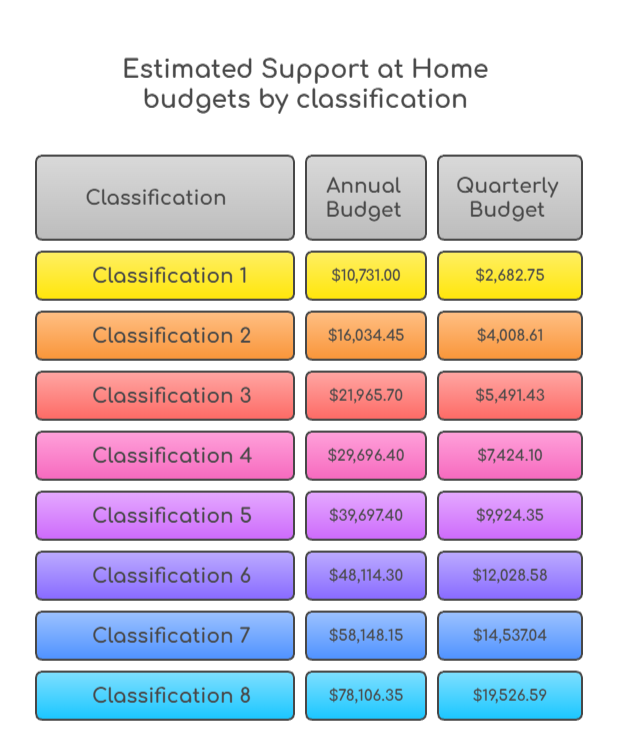
Your budget is not a set number of hours. It's a pool of funding, and your service mix determines how far it goes each quarter.
What each classification usually means
Every person's care plan is different. Still, there are common patterns by classification.
Think of classifications as a guide to the size and complexity of support, not a strict list of services.
Classification 1: occasional support
This level suits older Australians who are mostly independent, but may need help with a few tasks or short visits.
Support under this classification often includes:
- Light cleaning and laundry
- Shopping help or meal preparation
- Basic transport support
- Safety checks and well-being visits
Example: An older person who manages personal care, but needs help with housework once a fortnight.
Classification 2: regular weekly support
Level 2 is mainly for older people who need consistent help each week. They also may need some hands-on help at home.
Classification 2 may cover these services:
- Showering and dressing support
- Meal preparation and basic cooking
- Shopping, errands, and transport
- Companionship and social outings
- Simple medication reminders
Example: An older person who needs help showering twice a week and support with shopping.
Classification 3: moderate ongoing help
Classification 3 is best for older people who need several visits each week. This group is also for those who may have a higher risk of falls or mild memory changes.
Services under classification 3 might include:
- Personal care several times each week
- Mobility help and safe transfers
- Regular cleaning and laundry
- Transport to medical appointments
- Support to stay active and safe at home
Example: An older person with arthritis who struggles with bending, balance, and getting in and out of the shower.
Classification 4: near-daily support
This level suits older people who need help most days. They may require more personal care and more household support.
Support under classification 4 includes:
- Frequent personal care
- Meal support, including meal delivery
- Continence support
- Transport and appointment help
- Minor home safety changes, like rails
Example: An older person who needs daily help to shower, dress, and manage continence products.
Classification 5: daily support with health monitoring
Level 5 is intended for older people with significant daily needs. Those with health changes may also need monitoring and follow-ups.
Support often includes:
- Daily personal care
- Medication support (prompting, organising, and monitoring)
- Mobility equipment support, such as walkers
- Wound support or clinical checks
- Regular nursing visits when needed
Example: An older person recovering from surgery who needs daily help, plus nursing support for dressings.
Classification 6: higher clinical and allied health support
This level suits people with complex health needs. Support may involve several professionals. This includes:
- Multiple care visits each day
- Regular nursing, including clinical care
- Allied health services, like physiotherapy
- Specialised equipment, such as hoists
- Structured care planning across providers
Example: An older person with advanced diabetes and mobility limits who needs nursing, physio, and daily personal care.
Classification 7: intensive daily coordinated care
Classification 7 is for people with very high support needs. Many people at this level need a coordinated care team.
Support under Classification 7 often covers:
- Multiple visits each day
- Dementia-specific support
- Nursing and allied health input
- Respite for family carers
- Stronger care coordination and planning
Example: An older person with advanced dementia who needs support with all daily tasks and safe supervision.
Classification 8: highest care needs, including end-of-life support
This is the highest classification. It suits people with very complex needs, often including end-of-life care at home.
Classification 8 support often includes:
- Palliative nursing support (care focused on comfort and symptom relief)
- Rapid response to health changes
- Complex equipment and comfort supports
- Intensive personal care
- Support for carers and family members
Example: An older person who wants to stay at home during the final months, with nursing and daily care support.
How funding works under Support at Home
Support at Home funding is paid quarterly. This means your budget will be paid in four instalments throughout the year.
Your provider helps you plan how to use it. The goal is to support your health, safety, and independence.
Key points to understand:
- Budgets are indexed each year on 1 July.
- You can carry over up to $1,000 or 10% of your quarterly budget (whichever is greater) to the next quarter.
- Some people receive interim funding at 60% of their classification while waiting for full allocation to begin.
- You may pay participant contributions (your share of costs) based on your income and assets.
- Your provider deducts 10% of your quarterly budget for care management.
- Your budget is flexible, but it still needs to match your care plan and approved services.
Understanding care management costs
Your provider uses 10% of your quarterly budget for care management. This covers:
- Planning your care
- Coordinating services
- Reviewing your needs
- Managing your funding
The remaining 90% is available for direct services like personal care, cleaning, nursing, and transport.
For example, let's say your quarterly budget is $10,000. In that case, around $1,000 goes to care management and $9,000 is available for services you receive directly.
What about those transitioning from Home Care Packages?
If you already had a Home Care Package before Support at Home began, you are not placed into the eight ongoing classifications straight away.
Instead, you move into a transitioned Home Care Package level. Your funding stays linked to your original package amount.
This is because of the "no worse off" rule. This is a policy that protects your existing funding during the transition. In other words, you keep the same annual budget you had before Support at Home started.
If you were on a Home Care Package, your transitioned funding is usually one of these:
- HCP level 1: $10,986.50 per year (about $2,746.63 per quarter)
- HCP level 2: $19,319.45 per year (about $4,829.86 per quarter)
- HCP level 3: $42,055.30 per year (about $10,513.83 per quarter)
- HCP level 4: $63,758.20 per year (about $15,939.55 per quarter)
What you can use your classification budget for
Support at Home funding can cover many services. What matters is what you need and what supports your goals.
Commonly funded services include:
- Personal care, such as showering and dressing
- Domestic support, such as cleaning and laundry
- Transport to appointments
- Meal support
- Nursing and health care visits
- Allied health, such as physio, OT, and speech therapy
- Respite support for carers
- Care coordination and planning
- Basic equipment and minor home changes
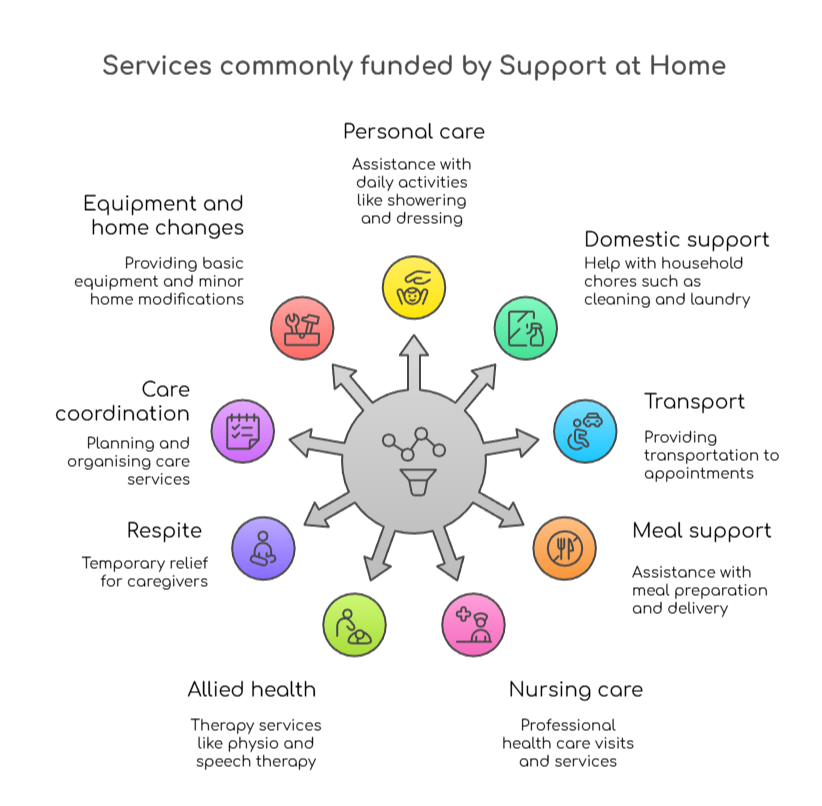
Your provider should explain what is covered and what may need extra approval.
Short-term funding that can sit on top of your classification
Sometimes your needs change quickly. That might happen after a hospital stay, a fall, or a major health event.
That's why Support at Home includes short-term pathways. These provide extra funding for specific situations.
Assistive technology and home modifications (AT-HM)
Assistive technology is equipment that helps you stay safe and independent. Home modifications are changes to your home.
Examples include:
- Shower chairs, walkers, and mobility aids
- Grab rails, ramps, and bathroom changes
- Bed rails, hoists, or hospital-style beds
AT-HM funding usually has set caps, such as:
- Low cap, around $500
- Medium cap, around $2,000
- High cap, around $15,000 or more
These supports often need a recommendation from an occupational therapist.
Restorative care pathway
Restorative care is short-term support to help you regain strength and independence after a setback.
Restorative care provides about $6,000 for a 16-week period. If your provider assesses that you need more intensive support, they can apply for up to an additional $6,000.
You can access up to two episodes of restorative care within a 12-month period.
It's usually goal-based. This might include walking safely again, cooking independently, or showering with less help.
This pathway may include:
- Physiotherapy or exercise support
- Personal care while you recover
- Equipment to build confidence and safety
End-of-life pathway
This pathway supports people who want to receive end-of-life care at home. It helps provide comfort, clinical care, and carer support.
End-of-life funding provides around $25,000 over a 12-week period. If you still need services after 12 weeks, you can continue using the funding up to 16 weeks.
Support may include:
- Nursing visits and symptom support
- Equipment for comfort and safety
- Increased personal care
- Support for family members and carers
How to request a review of your classification
Your needs can change. That might happen gradually, or it may occur after an illness, injury, or hospital stay.
You can request a review if:
- You need more help with daily care
- Your health has become less stable
- Your safety risks have increased
- Your carer situation has changed
Start with My Aged Care. Your provider can also help you prepare for a reassessment.
Key differences from the old Home Care Package system
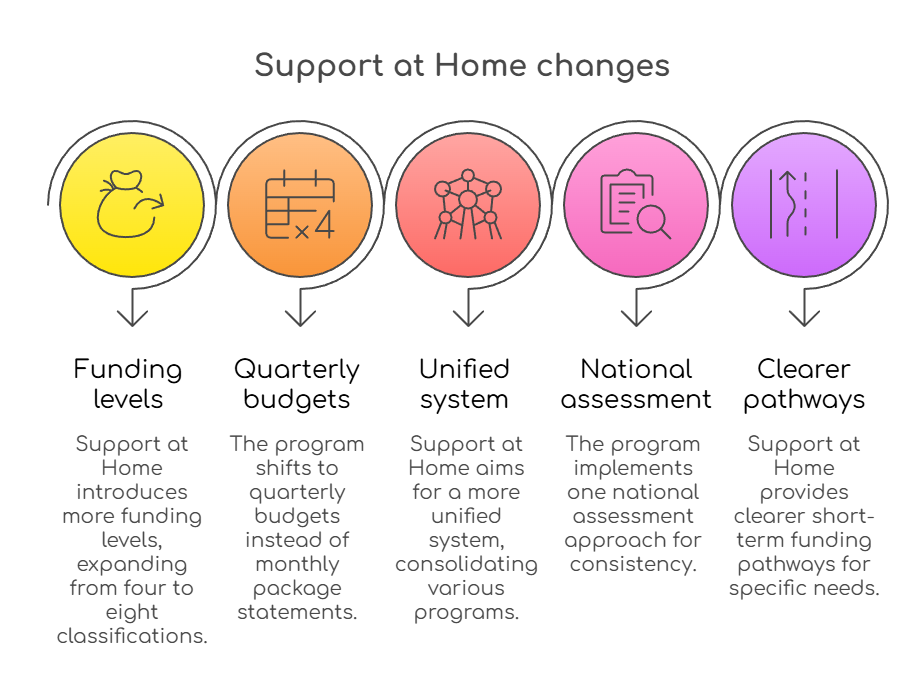
Support at Home was designed to be clearer and more responsive than Home Care Packages. Here are the key changes that come with Support at Home:
- More funding levels, with eight classifications instead of four
- Quarterly budgets rather than monthly package statements
- A more unified system, bringing programs together
- One national assessment approach
- Clearer short-term funding pathways for specific needs
Choosing a provider after you receive your classification
Once you receive your classification, you can choose a registered provider. You can also change providers later if you wish.
When comparing providers, ask about:
- Service availability in your area
- Experience with your classification level
- Fees and how they are explained
- How care is planned and reviewed
- How quickly support can start
- How care is coordinated if your needs grow
A good provider should explain your budget in plain language and help you plan quarter by quarter.
Getting the right support with Sensible Care
Your Support at Home classification determines your funding, service frequency, and the level of care you can expect. When you understand your classification, it becomes easier to plan your quarter and adjust your supports as your life changes.
Sensible Care can guide you through the system in plain language.
We can explain your classification, help you build a care plan that fits your routine and goals, and update your services if your needs change.
If you would like help navigating Support at Home classifications, contact Sensible Care. We will talk through your options and help you feel confident about your next steps.
These amounts are set by the Australian Government and change at least twice a year. Check health.gov.au for the current amounts before you make a decision.

Take the Next Step in Care
Download our Info Kit or speak to one of our friendly team members today.


Explore More Helpful Reads
More stories, guides, and updates to support you and your family.




Need Help Getting Started?
Reach out on your terms, pick a time that suits you and let’s talk about how we can help.


.webp)