.svg)

Understanding Support at Home levels
Support at Home levels explained: learn how each level works, what services are included, and how support is tailored to individual care needs.
Author: Sensible Care

There are eight ongoing Support at Home levels, plus four transitioned Home Care Package levels, each with its own quarterly budget. Short-term funding, such as restorative care or home modifications, can be added on top when you need extra help. You can apply, choose a reliable provider like Sensible Care, and ask for your Support at Home level to be reviewed if your needs change.
Since the Support at Home program has just rolled out, many of its participants are still confused about how levels work.
There are eight Support at Home levels. That doesn't include the four Home Care Package levels for those who have transitioned to the new program.
Each level reflects the amount of help you need with daily tasks, personal care, and health support. Of course, your level may also change as your needs grow.
If you want to know more about Support at Home levels, this article is for you.
Key takeaways
- Support at Home replaced Home Care Packages on 1 November 2025.
- There are 8 ongoing Support at Home funding levels, plus 4 transitioned Home Care Package levels.
- Funding is paid quarterly, with caps on how much unspent money you can carry over.
- Short-term programs sit on top of your usual Support at Home package level when you need extra help.
- You can ask for your Support at Home level to be reviewed if your needs change.
Support at Home levels and funding overview
Support at Home uses 12 funding classifications, which work like Support at Home package levels.
These include 8 ongoing Support at Home classifications, plus 4 transitioned Home Care Package levels.
If you're newly assessed on or after 1 November 2025, you are placed in one of the Support at Home levels. These are often referred to as ongoing classifications or Support at Home funding levels.
Let's take a closer look at each level and the amount of funding it comes with:
| Ongoing classification | Approx. annual budget | Approx. quarterly budget |
|---|---|---|
| Classification 1 | $10,731.00 | $2,682.75 |
| Classification 2 | $16,034.45 | $4,008.61 |
| Classification 3 | $21,965.70 | $5,491.43 |
| Classification 4 | $29,696.40 | $7,424.10 |
| Classification 5 | $39,697.40 | $9,924.35 |
| Classification 6 | $48,114.30 | $12,028.58 |
| Classification 7 | $58,148.15 | $14,537.04 |
| Classification 8 | $78,106.35 | $19,526.59 |
These Support at Home funding levels are indexed each year on 1 July. Actual amounts may change over time with government indexation.
Support at Home 8 levels explained
Each Support at Home level is linked to a budget, rather than a fixed number of hours.
Your level reflects how much support you need across personal care, domestic help, and clinical care.
Here's what each classification is for:
- Classifications 1–3 support lower care needs.
- Classifications 4–6 support moderate care needs.
- Classifications 7–8 support higher and more complex care needs.

Here are some examples:
Example 1: lower Support at Home levels (1–3)
Maria is 78 and lives alone. She needs help with cleaning, shopping, and getting to appointments, but showers safely by herself. She may be suitable for classification 2, a lower Support at Home funding level.
Example 2: mid-range Support at Home levels (4–6)
David has arthritis and heart disease. He needs regular help with showering, dressing, cleaning, and some nursing visits. He may be suitable for a mid-range Support at Home package level, such as classification 5.
Example 3: higher Support at Home levels (7–8)
Sana has advanced dementia and needs full support for daily care, plus regular nursing. Her family provides support, but they need daily professional visits and strong care coordination. She may be suitable for a higher Support at Home level, such as classification 7 or 8.
How is your Support at Home level decided?
Your Support at Home funding classification is set during your aged care assessment.
The assessor will use the Integrated Assessment Tool to understand your day-to-day support needs. After that, your support plan will be built.
This is how it happens:
- Referral + initial review: your assessment request is received and reviewed.
- Assessment appointment: an assessor completes your assessment using the Integrated Assessment Tool and talks through your needs and goals.
- Support plan: the assessor finalises a support plan that outlines recommended services and why.
- Decision + outcome letter: you receive a Notice of Decision that includes the services you’re approved for, reasons/evidence supporting the decision, and your review rights (plus a copy of your support plan).
Your classification then gives you a set quarterly budget to spend on services from the Support at Home service list, based on what was assessed.
The quarterly budget amounts include 10% allocated for care management.
Transitioned Home Care Package levels
If you were already on a Home Care Package (Levels 1–4) before Support at Home started, you don't automatically move into the new eight classifications.
Instead, you move onto a Transitioned HCP Level (1–4) and keep an equivalent funding level to what you had under HCP.
You'll also retain any unspent HCP funds. If your needs change over time, you can request a reassessment to move into one of the eight Support at Home classifications.
These are the transitioned Home Care Package funding levels:
| Transitioned HCP level | Approx. annual budget | Approx. quarterly budget |
|---|---|---|
| HCP level 1 | $10,986.50 | $2,746.63 |
| HCP level 2 | $19,319.45 | $4,829.86 |
| HCP level 3 | $42,055.30 | $10,513.83 |
| HCP level 4 | $63,758.20 | $15,939.55 |
If you had a Home Care Package approved or in place before 31 October 2025, your budget is covered by a "no worse off" rule. This rule ensures you are not disadvantaged when moving to Support at Home.
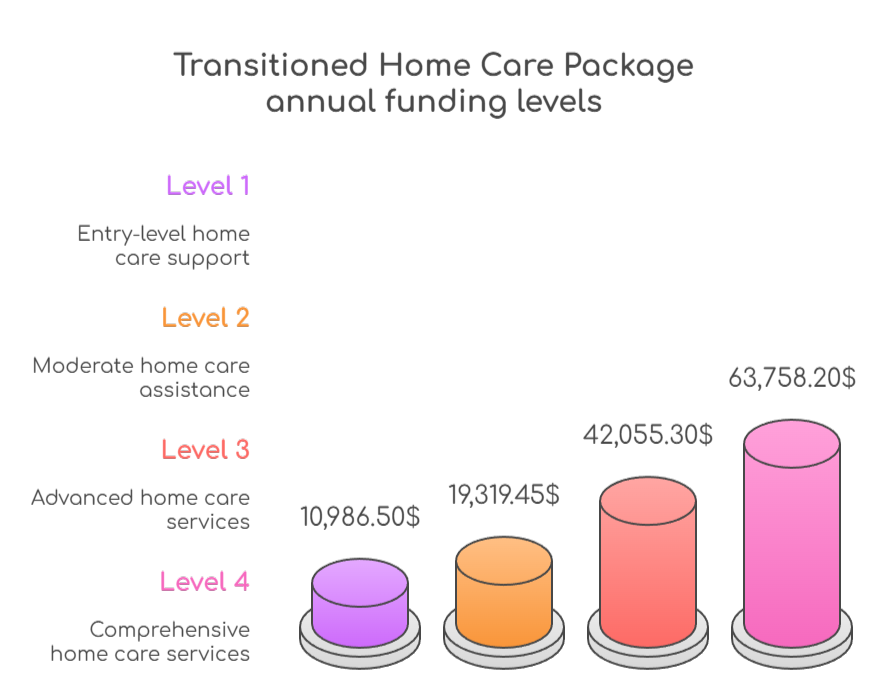
Transitioned levels are separate from the Support at Home 8 levels. However, they are managed under the same program and rules.
What different Support at Home levels cover
Support at Home funding is flexible. It can be used for a wide range of services chosen to meet your individual needs.
Common services under lower classifications (1–3)
Lower Support at Home levels usually focus on lighter, regular help, such as:
- Domestic aid, such as cleaning, laundry, and basic home tasks.
- Help with shopping and meal preparation.
- Social support and companionship.
- Transport to medical or social appointments.
- Basic personal care, such as supervision or light hands-on help.
Common services under mid-range classifications (4–6)
Mid-range Support at Home package levels often include:
- Regular personal care, including showering, dressing, and toileting.
- More frequent domestic aid and household support.
- Some clinical care, such as nursing and allied health visits.
- Care management and coordination of your services and appointments.
- Basic equipment and minor home modifications.
Common services under higher classifications (7–8)
Higher Support at Home levels support more complex and intensive needs, such as:
- Daily visits from care workers or nurses.
- Extensive personal care support, including hoist transfers and complex routines.
- Regular nursing and other clinical services.
- Complex care coordination to link services, carers, and health providers.
- Support with continence, behaviour changes, and specialised dementia care.
Short-term support on top of your level
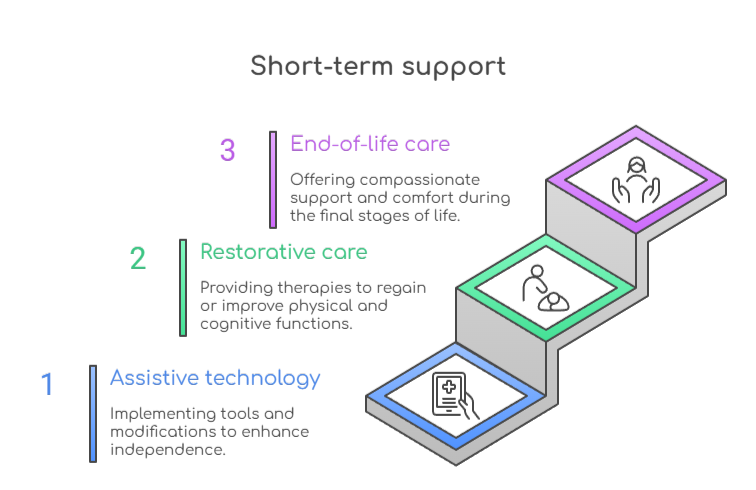
Sometimes you need more help for a limited time. Short-term funding pathways sit on top of your usual Support at Home package level.
These pathways are designed for specific situations, such as recovery, major home changes, or end-of-life care.
Assistive technology and home modifications (AT-HM)
Assistive technology includes equipment that helps you stay independent, such as shower chairs or mobility aids. Home modifications are changes to your home, such as rails, ramps, or bathroom alterations.
Typical funding bands include:
- Low: around $500.
- Medium: around $2,000.
- High: around $15,000 or more.
AT-HM support is usually approved for up to 12 months. It's separate from your ordinary Support at Home levels or transitioned packages.
Restorative care pathway
Restorative care is short-term, goal-focused support after an illness, injury, or a major setback. The aim is to help you regain function and confidence.
The restorative care pathway usually provides around $6,000 for up to 16 weeks. It can include allied health services, personal care, and exercise support.
End-of-life pathway
The end-of-life pathway supports people who want palliative care at home. It offers more intense personal and clinical support during the final stages of life.
This pathway may provide around $25,000 over 12 weeks. It can include nursing, personal care, equipment, and support for family and carers.
FAQ
Is Support at Home the same as Home Care Packages?
No. Support at Home replaced Home Care Packages, but it keeps the same goal of helping you stay at home. It uses more levels, quarterly budgets, and clearer short-term programs.
What are the Support at Home levels?
They are the eight ongoing funding classifications under Support at Home. They range from classification 1 for lower needs to classification 8 for higher, complex needs.
What is a transitioned Home Care Package level?
If you already had a Home Care Package before Support at Home started, you move to a transitioned level. This protects your old package funding so you are not worse off.
Does a higher Support at Home level always mean more hours?
Usually, a higher level means more funding and potentially more hours. However, the exact hours depend on the mix of services, hourly rates, and any short-term funding.
Do I pay anything towards my Support at Home package?
You may be asked to pay participant contributions, depending on your financial situation. My Aged Care can explain these rules in more detail.
Next steps with Sensible Care
Support at Home levels are central to the new in-home aged care system. They shape how much funding you receive, what services you can access, and how your support grows as your needs change.
When you understand your Support at Home funding level, you can make clearer choices about services, short-term programs, and future reviews. You do not need to manage this alone.
What to do next:
- Check your current status - Confirm whether you hold a transitioned Home Care Package level, or one of the 8 ongoing Support at Home classifications.
- Talk to Sensible Care - Ask us to explain your Support at Home level, your quarterly budget, and your care plan options in plain language.
- Review your needs - Think about whether your current Support at Home package level still matches your daily life, health, and goals.
- Arrange an assessment or review - If your needs have changed, contact My Aged Care to request a new Support at Home assessment.
- Learn more online - Visit the My Aged Care website for official information about Support at Home.
Sensible Care can help you understand your options, navigate the Support at Home system, and design a care plan that fits your life, your goals, and your budget.
If you have any questions about Support at Home levels, feel free to ask us.
These amounts are set by the Australian Government and change at least twice a year. Check health.gov.au for the current amounts before you make a decision.

Take the Next Step in Care
Download our Info Kit or speak to one of our friendly team members today.


Explore More Helpful Reads
More stories, guides, and updates to support you and your family.




Need Help Getting Started?
Reach out on your terms, pick a time that suits you and let’s talk about how we can help.


.webp)