.svg)

Support at Home grandfathering: What you need to know
Support at Home grandfathering explained: learn how existing care recipients are protected, and what changes and what stays the same under the new system.
Author: Sensible Care

If you were receiving a Home Care Package, approved for one, or on the waiting list by 12 September 2024, you may be grandfathered. Under Support at Home, this means you should be "no worse off." Your contributions should stay the same or decrease, even if you are reassessed later. Your unspent funds carry over, and you keep the lower lifetime contribution cap if you are grandfathered.
Australia's aged care system underwent major reform on 1 November 2025. Home Care Packages were merged with the Support at Home program.
During the transition, existing Home Care Package recipients receive special protections through "grandfathering" arrangements.
This type of protection lets you carry over the same costs from the old program into Support at Home.
If you were receiving home care, approved for it, or waiting for a package, your costs and funding may be protected.
This guide explains who qualifies for Support at Home grandfathering, what it covers, and how it applies if your needs change.
What does Support at Home grandfathering mean?
Support at Home grandfathering protects Home Care Package recipients from higher costs after the aged care changes.
Grandfathering means you keep key financial rules from the old system. The goal is to ensure that you are no worse off because of the change.
If you are grandfathered, your contributions should stay the same, or they may be reduced. More importantly, this protection continues even if your care needs increase and you are reassessed.
You can also keep the lower lifetime contribution cap. Any unspent Home Care Package funds carry over into Support at Home.
Who is grandfathered?
You're considered grandfathered under the Support at Home program if, on or before 12 September 2024, you were:
- Actively receiving a Home Care Package (HCP)
- On the National Priority System (the waiting list for home care)
- Assessed and approved as eligible for a Home Care Package
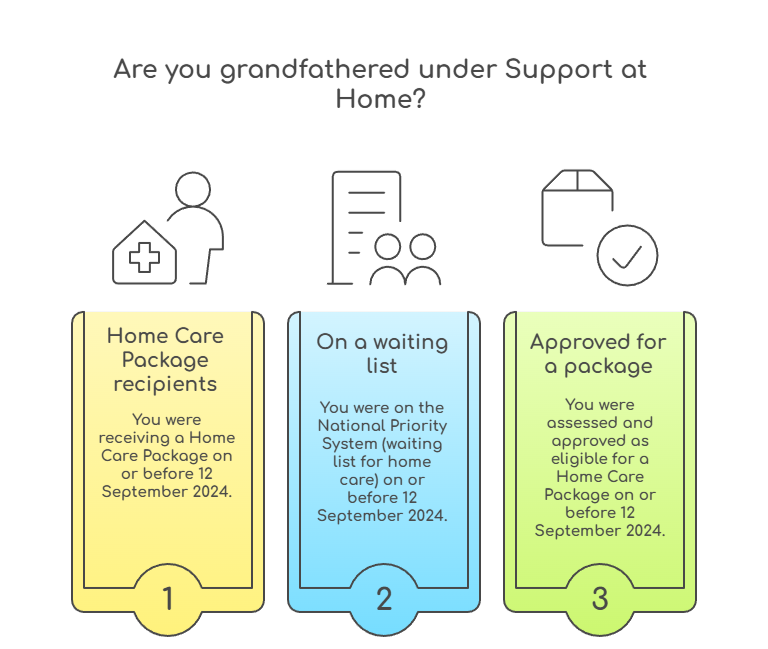
According to the Australian Government's Department of Health, people who transitioned to Support at Home on 1 November 2025 follow the "no worse off" rule.
The aim is to keep their contributions the same or lower than under the previous system.
So, if you were assessed or approved after 12 September 2024, you're subject to the new Support at Home contribution rules without grandfathering protections.
The "no worse off" principle: What it means for your contributions
The core promise of grandfathering is straightforward: you won't pay more under Support at Home than you would have under Home Care Packages.
If you are grandfathered, your contribution rates are protected under what the government calls the "no worse off principle."
These rates are significantly lower than the standard Support at Home rates that apply to new participants.
Here's what this means for full pensioners, part-pensioners, and self-funded retirees:
Full pensioners
If you were a full pensioner, you did not pay income-tested care fees under Home Care Packages. In that case, you should not pay contributions under Support at Home either.
This stays the same even if your needs change and you are reassessed. Your clinical care and support services continue to be funded by the government.
Part-pensioners and Commonwealth Seniors Health Card holders
If you were paying income-tested care fees under Home Care Packages, your grandfathered rates are capped substantially below standard rates:
- Clinical care: 0% contribution
- Independence supports: 0% to 25% contribution (dependent on your income assessment)
- Everyday living: 0% to 25% contribution (dependent on your income assessment)
The exact percentage you pay within the 0-25% range is determined by Services Australia, based on your income.
More importantly, you will never pay more than 25% for any service category, regardless of how high your income is.
Self-funded retirees
If you were a self-funded retiree paying income-tested care fees under Home Care Packages, your grandfathered rates are:
- Clinical care: 0% contribution
- Independence supports: 25% contribution
- Everyday living: 25% contribution
Lifetime contribution cap
If you are grandfathered, you also keep the lower lifetime contribution cap of $88,934.57 (as at 20 September 2025).
This cap is indexed on 20 March and 20 September each year.
In comparison, participants who entered Support at Home after 12 September 2024 have a lifetime cap of $140,652.80 (as at 20 September 2026). This is approximately 58% higher than the grandfathered cap.
Once you reach your lifetime cap, you no longer pay contributions for any Support at Home services. Your funding level or financial circumstances do not matter in this situation.
How grandfathering works with reassessments
One common concern is what happens if your care needs increase and you need reassessment. Here's how it works:
Before reassessment
When you first transitioned to Support at Home, you weren't automatically reassessed.
Your funding initially mirrored your existing Home Care Package level, which was converted to a quarterly budget format. You also kept receiving services under your current care plan.
Requesting reassessment
Reassessment occurs when you (or your provider) identify that your current funding no longer meets your needs.
For example, if you need additional equipment, more hours of personal care, or new therapies.
During reassessment, an approved assessor conducts an in-home evaluation. Then they recommend appropriate services.
Based on this assessment, you may be moved to one of the program's eight funding levels. Support at Home levels range from lower-intensity support to high-intensity care needs.
After reassessment: your protections continue
Your grandfathered status remains protected even after reassessment. This means:
- Full pensioners continue to pay nothing regardless of increased funding levels
- Part-pensioners and self-funded retirees maintain their legacy contribution rates (or pay less)
- The $88,934.57 lifetime cap stays in place
- Any unspent funds from your Home Care Package carry over to Support at Home
This means you can move to a higher funding level if your needs increase. Your contribution rate should not rise just because your funding level changes.
One exception: dementia and cognition supplements
The dementia and cognition supplement may stop after reassessment. This can happen when a grandfathered client moves into Support at Home funding levels. Instead, that funding is built into the Support at Home classification system.
Understanding Your Funding and Budget
Support at Home uses a different funding structure than Home Care Packages. The goal is to make budgets easier to track and services more consistent.
Here are the main changes to understand:
- Quarterly budgets
- Unspent funds
- Service eligibility
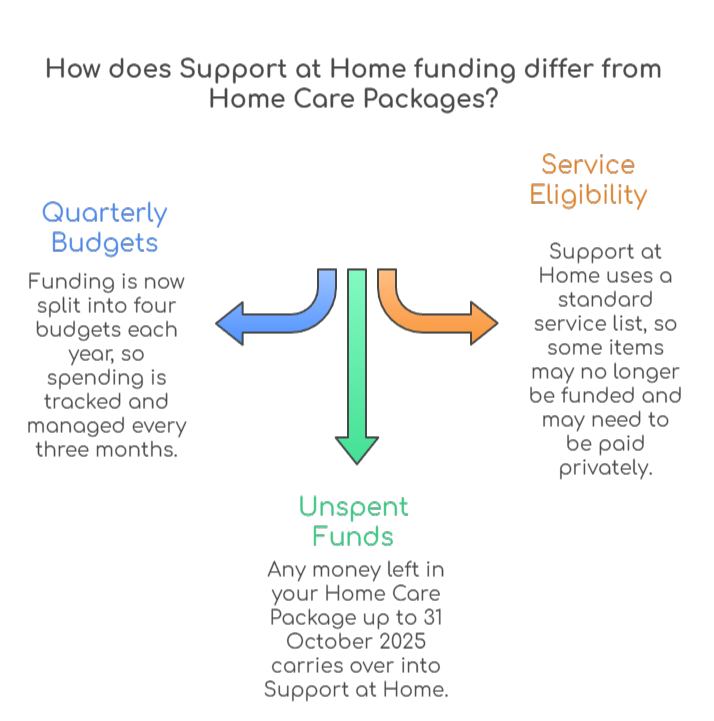
Instead of annual package amounts, funding is divided into quarters. This allows for more flexible management throughout the year.
Any money left in your Home Care Package up to 31 October 2025 carries over to Support at Home. This is often called unspent funds. Your provider should confirm your carried-over balance in writing.
Support at Home has a standard service list. Most common supports are still included, such as:
- Personal care, including showering, dressing, and toileting.
- Nursing care, including wound care and medication support.
- Allied health, including physiotherapy and occupational therapy.
- Domestic help, like cleaning, laundry, and meal preparation.
- Transport to appointments and essential errands.
Items like meal ingredients, pet care, and some social activities remain excluded and must be self-funded.
Your provider must update your service agreement under Support at Home. This document sets out what services you will receive and how your budget will be used.
It should clearly list what is funded and what is not. If a service you used before is no longer eligible, your provider should explain the options and adjust your care plan with you.
If you are not grandfathered
If you are not grandfathered, you may need to pay a contribution for some Support at Home services. A contribution is the amount you pay towards the cost of your care.
What you pay depends on two things. It depends on the service type you use and your financial situation.
Support at Home splits services into three groups:
- Clinical care is health care, like nursing, wound care, and medication support.
- Independence supports help you stay safe and manage daily tasks, like personal care and allied health.
- Everyday living covers home and lifestyle help, like cleaning, laundry, and meal preparation.
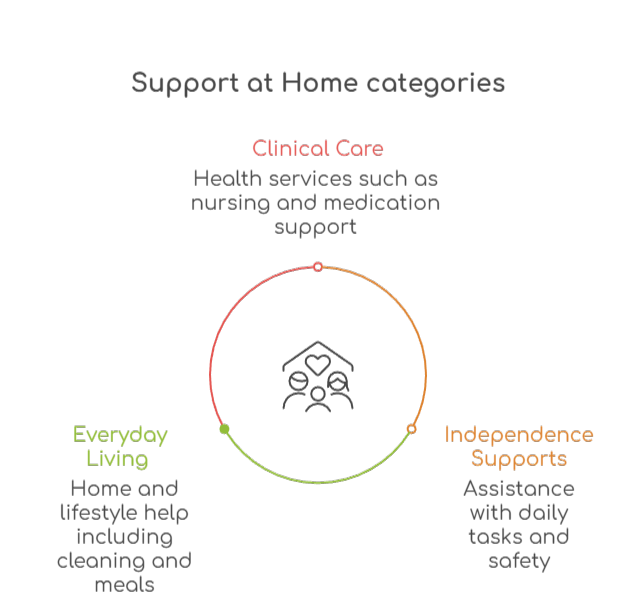
You will not pay a contribution for clinical care. The government funds clinical care in full.
You may pay a contribution for independence supports and everyday living. The percentage you pay depends on your pension or financial status.
Typical contribution rates
These examples show how rates can differ. Your exact rate is confirmed through your assessment and Services Australia.
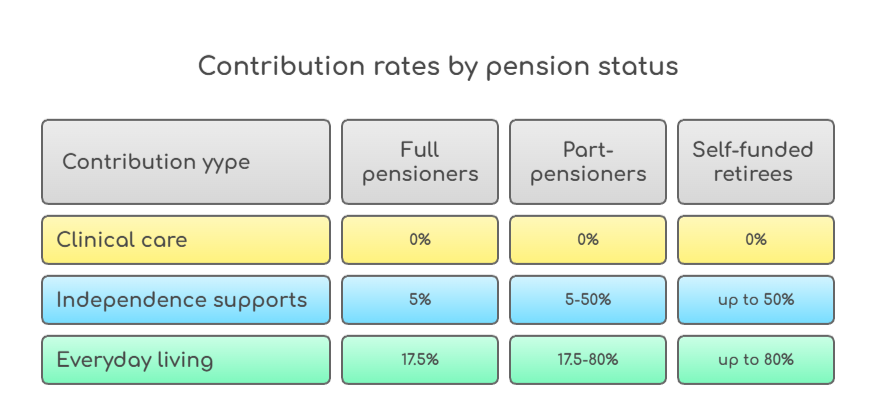
Full pensioners
- Clinical care: 0% contribution
- Independence supports: 5% contribution
- Everyday living: 17.5% contribution
Part-pensioners
- Clinical care: 0% contribution
- Independence supports: 5-50% contribution
- Everyday living: 17.5-80% contribution
Self-funded retirees
- Clinical care: 0% contribution
- Independence supports: up to 50% contribution
- Everyday living: up to 80% contribution
Grandfathered vs not grandfathered at a glance
| Topic | If you are grandfathered | If you are not grandfathered |
|---|---|---|
| Key protection | "No worse off" applies | New contribution settings apply |
| What you pay | Same as before, or less | Set as a percentage for some services |
| Lifetime cap | Lower cap | Higher cap |
| If needs increase | Protections are intended to stay | Contributions may rise with the services used |
The difference can be substantial. For example, a self-funded retiree who was grandfathered might pay a modest income-tested fee capped at the lower limit.
Meanwhile, someone entering the system after 12 September 2024 could face significantly higher contributions based on both income and assets.
What to discuss with your provider
The right conversation now can prevent billing surprises later. Bring any letters you have and ask for clear answers in writing.
- Ask them to confirm your grandfathered status and what it means for your costs.
- Ask for a plain summary of what services are funded, and what you might pay yourself.
- Ask how unspent funds are moved across and how they are tracked each quarter.
- Ask how reassessments work, and what changes if your needs increase.
Special circumstances
Some situations can affect how grandfathering works. These are three common examples to keep in mind.
Leaving and re-entering care
Grandfathering mainly relates to home care. Similar protections can apply in residential aged care.
If you entered residential care before 1 November 2025 and leave temporarily, you may keep your status. This usually applies if you return within 28 days, such as after a hospital stay.
National priority system participants
Some people were on the National Priority System (the waiting list) but had not yet received a package. In some cases, funding may still be provided at an equivalent Home Care Package level when it is allocated.
If this applies to you, ask My Aged Care or your provider to confirm what level you will receive. Keep any letters that show when you were added to the waiting list.
Hardship provisions
Hardship support may be available if the costs of care become difficult to manage. This support is not limited to grandfathered clients.
If you are struggling financially, speak with Services Australia about a hardship application. Your provider can also help you understand what information you may need to provide.
How Sensible Care can help
Sensible Care can help you understand what grandfathering means for your care and costs. We can explain your letters, your budget, and what you should expect to pay.
We can also review your service agreement and check that your plan matches the Support at Home service list. If something you used before is no longer funded, we can help you find the best alternative.
If your needs change, we can support you through a reassessment. We can help you prepare, document changes, and plan services that fit your new funding level.
Reach out to us if you have any questions.
These amounts are set by the Australian Government and change at least twice a year. Check health.gov.au for the current amounts before you make a decision.

Take the Next Step in Care
Download our Info Kit or speak to one of our friendly team members today.


Explore More Helpful Reads
More stories, guides, and updates to support you and your family.




Need Help Getting Started?
Reach out on your terms, pick a time that suits you and let’s talk about how we can help.


.webp)