.svg)

Support at Home assistive technology and the AT-HM scheme
Support at Home assistive technology funds mobility aids, home modifications, and safety devices for older Australians. Learn tiers and how to apply.
Author: Sensible Care
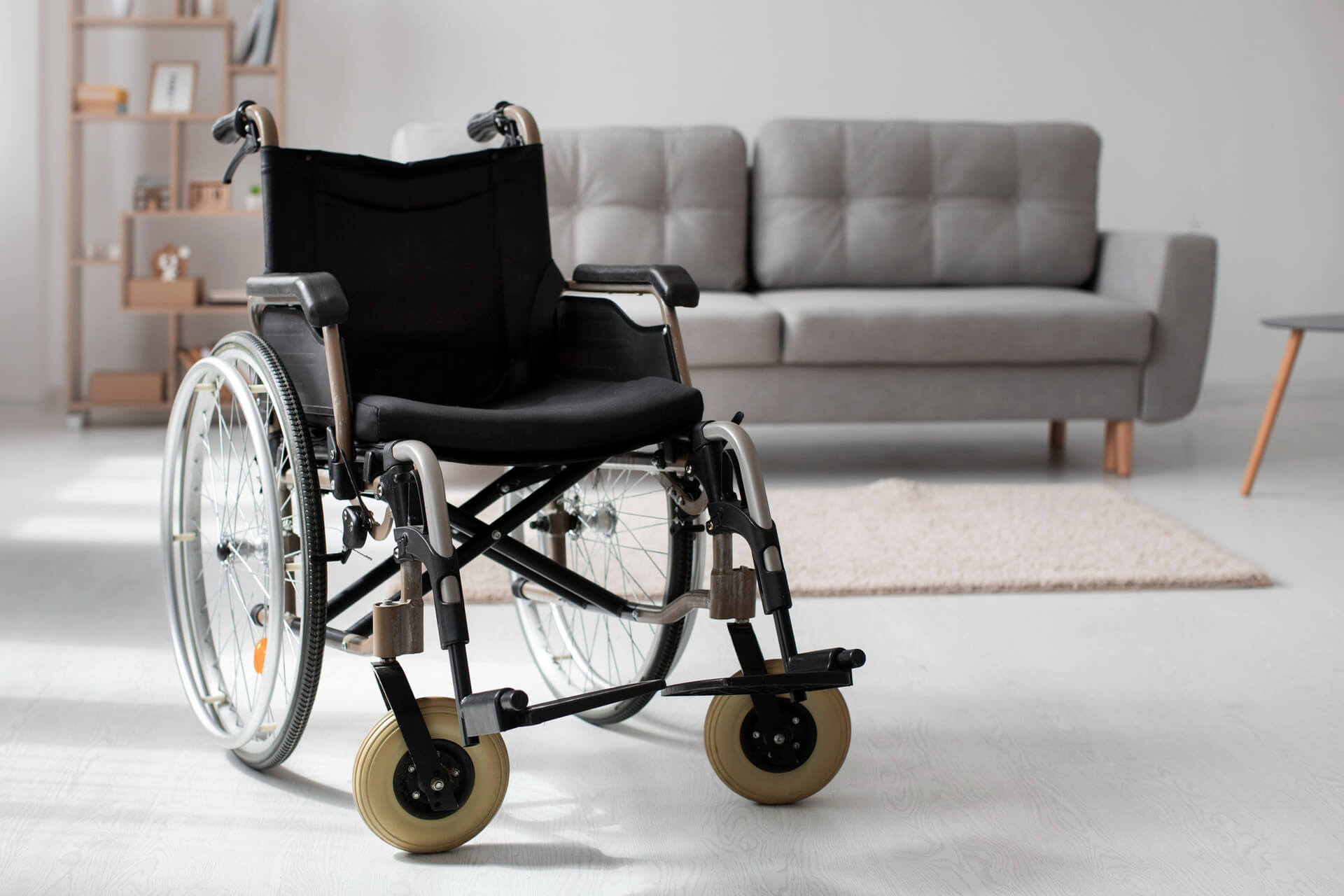
The Support at Home AT-HM scheme helps older Australians access assistive technology and home modifications. This includes mobility aids, grab rails, shower chairs, ramps, and personal alarms. Funding is separate from your regular Support at Home budget. There are three tiers based on assessed need: up to $500, $2,000, or $15,000. To access it, start with an aged care assessment through My Aged Care. You'll then work with a provider and a prescriber, usually an OT or physiotherapist, to choose the right equipment. Funding lasts 12 months in most cases. Some people pay part of the cost, depending on their income and assets.
The Support at Home program funds assistive technology and home modifications. This is done through a dedicated scheme called the AT-HM (Assistive Technology and Home Modifications) scheme.
It funds items like mobility aids, grab rails, and ramps to help you live safely at home.
This funding sits outside your regular Support at Home budget. In other words, there's no need to set aside money from your quarterly care allocation.
If you are an older Australian aged 65 or over, you are eligible. This also applies if you are Aboriginal or Torres Strait Islander and aged 50 or over. Eligibility is confirmed through a formal aged care assessment.
This guide explains how the scheme works, what you can get, and how to apply.
What is the Support at Home AT-HM scheme?
The AT-HM scheme is a government-funded program for Support at Home participants. It stands for assistive technology and home modifications. It provides equipment and items to help you live safely at home for longer.
The Support at Home program launched on 1 November 2025. It replaced the Home Care Packages (HCP) Program and the Short-Term Restorative Care (STRC) Program.
AT-HM is a separate scheme within Support at Home, alongside other pathways such as Restorative Care and End-of-Life support. You can access AT-HM alongside your ongoing services.
Funding is allocated through the AT-HM Priority System, separate from the main Support at Home Priority System. This means you can receive AT-HM funding before your ongoing services are confirmed.
What does assistive technology mean in this context?
Assistive technology (AT) refers to items, equipment, or products that help you do daily tasks more easily. These items should also help you carry out activities you can no longer do on your own.
Home modifications (HM) are physical changes to your home that improve safety and accessibility.
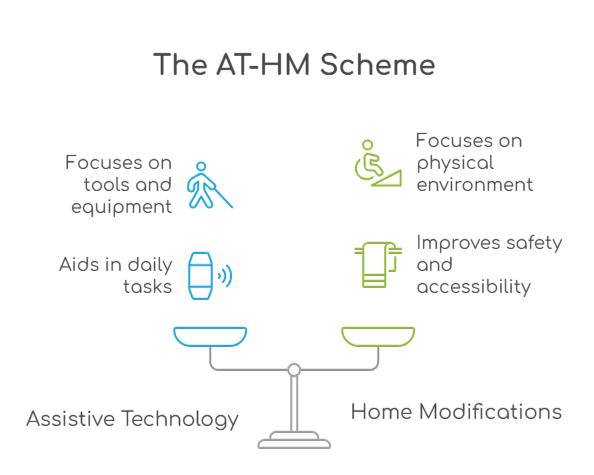
The AT-HM scheme covers both categories, each with its own separate funding allocation and tier.
Assistive technology examples
Common AT items covered by the scheme include:
- Mobility aids like walking sticks, frames, and wheelchairs that can help you move safely
- Toileting supports like bedpans and commodes to reduce fall risk
- Bathing aids like shower chairs and bath boards, so you can bathe by yourself
- Communication devices for people who struggle to speak or write
- Adaptive eating equipment, like modified cutlery and cutting boards, to help you eat on your own
- Personal safety items like alarms, non-slip footwear, and body protection to prevent injury
The scheme sorts AT into three risk levels: low risk, under advice, and prescribed.
Low-risk items are simple, low-cost products that don't need a prescription or customisation. This may include non-slip bathmats and assistive cutlery.
Under advice items are generally low risk but benefit from professional input. For instance, commode chairs without castors or electric recliner chairs.
Prescribed items are higher-cost or customisable equipment. They need a prescription from a qualified health professional. Examples include rollators, powered wheelchairs, hospital beds, and pressure mattresses.
Home modifications examples
Home modifications are structural or practical changes to your property. This includes:
- Grab rails in your shower or bathroom to reduce fall risk during bathing and toileting
- Internal and external handrails to support safe movement on stairs and along hallways
- Lever tap sets and lever door handles to make fixtures easier to use with limited hand strength
- Ramps and stair lifts to provide access for people with mobility impairments
- Non-slip materials and mats for floors and stairs to lower the risk of slips and falls
What are the Support at Home AT-HM funding tiers?
The AT-HM scheme provides three funding tiers based on your assessed needs.
The high tier works differently for each category.
For assistive technology, $15,000 is not a hard cap. You can access more if your needs require it and evidence is provided.
For home modifications, $15,000 is a lifetime cap. Each allocation must be spent within its funding period, and any unspent amount from that allocation lapses.
If you have not used your full $15,000 lifetime cap, you can be reassessed for another allocation. The 12‑month funding period can also be extended to 24 months for complex modifications.
Funding is upfront and separate from your other Support at Home services. You can start using it once your funding is active and your provider has set up your services, even if your ongoing funding is still pending.
AT-HM items count as independence services. You may need to contribute to the cost based on an income and assets assessment. Clinical supports like prescriptions and assessments are free.
If your tier isn't enough, your provider can request a Support Plan Review with evidence to increase it. Unused funds from a particular allocation don't roll over into the next funding period. If your needs change later, your provider can request a new review.
Extended access periods for progressive conditions
The standard access period is 12 months for both AT and HM funding.
If you have a specific progressive condition, your AT funding period is automatically set to 24 months. The list of qualifying conditions is in the AT-HM scheme guidelines. You can apply for an additional 24-month extension, bringing the total to 48 months.
For home modifications, the rules are different. Some complex modifications take longer than 12 months. If yours can't be finished in time, your provider can apply for an extra 12 months, bringing the total to 24.
You'll need to show that work has already started, with evidence submitted within the first 12 months. This extension does not increase the $15,000 lifetime cap.
How do I access the Support at Home AT-HM scheme?
You access the AT-HM scheme through the aged care assessment process, not by applying to the scheme directly. Here are the steps.
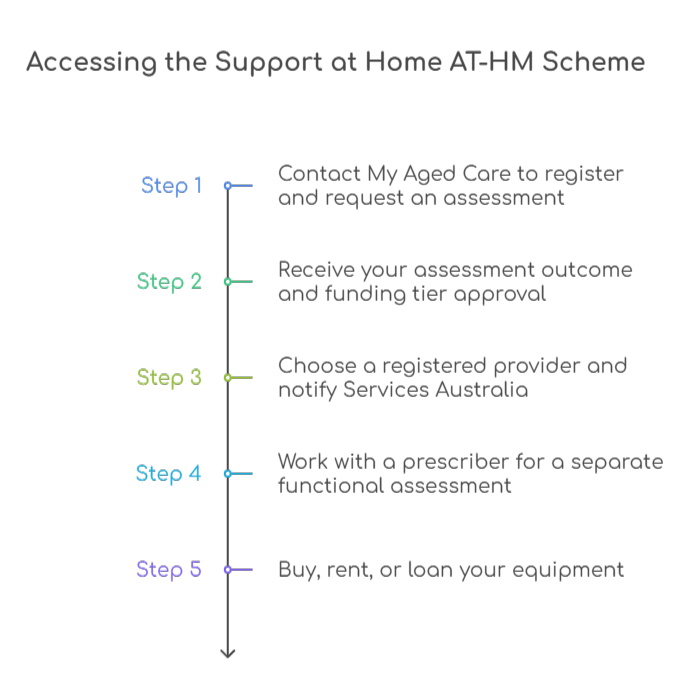
Step 1: Contact My Aged Care
Call My Aged Care on 1800 200 422 or visit myagedcare.gov.au to register and request an assessment. An assessor will visit you at home to understand your functional needs and living situation.
Step 2: Receive your assessment outcome
If the assessor finds a need for assistive technology or home modifications, they will approve you for the right funding tier. Your approval will be recorded in your Notice of Decision and support plan. The assessor may approve AT funding, HM funding, or both.
Step 3: Choose a registered provider
Once your funding is allocated, you need to find a registered provider. Your provider will notify Services Australia so your access can begin. If you used to receive Home Care Packages, you must use any unspent HCP funds before accessing AT-HM scheme funding.
Step 4: Work with a prescriber
Once your tier is set, a qualified health professional carries out a separate functional assessment. This is usually done in your home. It's often an allied health professional, like:
- An occupational therapist
- A physiotherapist
- A speech pathologist
The prescriber recommends specific equipment or modifications based on:
- Your goals
- Your home environment
- The risk level
They also provide the clinical justification required for Prescribed items on the AT-HM List.
Step 5: Buy, rent, or loan your equipment
You are not required to purchase AT outright. You can buy, rent, or loan equipment through the scheme. The AT-HM scheme applies a loan-before-buy principle where appropriate.
Your prescriber can check whether the item you need is available through a state or territory AT Loans scheme before purchasing. Note that the AT Loans scheme is still being developed through a staged implementation.
What does the Support at Home AT-HM list include?
The AT-HM List is the official catalogue of products, equipment, and home modifications eligible for funding. It's published by the Department of Health, Disability and Ageing and updated as the scheme evolves.
The list has two sections: assistive technology items and home modification types. Items are matched to funding tiers based on cost and complexity. Your prescriber uses the list to confirm which items fall within your approved tier.
The AT-HM List is publicly available at health.gov.au. Your provider and allied health team will help you work out which items apply to you.
How does Support at Home AT funding compare to NDIS assistive technology funding?
Support at Home AT-HM and NDIS AT funding are separate programs for different groups, with different rules.
The NDIS funds disability supports, not health care costs. If you have a permanent disability and apply before age 65, NDIS is the relevant program. If you are 65 or over (or 50+ as an Aboriginal or Torres Strait Islander person) and not already on the NDIS, Support at Home is the primary pathway.
People already on the NDIS when they turn 65 can choose to remain on the NDIS or transition to aged care, but not both. Those who stay on the NDIS keep their existing supports, including assistive technology. Those who move to aged care access AT through the Support at Home AT-HM scheme instead.
What are the main barriers to adopting assistive technology — and how to address them?
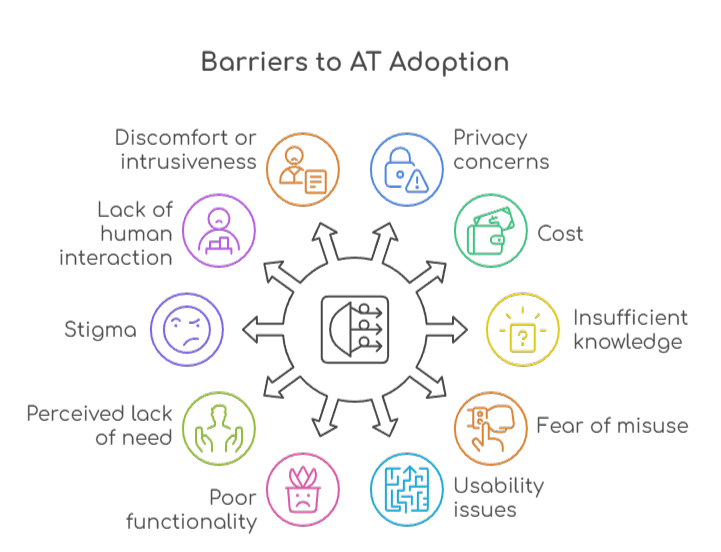
A 2025 systematic review in JMIR Aging identified ten common barriers to AT adoption in older adults.
The ten barriers are:
- Privacy concerns
- Cost
- Insufficient knowledge
- Fear of misuse
- Usability issues
- Poor functionality
- Perceived lack of need
- Stigma
- Lack of human interaction
- Discomfort or intrusiveness
Cost concerns
The AT-HM scheme removes much of the cost barrier by funding equipment separately from your ongoing care budget. A loan-before-buy principle further reduces upfront outlay.
Insufficient knowledge
Your occupational therapist or physiotherapist will guide you through the AT-HM List. Then, they will match options to your specific needs. Many older Australians and their families simply do not know what AT is available or how to access it.
Usability and functionality
Low-risk and under-advice AT items are chosen specifically for ease of use. Your prescriber will also look at your digital confidence and physical capacity.
Perceived lack of need
Getting low-tier items early prevents incidents before they occur. This may include non-slip matting or grab rails. Some people wait until a fall or hospital admission before seeking AT.
Privacy concerns
The AT-HM scheme does not require you to use connected or sensor-based technology. You choose what is appropriate for your situation with guidance from your assessor.
Does assistive technology actually help older Australians stay at home?
The Royal Commission into Aged Care Quality and Safety (2021) looked at how AT and home modifications affect older Australians. It found they support independence and help people stay at home for longer.
An Australian mixed-methods study published in JMIR Aging (2025) surveyed 226 in-home aged care staff. They rated 56% of common direct care tasks as likely to be digitally enabled. Staff also discussed how technology could reduce physical demands on both clients and care workers.
The same study reported that staff saw clear administrative time savings from technology. This, in turn, freed care workers to spend more time with clients.
What about wearable technology for fall prevention?
Wearables are increasingly seen as useful clinical tools for older adults.
A 2025 consensus study surveyed 17 hospital-based health professionals. They agreed that wearables offer both short and long-term benefits. These include identifying fall risk, assessing mobility, and measuring how well treatments work.
The experts identified practical concerns around implementation. This included cost and considerations for device fit and data sharing with GPs.
A separate 2024 study ran a wearables trial in a remote NSW community. The 11 older Indigenous Australians involved showed strong acceptance.
This held true even in challenging conditions with temperatures above 36°C and patchy internet. Participants reported high levels of comfort, safety, and convenience while using them.
Frequently asked questions about support at home assistive technology
Can I access AT-HM funding if I am still waiting for my ongoing Support at Home services?
AT-HM funding is allocated through a separate priority system. So, it can be allocated before your ongoing Support at Home services are confirmed. Your provider notifies Services Australia once you have chosen them, and your AT-HM access begins from that point.
What happens if my AT-HM funding tier is not enough for my needs?
Your provider can request a Support Plan Review and submit evidence to increase your funding tier. For AT, amounts above $15,000 can be approved with the right evidence. For home modifications, the high tier is capped at $15,000 per lifetime. If complex work can't be finished within 12 months, your provider can apply for a 12-month extension (24 months total). You'll need evidence that the work has started.
Do I have to buy my assistive technology outright?
No. You can buy, rent, or borrow AT through the scheme. The scheme follows a loan-before-buy approach where possible. Your prescriber will check if it's available through your state or territory AT Loans scheme first.
Who pays for repairs and maintenance of AT equipment?
Repairs and maintenance costs for AT purchased through the AT-HM scheme are funded from your AT-HM allocation. This applies to equipment you have purchased through the scheme, not rented or loaned items.
Does the AT-HM scheme cover smart home or digital monitoring devices?
Some are covered, but not all. The item must appear on the AT-HM List and match your assessed needs. Your occupational therapist or physiotherapist can advise on what's eligible for your situation.
Getting started with AT-HM with Sensible Care
The AT-HM scheme makes it easier for older Australians to stay safe and independent at home. Funding is separate from your care budget, and there's a tier to suit most needs.
The hardest part is usually knowing where to start.
Sensible Care is a registered Support at Home provider. We support older Australians across the country to get the help they need.
Our team helps you make the most of your AT-HM funding. We coordinate with your OT or physiotherapist, help you choose the right equipment, and arrange any home modifications you need.
Contact us if you have any questions.

Take the Next Step in Care
Download our Info Kit or speak to one of our friendly team members today.


Explore More Helpful Reads
More stories, guides, and updates to support you and your family.




Need Help Getting Started?
Reach out on your terms, pick a time that suits you and let’s talk about how we can help.


.webp)