.svg)

Support at Home pricing: A clear guide to fees, contributions, and price lists in Australia
Learn how Support at Home pricing works, what you may pay after means testing, and what to check in a provider's price list before you choose.
Author: Sensible Care

There are two things you need to think about when sorting out Support at Home pricing. The first is the service price, which is set by your provider. The second is the client contribution, which you may or may not pay after a government means test. Providers set their own prices, while the government sets contribution percentages and caps. These numbers depend on the outcome of your assessment and the type of service you need.
Support at Home pricing can feel confusing at first. You might see different hourly rates, new contribution rules, and unfamiliar terms like "means testing," "no worse off," and "lifetime caps."
This guide explains Support at Home fees in plain English. We'll go through how a Support at Home price list typically works, what you may contribute, and what the government covers.
From 1 November 2025, these rules apply to people on the new Support at Home fee arrangements. If you previously received a Home Care Package, "no worse off" protections can apply. That way, you pay the same or less than before.
If you want to know more, keep reading.
Key takeaways
- Support at Home pricing has two layers: provider-set service prices and government-set client contribution percentages (that may apply to some services).
- Clinical supports have a 0% client contribution rate when they are approved as part of your Support at Home services.
- Independence and everyday living services can attract co‑contributions, based on your means testing outcome and the official contribution schedule.
- Providers must publish common prices and keep them reasonable and transparent, and they must agree on pricing with you in writing.
- Travel time and care/package management must be built into unit prices, not added as separate administration or travel-only fees.
- Contribution caps and hardship support limit what you pay over time, to help keep Support at Home affordable if you need ongoing care.
How Support at Home fees work
Support at Home fees make more sense once you separate provider prices from government contribution rules.
Two layers of Support at Home pricing
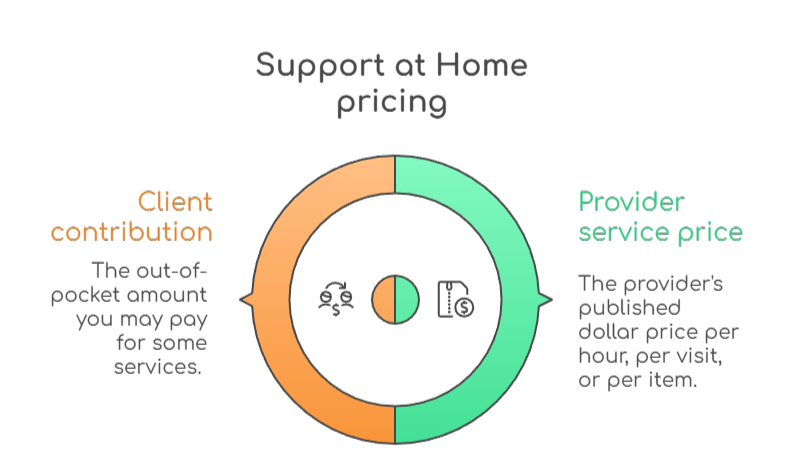
Layer 1: The provider's service price
This is the provider's published dollar price per hour, per visit, or per item. Providers set them themselves, but they must:
- Publish common prices
- Keep the prices reasonable
- Agree on the prices with you before delivering services
Layer 2: Your client contribution (if any)
This is the out‑of‑pocket amount you may pay for some services. It's calculated as a percentage of the service price, which may depend on:
- Your income and assets assessment
- Pension status
- The type of service you need
The three service types that influence fees
Support at Home groups services into three broad categories, and these categories drive the contribution rules.
These are the categories:
- Clinical supports—health and treatment services (like nursing and physiotherapy)
- Independence supports—services that support function, safety, and daily living skills (such as personal care and some assistive technology)
- Everyday living supports—services that support regular household tasks and home life (such as domestic assistance and gardening)
What transparent pricing should look like
Government guidance says Support at Home prices must be reasonable and transparent. Providers must publish and update common prices, and they must explain clearly what each unit includes.
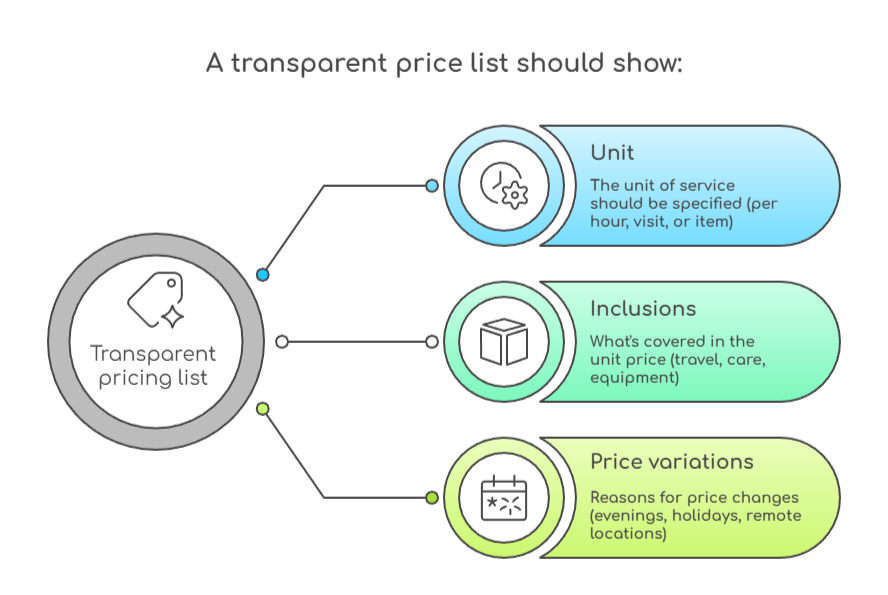
A transparent price list should show:
- The unit (per hour, per visit, or per item)
- What is included in that unit price (for example, travel time, care management activities, or equipment)
- When and why prices can vary, such as evenings, weekends, public holidays, or remote locations
Client contributions and means testing
Client contributions under Support at Home are calculated in percentages, not flat dollar fees.
They're based on a government assessment of your income and assets. Note that they only apply to some service categories.
What is means testing and how does it work?
Means testing does not decide whether you are approved for Support at Home. It affects the contribution percentage you may pay.
Here is what you need to know:
- You do not contribute to clinical supports that are approved as part of your Support at Home plan.
- You may contribute a moderate percentage for independence supports.
- You may contribute a higher percentage for everyday living supports.
Services Australia uses an income and assets assessment, similar to the Age Pension means test. This assessment is used to set your individual contribution rates.
Standard contribution rate ranges
The official Support at Home participant contributions schedule sets contribution percentages by service type and pathway. They differ for a full pensioner, a part pensioner, or a self‑funded retiree.
At a high level, the schedule shows:
| Service type | Typical contribution range | Notes |
|---|---|---|
| Clinical supports | 0% | No client contributions for approved clinical supports; the government pays the full service price. |
| Independence | 5% to 50% | The range depends on your means test outcome and pension status. |
| Everyday living | 17.5% to 80% | Higher co‑contribution ranges for some pathways. |
Note that these are percentages, not fixed dollar amounts. Your actual dollar contribution depends on the provider's service price for that unit.
"No worse off" arrangements
If you had a Home Care Package approved or in place before 12 September 2024, "no worse off" protections apply under Support at Home. It's also for those who were on the National Priority System or assessed as eligible for a package.
Under these protections:
- If you previously paid Home Care Package fees, you will pay the same or less under Support at Home.
- If you did not have to pay Home Care Package fees, you will not pay contributions under Support at Home.
- The Home Care Package lifetime cap of $88,935 (indexed) continues to apply as the cap on your Support at Home contributions.
The contribution schedule treats these protected participants as a separate pathway. They have different rates and a separate lifetime cap from new entrants.
A simple way to estimate contributions
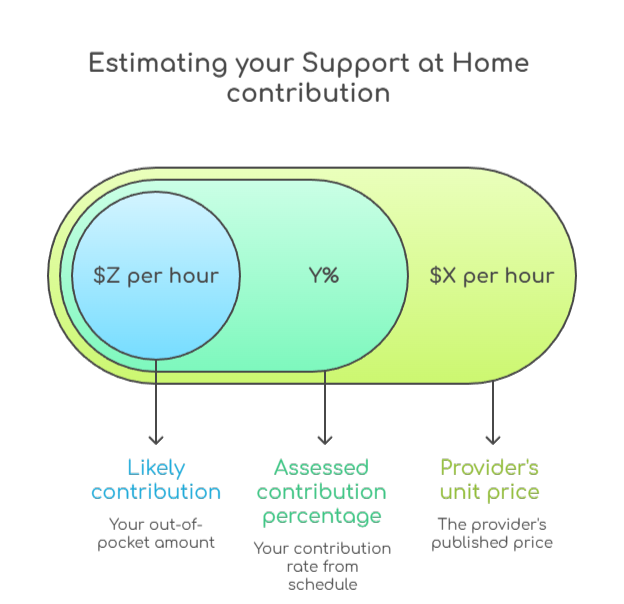
A quick way to estimate your likely contribution to a service uses three inputs:
- The service type (clinical, independence, or everyday living)
- The provider's unit price (for example, $X per hour)
- Your assessed contribution percentage from the Support at Home schedule
Let's say an everyday living service costs $100 per hour. Your contribution rate is 17.5%, in which case, your contribution would be $17.50 per hour. The government would pay the remaining $82.50.
You can use the Support at Home fee estimator provided through My Aged Care.
Service pricing and hourly rates
Service pricing is the provider's Support at Home price list. It's what you compare when you choose a provider.
What a useful Support at Home price list includes
A useful Support at Home price list should show the common prices most participants pay. Comparing across providers should be easy in this case.
Look for:
- Clear service names and units, such as "personal care – per hour" or "domestic assistance – per visit".
- A service category label (clinical, independence, and everyday living) so you can match each service to the correct contribution range.
- An explanation of what is included in each unit price, including travel time and any related care management where relevant.
- A short note on when prices vary, such as after‑hours, weekends, public holidays, or rural travel.
"All-in" unit pricing and why it matters
Government guidance for Support at Home requires that some costs must be included in the service price, not charged as separate add-ons. This includes travel and package/care management fees.
This "all‑in" approach:
- Reduces surprise administration or travel fees appearing on invoices.
- Makes it easier to compare one provider's price list against another because the unit rates already include typical travel and overheads.
A helpful provider will explain what's included in each unit price and how this aligns with the government's pricing rules.
Price caps and the transition period
During the early phase of Support at Home, providers continue to set their own prices. But they must be supported by government guidance and consumer protections.
The Australian Government has announced that price caps for Support at Home services are planned to apply from 1 July 2026. This new rule will further limit what providers can charge.
These caps are expected to sit alongside contribution rules and lifetime caps to improve affordability.
As price caps roll in, providers may update how they present their Support at Home pricing guides. That's why it's worth checking the "last updated" date on any price list.
Where to find Sensible Care's price list
If you are comparing providers and want to see Sensible Care's service price list, you can use our official pricing page:
Sensible Care Support at Home Pricing
Caps and hardship provisions
Caps and hardship provisions are built into the Support at Home system to protect people who need ongoing support. They're also in place to reduce financial stress over time.
Lifetime caps and other limits
Support at Home contributions are subject to a lifetime cap.
Lifetime caps limit what you can be asked to pay over your lifetime for eligible contributions. This applies to both home care and certain residential aged care arrangements.
For new Support at Home fee arrangements, the standard lifetime cap is $140,652.80 as of 20 September 2026.
This cap is indexed on 20 March and 20 September each year, so the exact figure changes over time. Check the Services Australia website for the current amount.
For "no worse off" arrangements, a separate lifetime cap is set at about $88,935 (indexed). It remains in place for eligible people transitioning from Home Care Packages.
These caps apply to your contributions, not to the provider's full service price. Government funding continues to support approved services after you reach the cap.
Hardship provisions
Financial hardship assistance is available if you genuinely cannot afford your aged care costs for reasons beyond your control. For instance, unexpected changes in your financial situation.
In practice, this means:
- You can apply for hardship assistance if you are struggling to meet your assessed contributions.
- Each application is assessed individually, taking into account your income, assets, and exceptional circumstances.
- If approved, your contribution amount may be reduced or waived for a period while your access to services continues.
If you are worried about affordability, raise the topic early. A reliable provider can help you understand whether caps or hardship provisions might apply in your situation. They can also point you to the correct government forms.
How to use a price list to choose a provider
Comparing providers works best when you compare a realistic service plan, not just a single hourly rate.
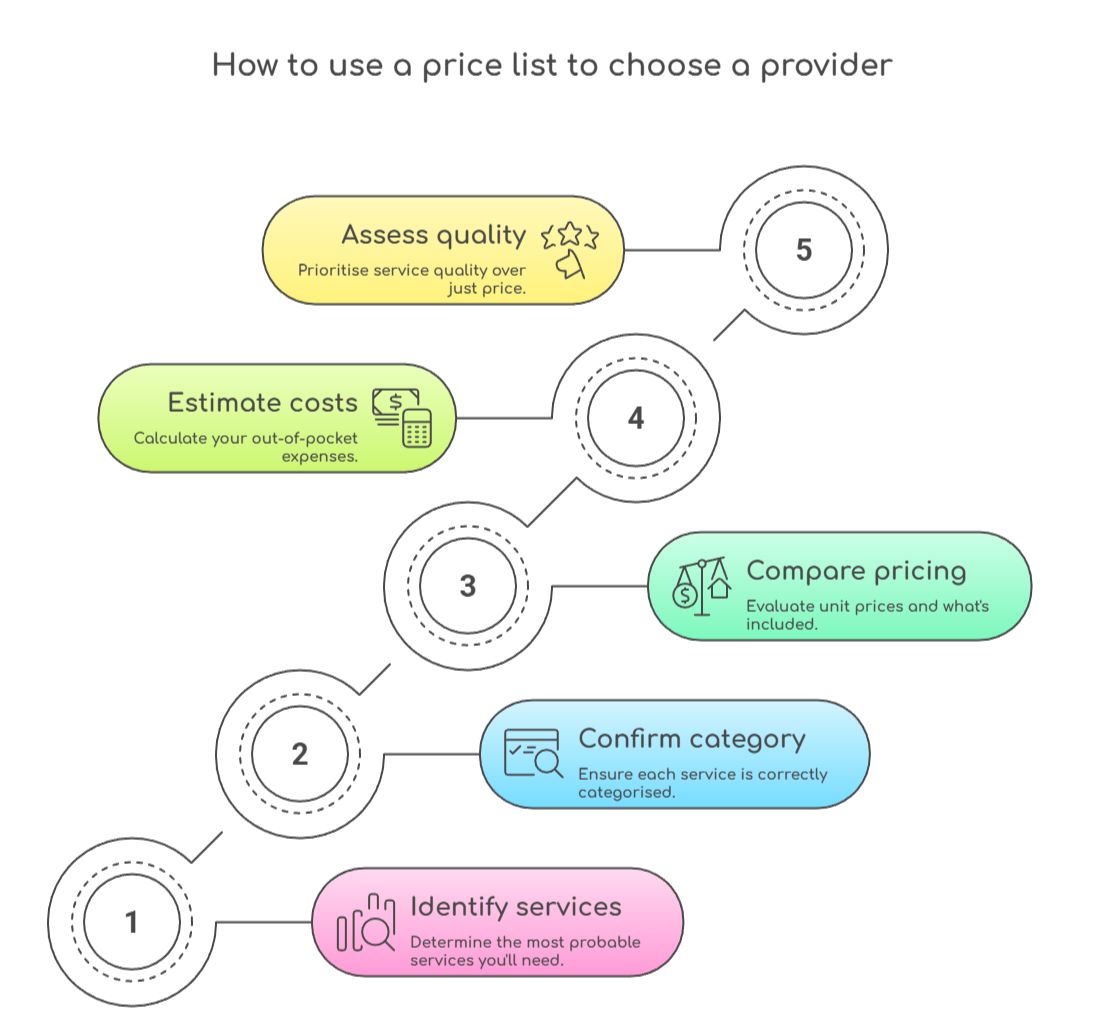
Use this checklist with any Support at Home price list or Support at Home price guide.
- Start with your most likely services.
- Confirm the service category for each item.
- Compare unit pricing and inclusions.
- Estimate out‑of‑pocket costs using your likely contribution rate.
- Compare service quality signals, not just price.
Start with your most likely services
List the services you expect to use most often. This can be personal care, domestic help, or nursing visits. Keep the list short and focused on your typical week.
Confirm the service category for each item
Ask the provider to confirm in writing whether each service is clinical, independence, or everyday living. This is important because it affects your contribution.
It also helps you match each service on the price list to the correct contribution range. You will be able to understand where you will and will not pay contributions.
Compare unit pricing and inclusions
For each key service, compare:
- The unit price
- What is included in that price
- When the price may change
Make sure you are comparing the same unit and inclusions across providers. That way, you won't be misled by a lower hourly rate that excludes travel or management time.
Estimate out‑of‑pocket costs using your likely contribution rate
Look at your assessed contribution percentage (or a likely range if you're still waiting for an assessment). Then apply it to each service's unit price to estimate your out‑of‑pocket cost.
If you don't know your rate yet, you can use the government's minimum and maximum ranges. For example, 5–50% for independence and 17.5–80% for everyday living.
You can then refine your budget once Services Australia confirms your exact rates.
Compare service quality signals, not just price
Price matters, but it's only one part of the decision. Look for:
- How clearly the provider explains invoices, contributions, and caps.
- How responsive they are to questions about inclusions and variations.
- Reviews, complaints information, and the quality of communication in your early contact.
Questions that prevent surprises
These short questions often reveal what a Support at Home pricing guide does not show at first glance:
- Is this price per hour, per visit, or per item?
- What exactly is included in this unit price (for example, travel time, administration, care management)?
- When can the price vary, and what are the different rates (for evenings, weekends, public holidays, or remote travel)?
- How will my contribution percentage appear on my statements?
- What happens if my circumstances change? Will my contribution be reassessed, and who updates it?
FAQ
Is there a single official Support at Home price list for Australia?
No. There is no one national list of what every provider charges. Providers set and publish their own prices. However, from 1 July 2026 government price caps will limit the maximum price that can be charged for each service.
What Support at Home fees might I pay myself?
You may pay client contributions for some independence and everyday living services. You will not pay contributions for approved clinical supports on your Support at Home plan.
Are clinical services always 0% contribution?
Clinical supports that are approved on your Support at Home plan have a 0% contribution rate. This means the government pays the full service price for those services. Clinical services obtained outside your plan are not covered.
Do Support at Home pricing rules allow separate travel or admin fees?
Travel and care/package management should be included in the service price, not charged as extra fees. If you see separate travel or admin charges, ask the provider why.
How do I estimate my Support at Home costs before choosing a provider?
Use provider price lists to understand unit prices for your likely services. Then, apply your contribution percentages to estimate your out‑of‑pocket costs.
Understand Support at Home pricing with Sensible Care
Support at Home pricing is easier once you separate the provider's service prices and assessed client contribution. Always check which category each service sits under. That single detail can change your out-of-pocket cost.
If you are considering Sensible Care, start by reviewing our Support at Home price list.
If you want help comparing options, our team can explain service categories, how contributions work, and what a good plan might look like. That way, you can choose confidently, with fewer surprises later.
Contact us if you have any questions.
These amounts are set by the Australian Government and change at least twice a year. Check health.gov.au for the current amounts before you make a decision.

Take the Next Step in Care
Download our Info Kit or speak to one of our friendly team members today.


Explore More Helpful Reads
More stories, guides, and updates to support you and your family.




Need Help Getting Started?
Reach out on your terms, pick a time that suits you and let’s talk about how we can help.


.webp)