.svg)

What are aged care standards in Australia, and what do they mean for you?
Australia's aged care standards made simple with Sensible Care. Learn what the seven quality standards mean for you and how to choose a reliable provider.
Author: Sensible Care

If you or a loved one receives government-funded aged care in Australia, the law sets clear standards for the care you should receive. There are seven standards in aged care. They were strengthened in November 2025, and they now place your rights at the centre of every care decision. They apply to every registered provider of government‑funded aged care. This includes home care, community support, and residential services.
Aged care standards are legally enforceable requirements set forth by the government. Every government-funded aged care provider in Australia must meet them to deliver safe, quality care.
There are seven standards in total. They are known as the Strengthened Aged Care Quality Standards. They came into effect under the Aged Care Act 2024.
These standards define what good care looks like across measurable areas. This can include everything from how your provider treats you as an individual to what food you receive.
Understanding aged care standards gives you a clear benchmark that you can use to measure any provider.
This article covers what each standard requires and what changed on 1 November 2025. We'll also talk about how you can check whether your provider is meeting their obligations.
What are the Aged Care Quality Standards?
The Aged Care Quality Standards are a legally enforceable framework in Australia. They set the requirements that every registered provider of government-funded aged care must meet.
The framework applies to:
- home care,
- residential care, and
- community support providers.
Each provider must show that they comply with the standards that match their registration category.
The Aged Care Quality and Safety Commission (ACQSC) regulates and monitors these standards. The Commission does the following:
- auditing providers
- investigating complaints, and
- cancelling a provider's registration or issuing fines for non-compliance.
The Australian Government first introduced the Aged Care Quality Standards in 2019.
The Royal Commission into Aged Care Quality and Safety found the original standards too broad and difficult to measure. So, the standards were substantially strengthened.
They came into full effect on 1 November 2025, alongside the new Aged Care Act 2024.
What changed on 1 November 2025?
The new Aged Care Act 2024 replaced the Aged Care Act 1997. It introduced a rights-based framework centred on the Statement of Rights for elderly people.
The Strengthened Aged Care Quality Standards replaced the previous standards. Now they apply to all registered providers delivering government-funded aged care services.
The Royal Commission recommended the changes after finding specific gaps in five key areas:
- Dementia care
- Clinical care
- Diversity
- Food and nutrition
- Governance
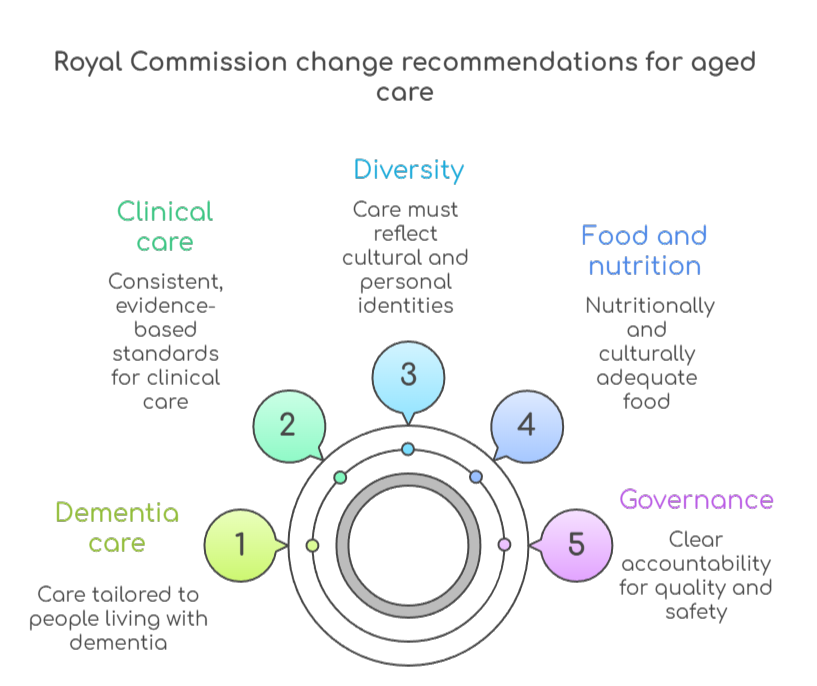
The new Act addresses approximately 60 of the 148 Royal Commission's recommendations.
The most significant shift is structural. The system has moved from a compliance-based model to a rights-based model. Elderly people's rights are at the centre of regulation and service delivery.
Under the old system, compliance often focused on paperwork and box‑ticking. Under the new system, providers must show they uphold your rights in day‑to‑day care.
What is the Statement of Rights?
The Statement of Rights is a core part of the Aged Care Act 2024. It explains the rights elderly people have when seeking or accessing government‑funded aged care.
The Statement of Rights guarantees your right to:
- Make decisions about your own life
- Have those decisions respected
- Receive safe and quality care
- Have your culture and identity respected
- Stay connected with your community
Compliance with the Statement of Rights is a mandatory condition of provider registration.
The seven Aged Care Quality Standards explained
The seven Strengthened Aged Care Quality Standards cover every dimension of your care experience.
Each standard contains four components:
- An intent statement
- Expectation statements outlining what you should receive
- Outcome statements describing what must be achieved
- Action statements describing how providers demonstrate compliance
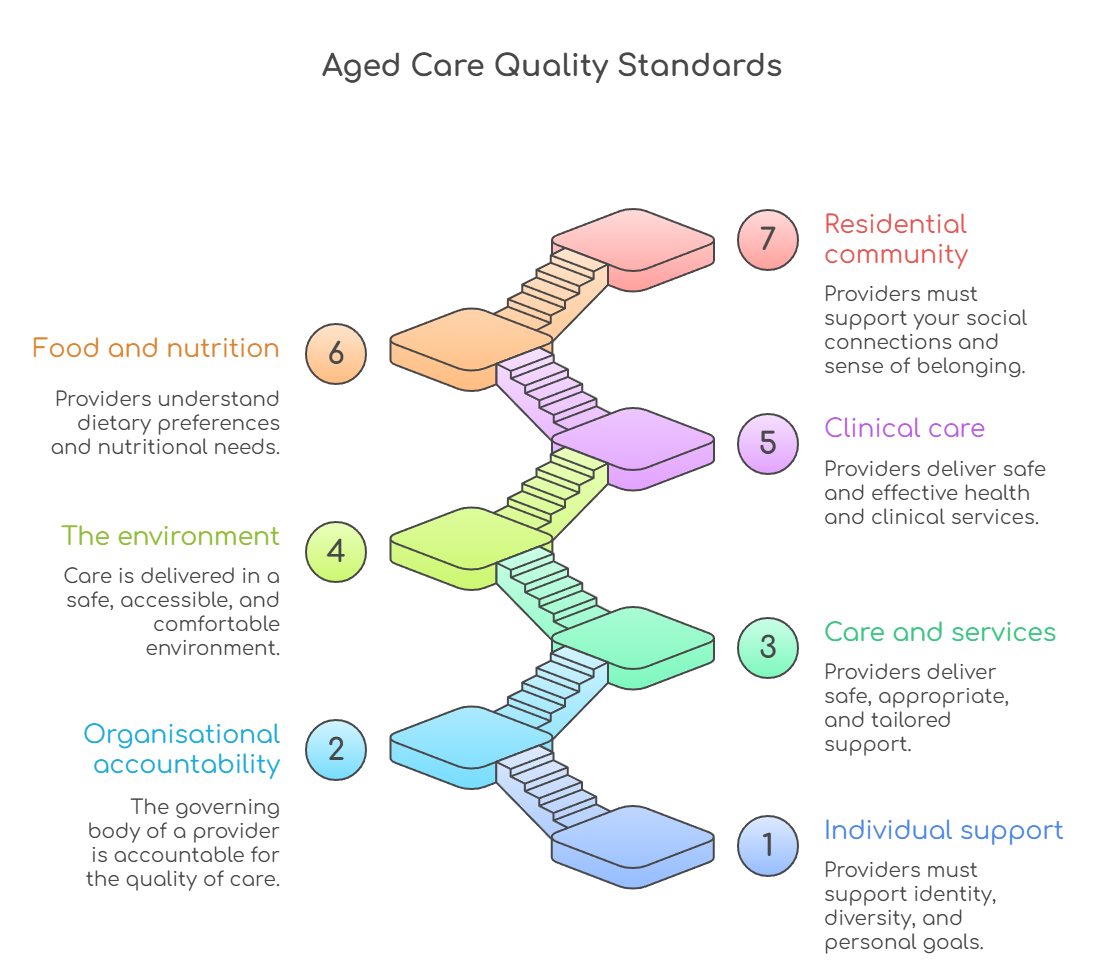
Standard 1: The individual
Standard 1 requires providers to support your identity, diversity, and personal goals in every aspect of care delivery.
Your care must reflect your:
- Individual preferences
- Cultural background
- Life history
Standard 1 underpins every other standard by placing you at the centre of all decisions.
Standard 2: The organisation
Standard 2 holds the governing body of a provider accountable for:
- Strategic priorities
- Workforce and risk planning and management
- Building a culture of safety and quality
Strong leadership and governance are regulatory requirements. They are tied to a provider's right to operate. They are not optional extras.
Standard 3: The care and services
Standard 3 requires providers to deliver safe, appropriate, and tailored support. Their services must match your assessed needs and preferences.
Care plans must be developed with your input. They must also be reviewed regularly and updated when your needs change.
Providers cannot deliver the same package of services to every client.
Standard 4: The environment
Standard 4 requires that care is delivered in a safe, accessible, and comfortable environment.
For home care clients, Standard 4 applies to how your home environment is assessed and managed to support your safety and wellbeing.
Standard 5: Clinical care
Standard 5 requires providers to deliver safe and effective health and clinical services.
Standard 5 applies to providers in registration categories 4, 5, and 6. This includes personal care, nursing, and residential services.
Clinical care must follow evidence-based practice, with:
- Qualified staff managing medication
- Wound care
- Health monitoring
Standard 6: Food and nutrition
Standard 6 requires providers to work with you to understand your:
- Dietary preferences
- Nutritional needs
- Cultural requirements around food
For residential care, Standard 6 means meals must be enjoyable and nutritious. They must also be calorically adequate.
The ACQSC actively monitors compliance with this standard.
Standard 7: The residential community
Standard 7 applies to residential aged care homes. It recognises that your residential community becomes a central part of your daily life.
Providers must support your social connections and sense of belonging. They must also help you take part in community activities.
Which providers must meet the Aged Care Quality Standards?
The standards that apply to a provider depend on the registration category assigned to that provider.
Not all seven standards apply to every provider. Registration categories are based on the services each provider delivers.
Every registered provider, regardless of category, must also comply with:
- The Statement of Rights
- The Aged Care Code of Conduct
- Worker screening requirements
- Incident management and complaints systems
How does the ACQSC assess compliance with the aged care standards?
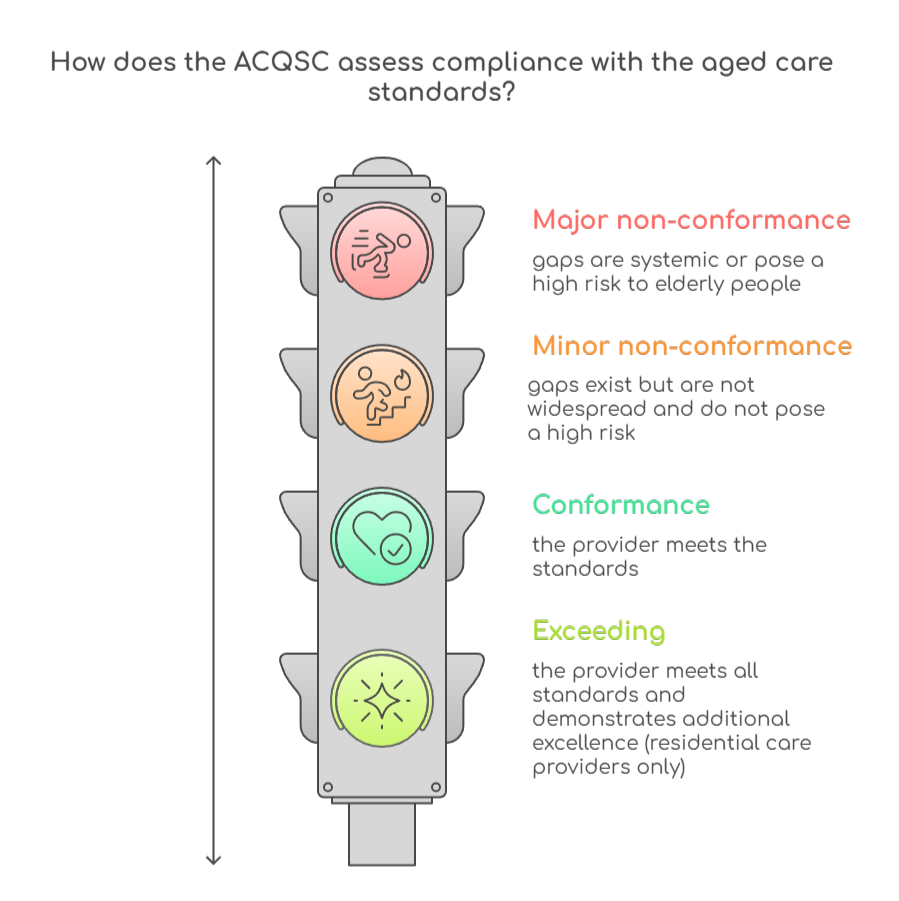
The Aged Care Quality and Safety Commission assesses compliance using a graded assessment model.
The graded model replaced the previous met/not met approach when the strengthened standards came into effect.
There are four grades:
- Exceeding — the provider meets all standards and demonstrates additional excellence (residential care providers only)
- Conformance — the provider meets the standards
- Minor non-conformance — gaps exist but are not widespread and do not pose a high risk
- Major non-conformance — gaps are systemic or pose a high risk to older people
Some providers must demonstrate compliance at registration and renewal. This applies to those in registration categories 4, 5, and 6. Registrations are renewed every three years.
Assessments are not limited to scheduled audits.
The Commission can undertake additional monitoring at any time. It can also issue notices requiring a provider to take specific actions.
If a provider fails to comply, the Commission has several enforcement options. These include:
- Compliance notices
- Civil penalties
- Enforceable undertakings
- Cancellation of registration
How does complaint data feed into compliance monitoring?
The Commission uses complaints data to check provider performance on an ongoing basis.
In 2023–24, complaints about residential aged care services rose by almost 7% compared to the previous year.
This is according to the ACQSC report Complaints about aged care – 2023–24 in review.
In-home services, the most common concerns were:
- Consultation and communication (15%)
- Fees and charges (11%)
- Management of finances (7%)
If you are unhappy with how your provider handles a concern, you can contact the Commission directly.
What do the aged care standards mean for home care clients?
The aged care standards set the requirements your home care provider must meet. It doesn't matter if you receive care through:
- Support at Home
- The Commonwealth Home Support Programme (CHSP)
- Another funded pathway
The standards protect your right to safe care, genuine choice, and a care plan tailored to your individual needs.
What is the Support at Home program?
The Support at Home program is the Australian Government's new in-home aged care program that began on 1 November 2025.
Support at Home replaced the Home Care Packages Program and the Short-Term Restorative Care Programme.
The program uses eight classifications to fund ongoing services. It also includes three short-term pathways for:
- Assistive technology and home modifications
- Restorative care
- End-of-life care
The Commonwealth Home Support Programme continues to operate until at least 1 July 2027. This gives providers and participants time to transition.
What rights do you have under the aged care standards as a home care client?
Under Standards 1 and 3, your provider must:
- Involve you in developing your care plan
- Give you a genuine choice in how services are delivered
- Update your plan when your needs change
Under Standard 2, your provider must have effective governance systems. This includes a competent, well‑managed workforce.
Under Standard 4, your provider must identify and manage safety risks in the environment where you receive care. This includes your home.
Providers cannot lock you into service arrangements that do not reflect your current needs.
If your provider is not meeting these obligations, you have the right to raise a complaint. You can also switch to a different provider.
How to check whether your provider meets the aged care standards
The My Aged Care website is your starting point.
Use the Find a Provider tool to check a provider's registration status and compliance history.
Provider profiles include information about their quality and compliance rating. This information is based on recent assessments and any regulatory actions.
Residential aged care homes are being progressively audited against the strengthened standards.
This process began on 1 November 2025 and will roll out over three years. During this time, some homes may not yet have updated audit results.
When evaluating any home care provider, ask these five questions:
- Is the provider currently registered and regulated by the Aged Care Quality and Safety Commission?
- What does the provider's audit history show?
- How does the provider handle complaints?
- Does the provider publish transparent pricing?
- Do the provider's workers meet mandatory screening requirements?
The first question regards registering with the Aged Care Quality and Safety Commission. Every provider of government-funded aged care must be currently registered.
Ask the provider directly for recent audit results or check their profile on the My Aged Care Find a Provider tool.
Registered providers must have a clear, documented complaints process and must explain that process to you on request.
The Aged Care Rules 2025 ask providers to declare prices before delivering services. Providers must also give a receipt after each service.
Every aged care worker must pass mandatory screening checks under the Aged Care Act 2024 and its Aged Care Rules.
Aged Care Accreditation Standards: What accreditation means
Accreditation is a formal check that residential aged care homes must pass to keep receiving government funding.
It shows whether they meet the Aged Care Quality Standards. The Commission audits and monitors them over time.
The ACQSC usually accredits residential aged care homes for up to three years. It can grant a shorter period if there are concerns about compliance.
By June 2025, almost all re‑accredited residential aged care homes (96.3%) had three‑year‑or‑longer accreditation.
In 2024–25, 95.2% of homes re‑accredited that year received three‑year‑or‑longer accreditation, up from 85.0% in 2021–22.
Accreditation is not permanent. The Commission monitors providers on an ongoing basis. If a provider you are considering does not hold current accreditation, treat it as a serious warning sign.
FAQ
What are the aged care quality standards in Australia?
The Aged Care Quality Standards are seven legally enforceable standards. Each has detailed requirements. Every registered government‑funded aged care provider must meet them. The current strengthened Aged Care Quality Standards came into effect on 1 November 2025 under the Aged Care Act 2024.
What is the ACQSC, and what does it do?
The Aged Care Quality and Safety Commission (ACQSC) is Australia's independent aged care regulator. It audits providers, investigates complaints, and enforces compliance. It can issue compliance notices or cancel a provider's registration.
How do I know if my aged care provider is meeting the standards?
Use the 'Find a provider' tool at myagedcare.gov.au to check a provider's quality and compliance record. You can also ask the provider for their latest audit results and to explain their complaints process.
What replaced the Home Care Packages Program?
The Support at Home program replaced the Home Care Packages Program on 1 November 2025. Support at Home uses eight classifications to fund ongoing services and three short-term pathways. The Commonwealth Home Support Programme continues operating until 30 June 2027. It will transition to Support at Home no earlier than 1 July 2027.
Can I switch aged care providers if I am unhappy with my current care?
Yes. You have the right to change your aged care provider at any time, including if they are not meeting your needs. Under the new aged care laws, providers cannot charge exit fees.
How Sensible Care aligns with the Aged Care Quality Standards
Sensible Care is a registered provider delivering government-funded in-home care across VIC, NSW, QLD, WA, SA, and TAS. We provide what the aged care quality standards demand: safe care, genuine choice, and transparent pricing.
Sensible Care accepts more than eight funding types, including:
- NDIS
- Support at Home
- CHSP
- TAC
- DVA
- TCP
- PAC
- STRC
You don't have to navigate the funding system alone. Sensible Care offers both self-managed and care-managed options under the Support at Home program.
Our pricing page is published openly on the website so you can compare costs before making any commitment.
When you switch from your current provider, Sensible Care handles all the paperwork and administration for you.
Across 25+ service types, Sensible Care covers:
- Personal care
- Clinical care
- Domestic help
- Transport
- Dementia care
- Palliative care
Our in-house allied health team covers physiotherapy, occupational therapy, podiatry, dietetics, etc. Community nursing services are delivered by qualified registered nurses in your own home.
The Sensible Care team will:
- Walk you through your funding options
- Explain what you are entitled to
- Help you get more hours of support for your budget

Take the Next Step in Care
Download our Info Kit or speak to one of our friendly team members today.


Explore More Helpful Reads
More stories, guides, and updates to support you and your family.




Need Help Getting Started?
Reach out on your terms, pick a time that suits you and let’s talk about how we can help.


.webp)