.svg)

Support at Home care management explained
Support at Home care management is funded by 10% of your quarterly budget. Learn what your care partner does and how much you'll pay.
Author: Sensible Care

Care management isn't an optional add-on or a separate bill. Under Support at Home, 10% of your quarterly budget is set aside for it automatically and paid to your provider. This replaced the old Home Care Package model, which allowed up to 20% for care management plus 15% for package management. Separate administration fees are now banned, and travel must be built into the service price. What you contribute depends on your means and the service type. Clinical supports cost you nothing; everyday living services can reach 80%. You can request a different care partner or switch providers; your budget and allocation follow you, with no exit fees.
Support at Home care management is the ongoing coordination of your aged care services. It covers care planning, service scheduling, and adjusting your supports as your needs change.
Care management is a government-funded, essentially universal part of Support at Home. Ongoing services include a dedicated care partner, even for self-managing participants. This is funded by 10% of your quarterly budget, which is reserved for that purpose.
This differs from the NDIS and CHSP, where equivalent coordination is funded only based on assessed need.
Your care partner works with you, and your family if you wish, to keep your services running well and your budget spent wisely.
Figures in this article were current at the time of writing. Support at Home classification budgets are indexed each 1 July. The lifetime contribution caps are indexed twice a year, on 20 March and 20 September. Check My Aged Care for current amounts.
What is Support at Home care management?
Support at Home care management is the set of activities a provider carries out to plan, coordinate, and review your care. It's not the same as the services themselves, but the work that keeps those services organised and responsive to you.
Care management includes:
- Developing and updating your personalised care plan to match your current needs
- Coordinating your support workers, nurses, and allied health team so services do not overlap or clash
- Monitoring your safety and wellbeing at home through regular check-ins
- Reviewing your plan regularly and adjusting services when your needs change
- Advocating for you when new services or equipment are needed
- Keeping you and your family informed at every stage of your care
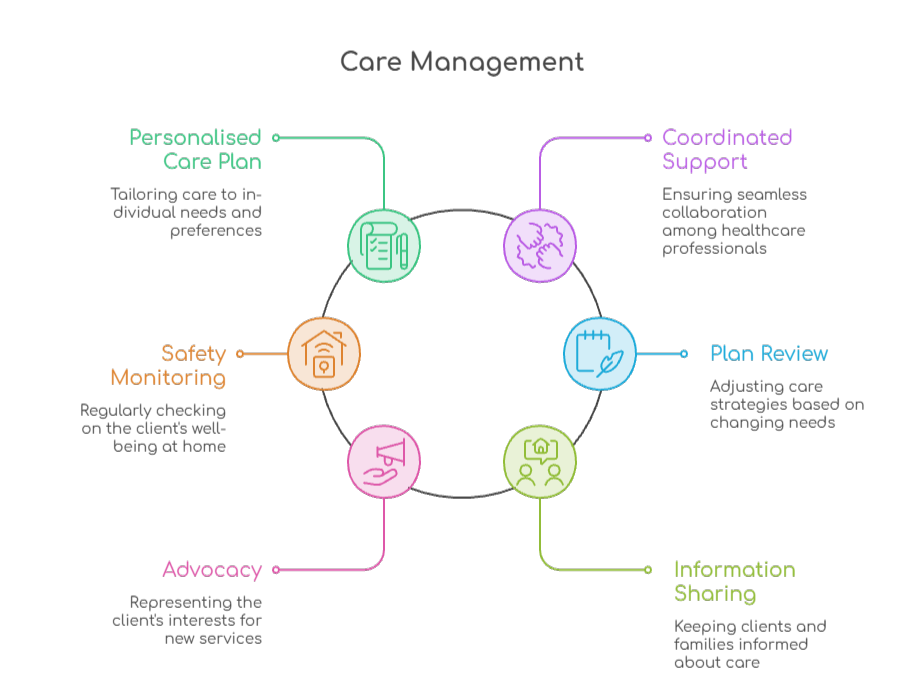
Your care manager acts as your main point of contact. They liaise with providers on your behalf, flag risks early, and make sure your funding is directed toward the outcomes that matter most to you.
How is care management funded under Support at Home?
Under Support at Home, 10% of your quarterly budget is set aside for care management and paid directly to your provider. This amount is built into every classification level's budget. Providers may claim additional supplements for care management if you have specific higher needs.
This funding is drawn from your overall quarterly budget. That means it's a mix of government contribution and your personal contribution, the same as your other Support at Home services. The exception is clinical supports, which remain fully government-funded with no contribution required.
Support at Home uses eight ongoing service classifications, each with a defined quarterly and annual budget. The table below shows the budget range across classifications:
| Classification | Quarterly budget | Annual budget |
|---|---|---|
| 1 (lower needs, ongoing) | $2,757.89 | $11,031.56 |
| 8 (higher needs, ongoing) | $20,073.50 | $80,294.00 |
| Transitioned HCP Level 4 | $16,385.99 | $65,543.98 |
Source: My Aged Care, Support at Home costs and contributions, current as of 1 October 2026. Budgets indexed annually; figures shown are for 2026–27.
If you were approved for a Home Care Package on or before 31 October 2025, you will instead receive one of four transitioned HCP classifications. These classifications mirror your previous HCP level.
What do you contribute toward your care?
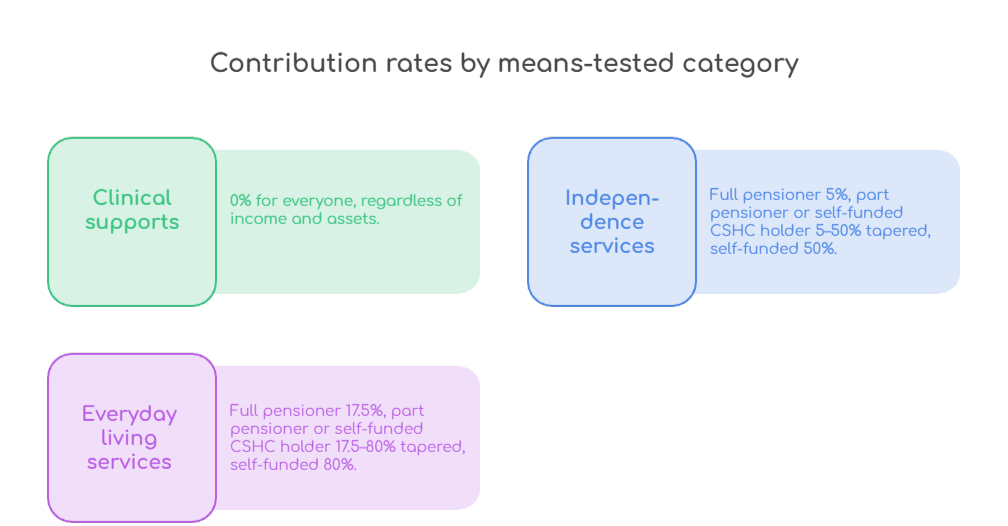
Your contribution depends on your income and assets, and on which type of service you are receiving. Clinical supports such as nursing and physiotherapy are fully funded by the government. You pay nothing for these.
For other services, contribution rates vary by means-tested category.
| Financial situation | Clinical supports | Independence services | Everyday living services |
|---|---|---|---|
| Full pensioner | 0% | 5% | 17.5% |
| Part pensioner / self-funded CSHC holder | 0% | 5–50% (tapered) | 17.5–80% (tapered) |
| Self-funded (no CSHC, or means not disclosed) | 0% | 50% | 80% |
Source: My Aged Care. Contribution rates are set percentages and are not indexed.
From 1 October 2026, the Australian Government will fully fund personal care services for eligible people. This applies to those approved for that service type in their support plan. This means no out-of-pocket cost for:
- Showering
- Dressing
- Continence support
- Help with eating
- Personal hygiene
A lifetime cap limits total contributions for people who were receiving or approved for a Home Care Package on or before 12 September 2024. The cap is $88,934.57 as at 20 September 2026 and is carried over as a protection under Support at Home.
Other participants are subject to a separate, higher lifetime cap of $140,652.80 on non-clinical contributions. Both caps are indexed on 20 March and 20 September each year.
What is the difference between care management and package management?
Care management and package management were the two fee types under the Home Care Packages program. From 1 January 2023 until the program closed, providers could charge only these two fees. This meant no extra administration or account-keeping fees.
Care management covered the clinical and coordination work. This included care planning, risk monitoring, service review, and advocacy. It was capped at 20% of package funding.
Package management covered the financial and administrative side. This included managing the budget, processing invoices, and reporting to the government. It was capped at 15% of package funding.
Under Support at Home, the 10% budget allocation replaces this percentage-fee model entirely. Providers can no longer charge a separate package management or administration fee at all. Travel costs must also be built into the published service price rather than billed separately.
How do you get the most from your care management relationship?
Your quarterly budget puts 10% toward care management regardless of how much you draw on it. There's no cost advantage to keeping your care partner at arm's length.
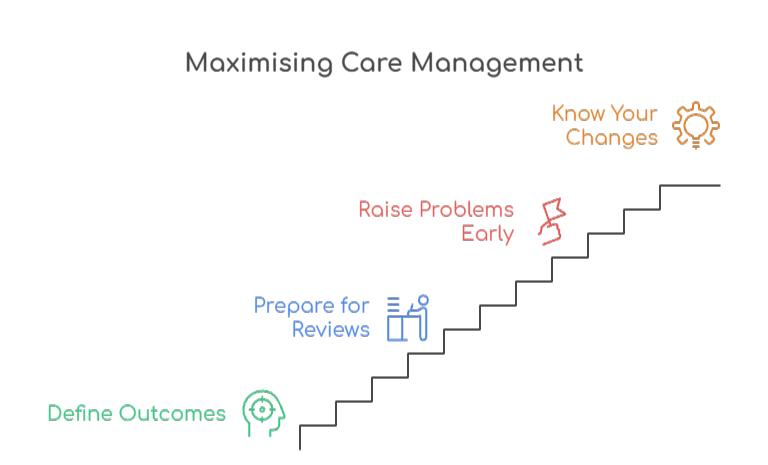
Here is how you can get the most from your care management relationship:
- Be specific about outcomes, not services.
- Prepare for reviews.
- Raise problems early.
- Know what you can change.
Tell your care partner what a good week looks like. For example, staying in your garden, getting to a weekly service, or managing your own shopping. Let them work backwards to the supports that make it possible.
Note anything that's become harder since last time. This may include:
- Services you aren't using or that aren't working
- Upcoming changes, like a hospital stay or a carer moving away
- How much of your budget has been spent
You're entitled to see your budget and ask how unspent funds carry over.
If a support worker isn't a good fit or your plan no longer matches your needs, say so before the next scheduled review. Flagging risks early is part of what care management is funded to do.
You can nominate a family member to join care planning conversations. You can also request a different care partner within your provider or move providers entirely. Your classification, budget, and care management allocation move with you, and Support at Home rules do not allow exit fees.
FAQ
Is care management free under Support at Home?
Care management is not a separate charge you pay on top of your budget. The funding comes from within the budget itself. Under Support at Home, 10% of your quarterly budget is allocated to care management and paid to your provider.
This amount is built into your classification budget and is not charged as a separate contribution. It doesn't change the percentage you pay toward individual services. You simply don't receive a separate bill for care management.
Can I choose my own services and still have care management?
You can be self-managed or care-managed under Support at Home. Even if you self-manage parts of your care, your provider must still carry out certain care management activities each month. This is required to meet their obligations under the Aged Care Quality Standards.
Care management and self-management are not mutually exclusive. You can direct your own services while retaining support. A care partner can still monitor your plan and assist you with reviews.
What happens to my care management if I switch providers?
Switching providers does not stop your care management funding. Your Support at Home budget and classification move with you, including the 10% care management allocation. Your new provider works with you to update your care plan and budget so your services continue smoothly.
Many providers offer to handle most of the transfer administration for you. Support at Home rules do not allow exit fees, so you are not charged to leave your current provider.
This can include helping arrange the transfer of unspent funds and updating My Aged Care records. The exact support may differ between providers.
What is the lifetime cap on aged care contributions?
There are two lifetime caps, and which one applies to you depends on when you entered the system.
Under the older 1 July 2014 fee arrangements, the lifetime cap on the means-tested care fee is $88,934.57 as at 20 September 2026. This figure is indexed on 20 March and 20 September each year.
Your income-tested and means-tested care fees from both home care and residential aged care count toward the cap. Once you reach it, you stop paying the means-tested care fee, and the government covers further eligible care costs.
Under Support at Home, there is a separate lifetime cap on non-clinical contributions of $140,652.80. The lower $88,934.57 cap is preserved for grandfathered clients under the "no worse off" principle. This covers people who were receiving or approved for a Home Care Package on or before 12 September 2024.
Making care management work for you
Care management is built into every Support at Home budget by default. That 10% is set aside whether you use your care partner heavily or barely at all.
So the question isn't whether you're paying for it. It's whether you're getting value from it. Talk to your care partner about outcomes, not services.
At Sensible Care, your 10% care management allocation goes toward a dedicated care partner who actually knows your plan, not a call centre. Choose care-managed or self-managed Support at Home. Either way, you get real clinical support from our in-house registered nurses and physiotherapists.
Our pricing is upfront, so more of your budget goes toward the services you actually receive. Not happy with your current provider? Switching is easier than you'd think. Sensible Care handles the transfer paperwork for you at no cost, with no exit fees.
Get in touch with Sensible Care to talk through your options.
These amounts are set by the Australian Government and change at least twice a year. Check health.gov.au for the current amounts before you make a decision.

Take the Next Step in Care
Download our Info Kit or speak to one of our friendly team members today.


Explore More Helpful Reads
More stories, guides, and updates to support you and your family.

.jpg)
.webp)
.webp)
Need Help Getting Started?
Reach out on your terms, pick a time that suits you and let’s talk about how we can help.


.webp)