.svg)

Aged care fees explained: What you'll pay in Australia in 2026
Understand aged care fees in Australia — Basic Daily Fee, RAD, and home care costs updated for 2026. Get a free consultation with Sensible Care today.
Author: Sensible Care

Every resident in permanent residential aged care pays the Basic Daily Fee of $65.55 per day. You may also pay means-tested contributions — up to $22.15 per day for everyday living and up to $105.30 per day for personal care. Accommodation costs are separate, with RADs averaging above $570,000 nationally as of mid-2025. If you stay at home, you pay no Basic Daily Fee and no accommodation costs. This makes in‑home care usually cheaper out of pocket than residential aged care for people with similar support needs.
Aged care fees in Australia include a:
- Basic Daily Fee of $65.55 per day
- Means-tested Hotelling Contribution of up to $22.15 per day
- Non-Clinical Care Contribution of up to $105.30 per day
You may also pay accommodation costs, such as a Refundable Accommodation Deposit (RAD).
If you receive in-home care through Support at Home, your fees are means-tested and capped based on your income and assets.
Knowing your costs before choosing a provider saves you money and prevents surprises. This guide covers every fee type for both residential and in-home aged care.
What are the main types of aged care fees in Australia?
Australian aged care fees fall into four categories:
- Basic Daily Fee — paid by every resident in permanent residential aged care, currently $65.55 per day
- Hotelling Contribution — a means-tested daily fee towards meals, cleaning, and laundry, up to $22.15 per day
- Non-Clinical Care Contribution (NCCC) — a means-tested daily fee towards personal care, up to $105.30 per day
- Accommodation costs — paid as a Refundable Accommodation Deposit (RAD), a Daily Accommodation Payment (DAP), or a combination of both
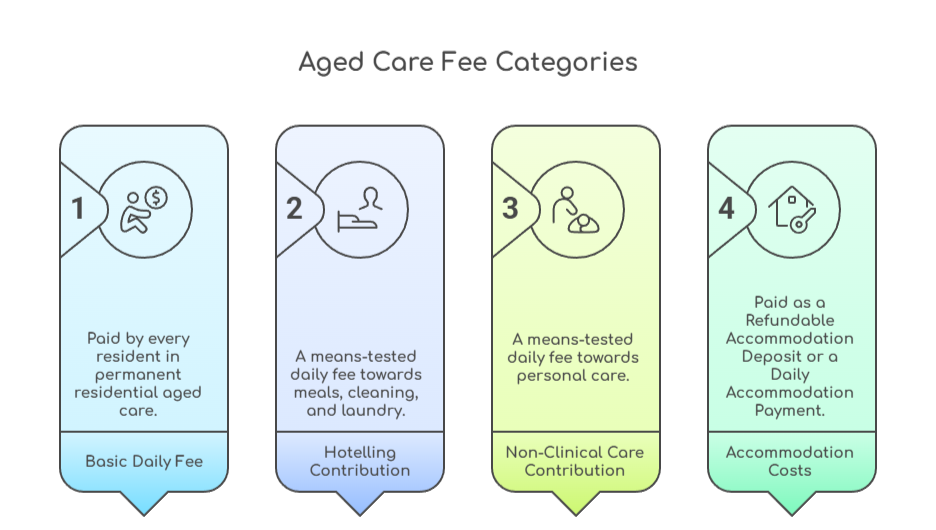
Every person entering permanent residential aged care pays the Basic Daily Fee. Means-tested fees and accommodation costs vary based on your income and assets.
The Australian Government contributed $39.8 billion to aged care services in 2024–25. Residents and home care clients still contribute based on their capacity to pay.
How much is the Basic Daily Fee?
The Basic Daily Fee is $65.55 per day. It applies to all residents in permanent residential aged care, regardless of income or assets.
It covers meals, cleaning, laundry, and utilities inside the aged care home. It's not means-tested. Instead, every resident pays it.
At $65.55 per day, the Basic Daily Fee adds up to approximately $23,926 per year. This rate will change on 20 March 2026, when it is next indexed in line with Age Pension increases.
The Australian Government sets it at 85% of the single basic Age Pension and updates it twice a year. This happens on 20 March and 20 September.
What is a Refundable Accommodation Deposit (RAD)?
A Refundable Accommodation Deposit (RAD) is a lump-sum payment you make to an aged care home to cover your accommodation costs.
The remaining balance is refunded when you leave or pass away.
For residents entering care on or after 1 November 2025, providers keep 2% of the RAD per year for up to five years. This means that up to 10% may be deducted before the refund is made.
The national average RAD in Australia was approximately $573,000 as of mid-2025. The amount varies by location and facility type.
If a lump sum does not suit you, you can pay a Daily Accommodation Payment (DAP) instead, or a mix of both.
The Maximum Permissible Interest Rate (MPIR) used to calculate DAPs is currently 7.65% per annum (January–March 2026). This rate changes quarterly.
Who is exempt from paying the RAD?
You do not pay a RAD or DAP if Services Australia assesses you as fully supported.
This applies if your annual income is below $34,762 and your assessable assets are below $63,000 (indexed until 19 March 2026). In this case, the Australian Government pays your full accommodation costs.
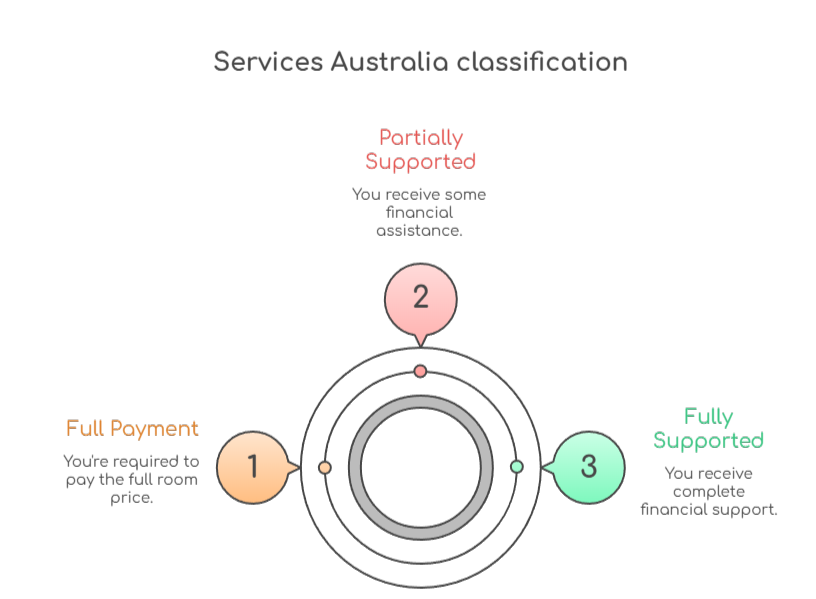
Services Australia (or DVA for some veterans) assesses your income and assets. Based on that assessment, you are classified as:
- Fully supported
- Partially supported
- Required to pay the full room price
What is the means-tested care fee?
The means-tested care fee is an additional daily amount. It's calculated by Services Australia based on your income and assets.
Providers charge it on top of the Basic Daily Fee for residents whose finances exceed the income and asset thresholds.
The fee is capped at $35,238.11 per year and $84,571.66 over your lifetime. In other words, there is a legal limit on how much you can be charged.
Once you reach the annual cap, you stop paying until the next anniversary of your entry date. But when you reach the lifetime cap, you never pay a means-tested care fee again.
How do the November 2025 aged care reforms change your fees?
The Australian Government started funding clinical care directly for new residents. This change began on 1 November 2025, under the Aged Care Act 2024, and it includes nursing and medical services.
New residents no longer pay a means-tested fee for clinical care. Instead, residents entering care on or after 1 November 2025 may pay two new contributions:
- Hotelling Contribution — covers everyday living expenses (meals, cleaning, laundry).
- Non-Clinical Care Contribution (NCCC) — covers personal care costs (bathing, mobility, and lifestyle activities).
The Hotelling Contribution has a max daily amount of $22.15. There is no annual or lifetime cap on this contribution.
The Non-Clinical Care Contribution (NCCC) is capped at $105.30 per day. It comes with a lifetime cap of $135,318.69 or four years in care, whichever comes first. Only residents who pay the full Hotelling Contribution are assessed for the NCCC.
The 1 November 2025 arrangements apply to people who first enter permanent residential care on or after that date.
If you were approved for or accessing a Home Care Package on or before 12 September 2024, the 'no worse off' principle applies. You continue under the 1 July 2014 fee arrangements.
What fee arrangement applies to you?
How much do care homes cost in Australia?
Residential aged care costs typically include:
- The Basic Daily Fee
- Accommodation payments
- Means-tested contributions
RADs now average above $570,000 nationally. If you pay a DAP instead, it is calculated using the current MPIR of 7.65% per annum.
For example, a resident paying the full Basic Daily Fee plus a DAP on a $470,000 RAD would spend more than $59,600 per year, before means-tested fees.
The Australian Government subsidises most of the cost of residential care through the AN-ACC funding system.
In 2023–24, the average annual subsidy per resident was $105,157. It rose to $117,396 per resident in 2024–25 under the AN‑ACC funding system.
What are the fees for in-home aged care?
In-home aged care fees depend on which program you access - the Commonwealth Home Support Programme (CHSP) or Support at Home.
Commonwealth Home Support Programme (CHSP) fees
CHSP is designed as entry‑level in‑home support, so services include:
- Cleaning
- Meals
- Personal care
- Transport
- Home maintenance
CHSP fees are small co-payments you make per service session.
The Australian Government spent an average of $3,899 per CHSP recipient in 2024–25. Your provider sets your contribution. It's typically a modest amount per visit.
Support at Home fees
The Support at Home program funds in-home care across eight budget levels. Your personal contribution is means-tested based on your income and assets.
Under the previous Home Care Package system, the average annual payment per package was $29,800 in 2024–25.
This ranged from $9,300 for a Level 1 package to $50,500 for a Level 4 package. These figures reflect the government-funded budget, not what you personally pay.
Participant contributions are calculated using your income and assets. They're subject to a lifetime cap, which is currently $135,318.69 for new participants.
For people covered by the 'no worse off' principle, it's $84,571.66.
What income is excluded from the home care income test?
If your income is at or below the income-free area for your situation, you pay no home care income-tested fee.
If your income exceeds the higher threshold (for example, $66,960.40 per year for a single person), the higher daily and annual caps apply.
What is the difference between home care and nursing home costs?
Home care costs less out of pocket than residential aged care. You pay no Basic Daily Fee and no accommodation payment (RAD or DAP).
The table below compares the key cost differences.
Can you get help paying aged care fees?
Yes. Financial hardship help is available if you genuinely cannot afford your aged care fees.
Services Australia administers hardship provisions that reduce or waive certain fees. But this is only for residents who qualify. You need to apply through Services Australia, separately from the standard means assessment.
Getting independent advice before you enter residential care can save you thousands of dollars. Turn to a specialist aged care financial adviser.
They can help you compare RAD and DAP options. They can also help you structure your assets to manage fees, pension entitlements, and estate outcomes.
The Australian Government's My Aged Care website also offers a free aged care home fee estimator.
Frequently Asked Questions
How much does aged care cost in Australia per year?
Residential aged care costs vary by financial situation. They typically include:
- The Basic Daily Fee of $65.55 per day (about $23,926 per year as at 1 January 2026)
- Accommodation costs (average RAD above $570,000 nationally, or an equivalent DAP)
- Any means-tested contributions
The Australian Government covers most remaining costs through AN-ACC subsidies. They average around $110,000–$115,000 per resident per year.
Are nursing home fees the same everywhere in Australia?
No. Nursing home fees vary by facility, location, and individual financial assessment. The Basic Daily Fee of $65.55 per day is standard across all providers, but RADs vary widely. They now average above $570,000 nationally. Means-tested contributions also differ based on each resident's income and assets.
What is the income-tested fee for home care?
The income-tested fee for home care is a daily amount calculated by Services Australia after an income assessment. It is subject to:
- Daily caps of $19.36 or $38.72
- Annual caps of $7,047.55 or $14,095.20
- A lifetime cap of $84,571.66
Do you still pay fees if you stay at home?
Yes. Many in-home aged care clients pay a means-tested contribution based on their income. Full Age Pensioners generally pay no income-tested fee. Those with higher incomes may pay up to the current daily and annual caps.
Is your family home included in the aged care assets test?
For residential aged care, your former home counts as an asset, unless a 'protected person' lives there. A protected person includes:
- A spouse,
- A dependent child,
- An eligible carer,
- Or an eligible close relative who meets specific Centrelink criteria.
If no protected person remains, the home is included in the assets assessment up to a capped value.
How Sensible Care keeps your in-home aged care fees low
Sensible Care focuses on transparent, low fees and helping you get more care hours from your government funding.
We support clients across VIC, NSW, QLD, WA, SA, and TAS. We charge no daily fees, no lock-in contracts, and no exit charges.
Sensible Care works with multiple funding sources, including Support at Home, CHSP, and NDIS, and handles the paperwork for you.
Book a free initial consultation by phone or schedule a callback to get a clear picture of your costs and options.

Take the Next Step in Care
Download our Info Kit or speak to one of our friendly team members today.


Explore More Helpful Reads
More stories, guides, and updates to support you and your family.




Need Help Getting Started?
Reach out on your terms, pick a time that suits you and let’s talk about how we can help.


.webp)