.svg)

Explaining the new Single Assessment System (replacing ACAT)
Read on to learn how the Single Assessment System replaced ACAT, how the assessment works, how to prepare, and what your outcome means.
Author: Sensible Care

Australia's Single Assessment System replaced the ACAT (aged care assessment team) system on 9 December 2024. You now follow one assessment pathway through My Aged Care as your needs change. The assessment looks at your health, daily tasks, safety, supports, and goals. After the visit, you receive an outcome letter and a support plan with your next steps.
The Single Assessment System (SAS) is now Australia's official way to access government‑funded aged care. It gives you one national assessment pathway instead of separate systems for different levels of care.
But before it was rolled out on 9 December 2024, the aged care assessment team (ACAT) system was used.
ACAT was used for Home Care Packages, residential care, and respite care. Its primary goal was to estimate what support you needed and to approve access to government-subsidised aged care services.
Some things haven't changed. You still start with My Aged Care. After you apply, you will be contacted to explain your needs and book the assessment.
If you want to know what to expect at each step and how to prepare, keep reading.
ACAT vs. the Single Assessment System
Australia's Single Assessment System is now used instead of ACAT (Aged Care Assessment Team).
Before, different groups handled different assessments. Aged care assessment teams (ACATs) were used to approve several higher-level services, including:
- Home Care Packages (the old ongoing home care program)
- Entry to an aged care home (permanent residential care)
- Residential respite care
- Transition care (usually arranged while you are still in hospital)
For entry-level help at home (CHSP), the system used Regional Assessment Services (RAS), not ACAT.
From 9 December 2024, the Single Assessment System replaced both RAS and ACAT. Now, one workforce covers these assessments.
What changed
- One workforce: A single national assessment team replaced ACAT, RAS, and independent AN‑ACC assessors.
- One national tool: Assessors use the Integrated Assessment Tool (IAT), which replaced the old National Screening and Assessment Form on 1 July 2024.
- Early triage call: A short triage call usually happens within about two weeks of your referral being accepted.
- Stronger continuity: You can often stay with the same assessment organisation as your needs change, instead of being passed between different teams.
What stays the same
- You still start through My Aged Care (online, by phone, or via a health professional) to request an assessment.
- The assessment still looks at your health, daily tasks, safety, and supports so you can be matched to the right care.
- You still receive an outcome letter (often called a Notice of Decision) and a support plan explaining what you are approved for and what to do next.
Many people still say ACAT assessment or ACAT team, even though the system name has changed.
How does the Single Assessment System work?
The Single Assessment System is Australia's national process for aged care assessments. It uses one workforce to match you to the right subsidised support.
You start through My Aged Care. A local assessment organisation then takes over to book and do your assessment.
Assessors use the Integrated Assessment Tool (IAT) to record your needs and work out what you are eligible for. The IAT has been in place since 1 July 2024. It is now the standard tool for all Commonwealth‑subsidised aged care assessments.
Here is the process step by step:
- Request an assessment through My Aged Care (online or by phone).
- My Aged Care registers you and sends your referral to a local assessment organisation.
- A Triage Delegate calls you within two weeks to confirm your needs and book the right assessment type.
- An assessor meets you at home (or in hospital if needed) and completes the assessment using the IAT.
- You receive an outcome letter (often called a Notice of Decision) and a support plan with your next steps.
.png)
What services can the Single Assessment System approve?
Assessors use the Integrated Assessment Tool (IAT) to determine eligibility for:
- In‑home aged care
- Flexible aged care programs
- Residential respite
- Entry to residential aged care
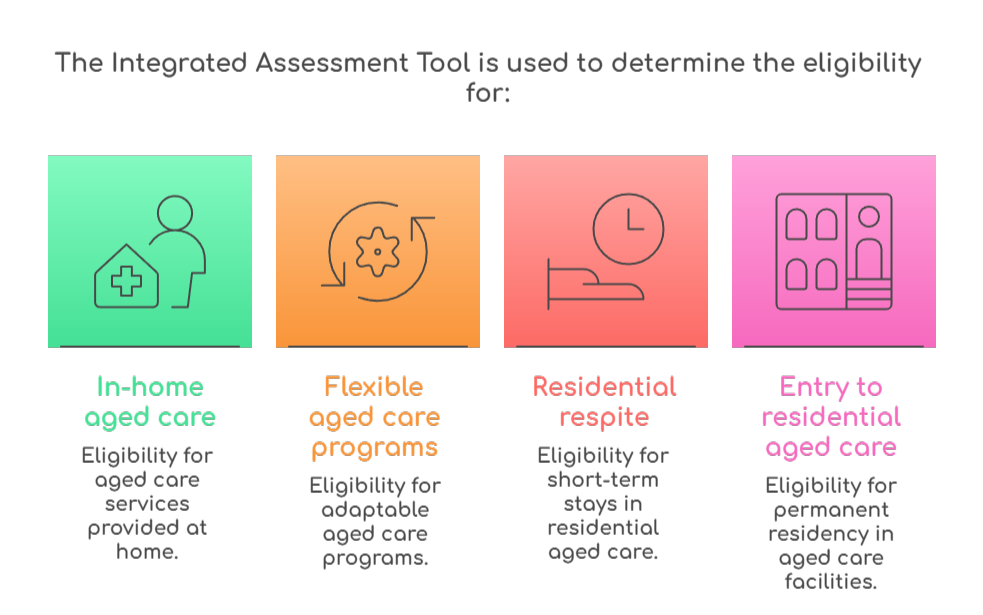
For residential care funding, they use the AN‑ACC Assessment Tool to classify your funding level once you are settled in the aged care home.
Because there is now one assessment pathway, you do not need separate assessments every time your needs change or you move between programs. For example, from home support to residential respite.
You can be approved for:
- Support at Home: the main in‑home aged care program that replaced Home Care Packages
- Commonwealth Home Support Programme (CHSP): entry‑level help at home
- Residential respite care: a short stay in an aged care home
- Transition care: short‑term support, usually after a hospital stay
- Entry to an aged care home: permanent residential aged care
If you are approved, your outcome letter and support plan explain:
- What program(s) and services you can access
- Any referral codes you can give to providers
- What to do next if you need help starting services or want a review
Support at Home priority and wait times
If you are approved for Support at Home, you enter the Support at Home Priority System. Your priority category helps decide how quickly ongoing funding is offered.
My Aged Care lists 4 Support at Home priority categories:
- Urgent
- High
- Medium
- Standard
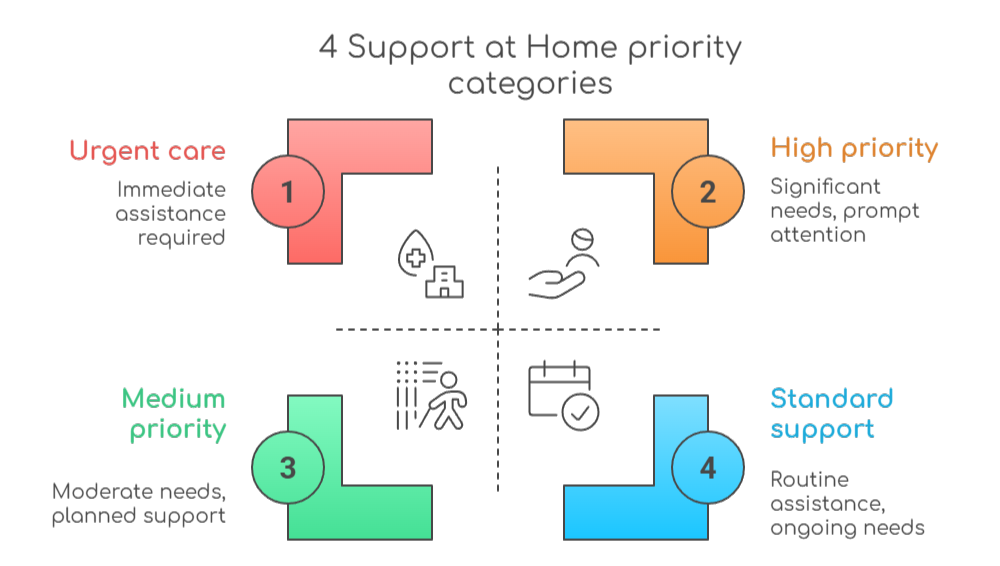
As at 1 November 2025, My Aged Care's estimated wait times for ongoing Support at Home funding are:
- Urgent: within 1 month
- High: 1.5 to 2.5 months
- Medium: 8 to 9 months
- Standard: 10 to 11 months
These are estimates only and may change. My Aged Care updates wait time information periodically as new data becomes available.
What happens during the assessment?
Most assessments happen in person at your home, so you usually do not need to travel.
Here is what to expect at the start:
- The assessor explains their role and asks for your consent to run the assessment.
- They also ask for permission to speak with people who support you (family, carers, or health professionals).
There are no wrong answers. The goal is to understand your situation and match you with safe, suitable support, not to test you.
Your assessor asks about your:
- Current formal and informal supports
- Health conditions and recent changes
- Daily tasks (for example, showering, dressing, meals, medication, housework, shopping, transport, etc.)
- Memory, thinking, and mood
- Safety at home (falls risk, home layout, equipment needs)
- Social and cultural activities, and what is important to you day‑to‑day
They may also ask to speak with your GP or other health professionals (with your consent) to clarify medical information and coordinate care.
Building your support plan
You and the assessor work together to create a support plan that records:
- Your strengths and what you can still manage
- Your difficulties and risks
- Your personal goals (for example, staying at home longer, reducing fall risks, or maintaining social activities)
- Your preferences about services (types of support, timing, cultural considerations, etc.)
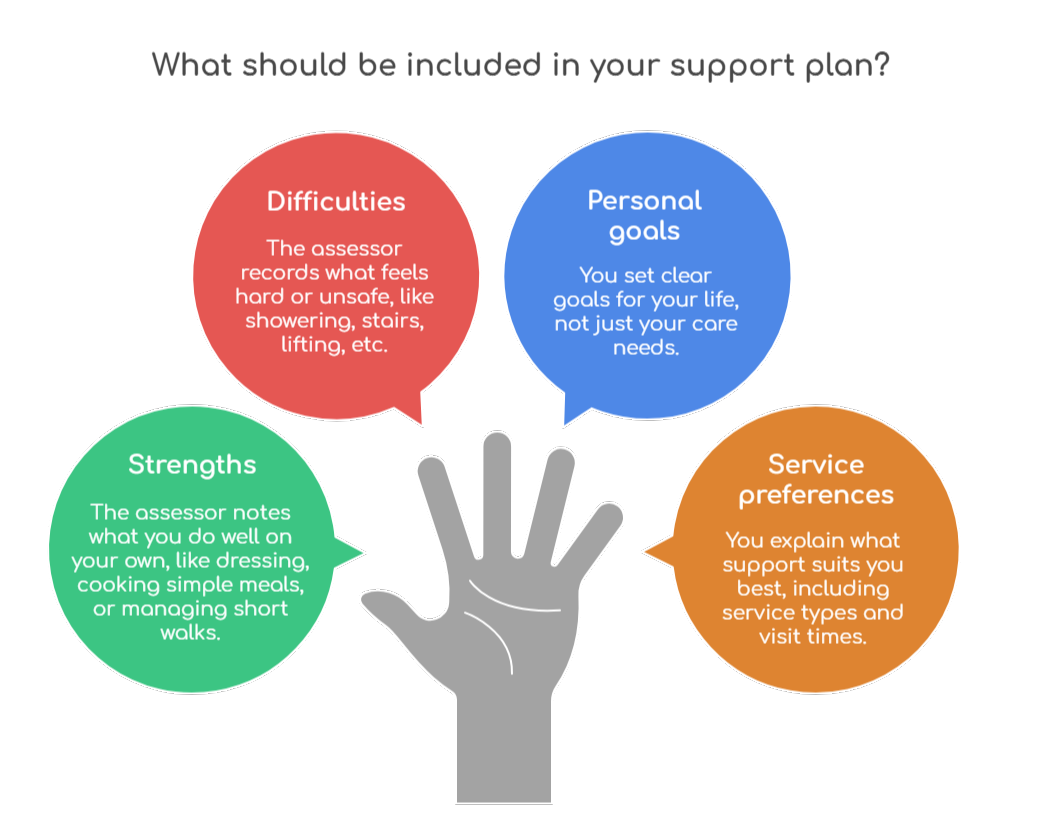
This plan then guides referrals, provider choice, and future reviews.
How do you prepare for your assessment?
Prepare your key documents and details so you can answer clearly and confidently. My Aged Care suggests having:
- Your Medicare card
- Any other ID
- Any doctor referrals or specialist letters
- Your GP and regular health professional details
- Information about your current supports (family, friends, paid services)
You can also bring or prepare:
- A current medication list (or bring your medication containers in a bag)
- Any recent hospital discharge summaries or test results (if available)
You are allowed and encouraged to have a support person if it helps you feel comfortable or remember details. This can be a:
- Family member
- Friend
- Neighbour
- Carer
- Registered supporter
- Interpreter
- An Elder Care Support worker (for Aboriginal and Torres Strait Islander people)
What does your assessment outcome mean, and what do you do next?
After this step, the assessment organisation reviews your information and makes the decision.
My Aged Care says this decision step can take up to two weeks, depending on the needs found in your assessment.
You then receive an outcome letter (often called a Notice of Decision) and your support plan.
For aged care home decisions, the letter includes your eligibility, the reasons and evidence, and your support plan with referral codes.
Next steps after you get the letter
- Read the reasons and match them to your day‑to‑day experience. Check that the letter reflects your real difficulties, risks, and goals.
- Use your referral codes to connect with providers, or ask your assessor or My Aged Care to send referrals on your behalf.
- If you disagree with the decision, follow the review or appeal pathway described in your letter. My Aged Care states that your Notice of Decision includes your rights and the process to request a review.
- If you need help understanding the letter or review options, you can also call My Aged Care.
FAQ
How do I apply for a Support at Home assessment?
You can apply through My Aged Care, including via the online application. The form covers help at home, short-term care, aged care home, and end-of-life care.
What questions are asked in the assessment?
The assessor asks about your health, daily tasks, memory, safety, and current supports. They also discuss your goals and preferences to build your support plan.
How long does the assessment take?
The visit time depends on your needs, but the key decision step happens after the visit. My Aged Care says the assessment organisation can take up to two weeks to review information and determine eligibility.
Can I appeal the decision?
Yes. My Aged Care states your Notice of Decision letter includes your rights to have the decision reviewed if you disagree.
How Sensible Care can help
You get the best outcome when you describe your needs clearly and back them with real‑life examples.
Sensible Care stays up to date with the Single Assessment System and Support at Home rules. We can help you feel prepared and supported at each step.
Sensible Care can:
- Help you prepare your checklist and goals before the assessment
- Join you at the assessment (if you want support) to help you explain your situation
- Go through your Notice of Decision and support plan in plain language
- Explain your Support at Home priority category and what it means for wait times
- Help you use your referral codes, compare providers, and start services sooner
We work alongside My Aged Care and assessment organisations, not instead of them. We can help you make informed decisions and get the right care in place.
If you want to know more, please reach out to us.

Take the Next Step in Care
Download our Info Kit or speak to one of our friendly team members today.


Explore More Helpful Reads
More stories, guides, and updates to support you and your family.



.webp)
Need Help Getting Started?
Reach out on your terms, pick a time that suits you and let’s talk about how we can help.


.webp)