.svg)

Restorative Care Pathway (Support at Home): What it is and how to access it
The Restorative Care Pathway (Support at Home) offers up to 16 weeks of funded allied health care. Find out if you're eligible and how to access it.
Author: Sensible Care

The Restorative Care Pathway is a short-term, government-funded program under Support at Home. It gives you up to 16 weeks of intensive allied health and nursing support to help you regain independence at home. It's funded at around $6,179 per episode, separate from your regular aged care budget. Clinical services such as physiotherapy and occupational therapy cost you nothing out of pocket. To access it, you need a formal aged care assessment through My Aged Care, and the average wait time is 163 days.
The Restorative Care Pathway is a short-term, government-funded program within Australia's Support at Home system. It gives you up to 16 weeks of intensive allied health and nursing support to help you regain function and stay independent at home.
This pathway has its own dedicated funding (around $6,179 per episode), separate from your regular Support at Home quarterly budget. You can access it even if you're already receiving ongoing Support at Home services.
It's designed for people who have experienced a setback, such as a fall, illness, or hospital stay. They usually need a focused burst of clinical support to get back on track.
What is the Restorative Care Pathway (Support at Home)?
The Restorative Care Pathway is part of the Support at Home program. It's a short-term pathway that delivers intensive allied health and/or nursing services. The goal is to rebuild your physical function and prevent your condition from declining further.
The Restorative Care Pathway replaced the previous Short-Term Restorative Care (STRC) Programme. Along with Home Care Packages, this pathway became a part of Support at Home on 1 November 2025. The episode length increased from up to 8 weeks under the old STRC Programme to up to 16 weeks under the new pathway.
Unlike Support at Home services, the Restorative Care Pathway is goal-directed and time-limited. You work with a multidisciplinary team to set specific goals and reach them within your episode. This team can include physiotherapists, occupational therapists, and nurses.
The Restorative Care Pathway is not a substitute for ongoing care. It's a targeted intervention to help you recover function so you can keep living at home, with as little ongoing support as possible.
Who is eligible for the Restorative Care Pathway?
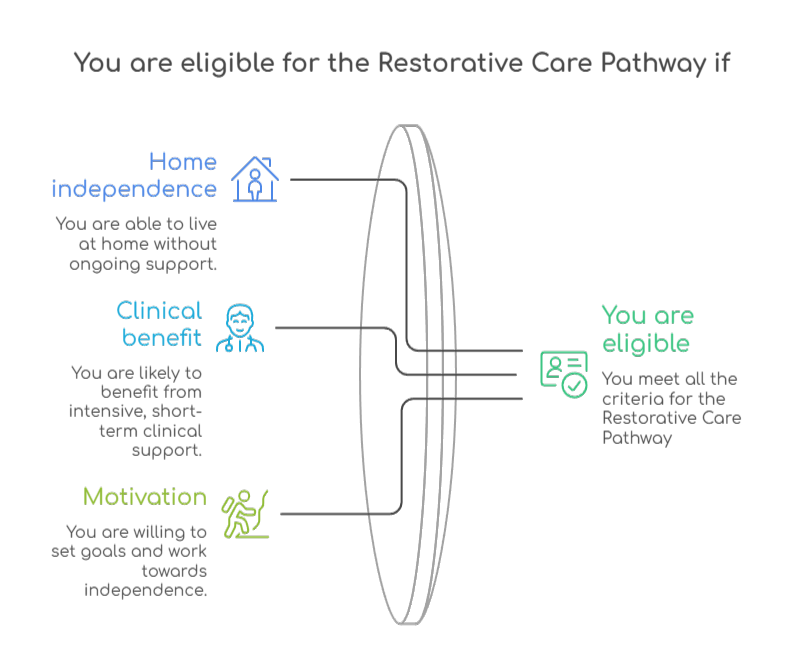
You are eligible for the Restorative Care Pathway if an aged care assessment confirms you meet the eligibility criteria. You must meet all three of the following criteria:
- You will be able to keep living at home without ongoing Support at Home services, or without changes to your existing services.
- You are likely to benefit from intensive, short-term clinical support.
- You are motivated and willing to set goals and actively work toward greater independence.
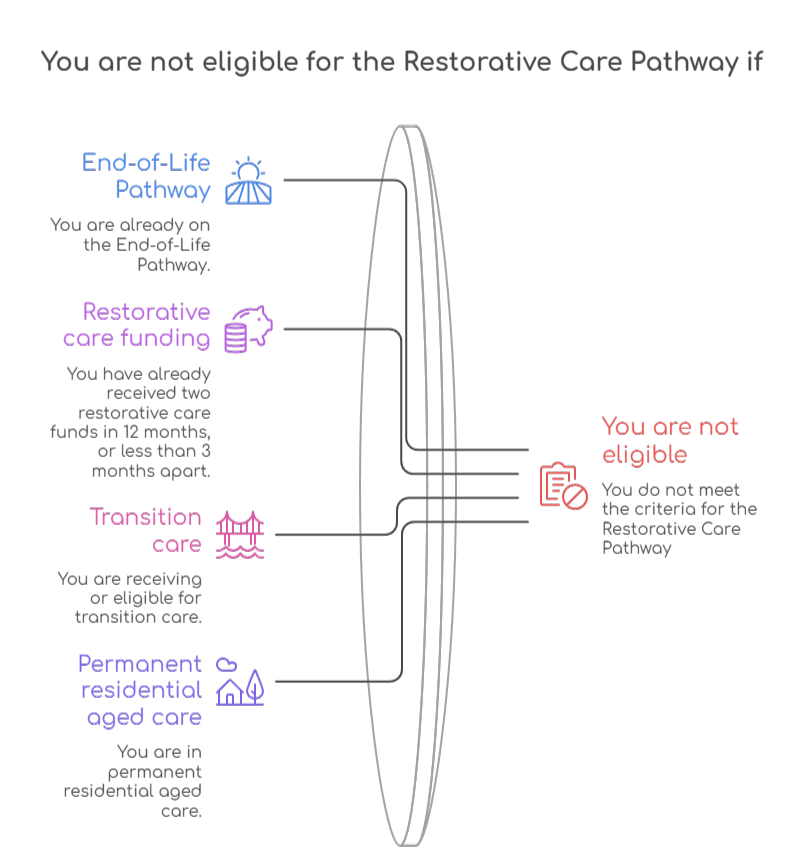
You are not eligible for the Restorative Care Pathway if any of the following apply:
- You are on the End-of-Life Pathway.
- You have already received two episodes of restorative care funding in the last 12 months, or your two episodes have not been separated by at least 3 months.
- You are receiving, or are eligible to receive, transition care.
- You are in permanent residential aged care.
You do not need to have been hospitalised to qualify for the Restorative Care Pathway. The pathway is available after any functional decline that meets the eligibility criteria, including after a fall at home. It also applies after a gradual change in what you can manage day-to-day.
You must have a formal aged care assessment through My Aged Care. Previous service approvals do not automatically qualify you for the Restorative Care Pathway.
How much funding is available?
Each episode of the Restorative Care Pathway provides around $6,179 for up to 16 weeks of intensive services. This funding is entirely separate from your ongoing Support at Home budget.
Eligible participants can apply for a second unit of Restorative Care Pathway funding through a Support Plan Review. This brings the total to up to $12,359 for a single episode.
The Restorative Care Pathway can be accessed up to twice per year, at $6,179 per episode. You must wait at least three months between episodes.
If you access the Restorative Care Pathway twice in a 12-month period, here is how the funding works:
- Episode 1: $6,179 for up to 16 weeks.
- Minimum 3-month gap between episodes.
- Episode 2: $6,179 for up to 16 weeks.
- Maximum total: $12,359 per 12-month period (two standard episodes).
If additional funding is approved for an episode (bringing it to $12,359), a second episode cannot be accessed in that 12-month period. Restorative Care Pathway funding does not reduce your quarterly Support at Home budget. If you are on an ongoing classification, both streams run separately.
What services are covered?
The Restorative Care Pathway covers the same services as the broader Support at Home program. The table below summarises the main service types and how costs are shared.
| Service type | Examples | Your contribution |
|---|---|---|
| Clinical supports | Nursing, physiotherapy, and occupational therapy | Nil — fully government-funded |
| Independence services | Personal care, transport, respite | Moderate — means-tested |
| Everyday living services | Domestic assistance, gardening, shopping | Higher — means-tested |
Source: Australian Government Department of Health, 2026.
Clinical services such as nursing and physiotherapy are fully funded by the government. You cannot be asked to contribute to these services.
From 1 October 2026, personal care services will also move to the clinical supports category. They will be fully government-funded with no out-of-pocket costs.
Within the Restorative Care Pathway, participants can access:
- Low- and medium-tier home modifications (under $500 and up to $2,000, respectively)
- Assistive technology at all three funding tiers (up to $500, $2,000, or $15,000)
High-tier home modifications (up to $15,000) require separate approval through the AT-HM scheme. For assistive technology, funding above $15,000 may be available with a valid prescription and formal approval.
Does the Restorative Care Pathway include therapy, exercise, and reablement?
Yes. The Restorative Care Pathway can fund a wide range of allied health therapies, such as:
- Physiotherapy
- Occupational therapy
- Exercise physiology
- Speech pathology
- Dietetics
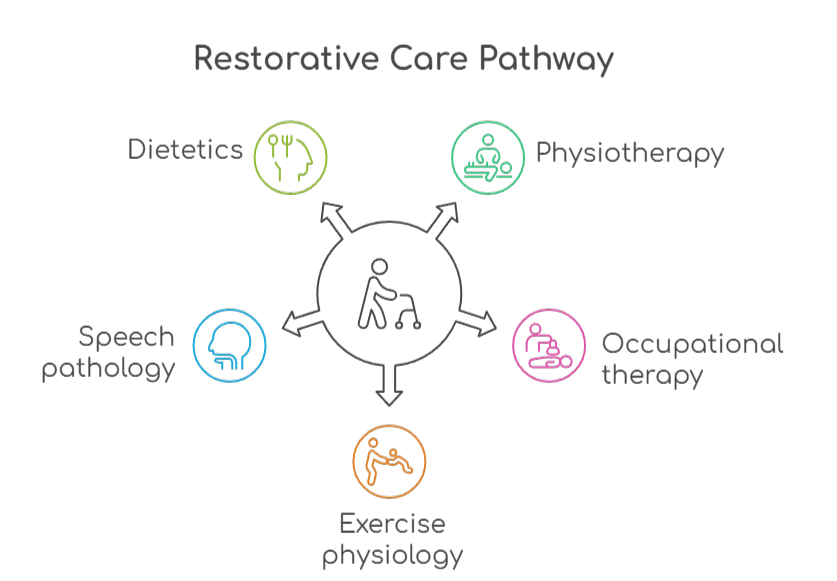
The focus is on rebuilding strength, balance, mobility, and confidence after a setback.
These services often include tailored home- or community-based exercise programs and reablement-focused interventions. The goal is to help you regain function and return to everyday activities as independently as possible.
Does the evidence show the Restorative Care Pathway works?
The Restorative Care Pathway replaced the Short-Term Restorative Care (STRC) Programme. The clinical model is the same, so research on the STRC Programme gives a reliable indication of what to expect.
A 2025 study published in BMC Health Services Research analysed 484 STRC clients with a mean age of 81.5 years. Key findings include:
- 97% of clients remained living in their own homes after program completion.
- Daily physical function, measured using the Modified Barthel Index, improved by a median of 2.5 points.
- Physical health scores improved by a median of 3.2 points on the PROMIS10 scale, and mental health scores by 2.5 points on the same scale.
- 48% of participants improved their physical health category, and 37% improved their mental health category.
A separate study by Schmidt et al. It reviewed 921 STRC participants. It found that 61.3% showed measurable improvement in physical functioning on the Modified Barthel Index after completing the program.
How long do you wait for restorative care?
The average wait time for the Restorative Care Pathway is 163 days from application to first service. This is significantly shorter than the 347-day average wait for ongoing Support at Home services.
The table below compares wait times across Support at Home pathways:
| Pathway | Median wait time |
|---|---|
| End-of-Life Pathway | 15 days |
| Assistive technology | 101 days |
| Home modifications | 102 days |
| Restorative Care Pathway | 163 days |
| Ongoing Support at Home | 347 days |
Source: Aged Care Decisions, May 2026
State variation is significant. Victoria recorded the shortest median overall wait at 273 days. Queensland had the longest at 322 days.
What is the timeline once you are approved?
Once you are approved for the Restorative Care Pathway, you have 56 days to start services with a provider. If you need more time, you can contact My Aged Care to request a 28-day extension, giving you a total of 84 days to begin.
If you don't start services before the take-up date, your funding is withdrawn. You would need to apply for a reassessment to regain access.
The 16-week episode runs consecutively from the day you start. There are no options to pause the episode for any reason, including hospitalisation or family emergencies. Your provider should begin planning your exit from the very start of the episode.
What happens at the end of the episode?
At the end of your Restorative Care Pathway episode, your provider must prepare an exit plan. It must include:
- The episode start and end dates
- Whether your goals were achieved
- Services you received during the episode
- Any assistive technology or home modifications provided
- Recommendations from the multidisciplinary team about your ongoing functional needs
You receive a copy of both your Restorative Care Pathway goal plan and your exit plan for your own records.
After the Restorative Care Pathway episode ends, your care team will assess whether you need more support. They can request a Support Plan Review on your behalf if needed. To access a second episode, you will need a new referral and aged care assessment, subject to the 12-month and 3-month eligibility rules.
How to access the Restorative Care Pathway: step by step
You access the Restorative Care Pathway by completing an aged care assessment through My Aged Care. The four steps below cover:
- Registration
- Assessment
- Approval
- Starting services
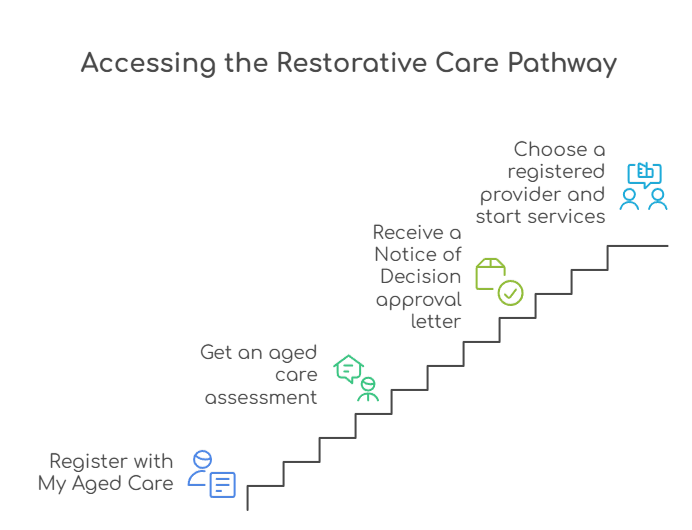
Step 1: Register with My Aged Care
Contact My Aged Care online or by phone to register your details. You can also ask a family member or carer to help with this step.
Step 2: Get an aged care assessment
An assessor will contact you to arrange an assessment. This typically occurs within 2 to 6 weeks of your application. The assessment itself is conducted in person, usually at home. You will receive your Notice of Decision letter within approximately 2 weeks of the assessment visit.
Step 3: Receive your approval
If approved, you will receive a Notice of Decision letter. Your take-up date, the deadline to begin services, is 56 days from your approval date.
Step 4: Choose a registered provider and begin services
Select a registered Support at Home provider. Your provider will develop a goal plan and individualised budget with you. Services must begin before your take-up date.
FAQ
Can I access the Restorative Care Pathway if I already receive ongoing Support at Home services?
You can access the Restorative Care Pathway while receiving ongoing Support at Home services. The two funding streams are separate. Your provider will make sure the two programs do not overlap.
What if my STRC approval was issued before 1 November 2025, but I have not started?
If you had an active Short-Term Restorative Care (STRC) approval and had not started an episode before 1 November 2025, your approval remains valid. You can use that approval for the new Restorative Care Pathway.
This is only valid for six months from the original STRC approval date. After six months, you will need a reassessment.
Is there a lifetime cap on what I contribute to Support at Home services?
There is a lifetime cap of $140,652.80 (current as of 20 September 2026) on income-tested contributions. This is a combined cap across Support at Home and residential aged care. Clinical supports are fully government-funded and do not count toward this cap.
What tools are used to measure progress during the pathway?
Providers use standardised tools to track your progress. This includes the Modified Barthel Index (mBI), the PROMIS10 Global Health scale, and the Goal Attainment Scale. A study of 484 STRC clients found a median improvement of 2.5 points on the mBI by the end of the program. Your provider must record whether your goals were achieved in your exit plan and give you a copy.
Does the Restorative Care Pathway cover home modifications?
The pathway covers assistive technology at all funding levels, and low- and medium-tier home modifications. High-tier home modifications (up to $15,000) require separate approval through the AT-HM scheme. Assistive technology above $15,000 may also be available where clinically justified.
Start your Restorative Care Pathway with Sensible Care
The Restorative Care Pathway is one of the most accessible short-term programs in Australia's aged care system. Clinical services are fully funded, wait times are shorter than ongoing care, and your regular Support at Home budget is not affected.
The key is acting early. Register with My Aged Care, confirm your eligibility, and have a provider ready before your take-up date.
Sensible Care is a registered Support at Home provider operating across VIC, NSW, QLD, WA, SA, and TAS. Our in-house allied health team can support you through every stage of your restorative care episode. This means from setting your goals to completing your exit plan.
There are no lock-in contracts, no daily fees, and no exit charges. Call us to book a free consultation.
These amounts are set by the Australian Government and change at least twice a year. Check health.gov.au for the current amounts before you make a decision.

Take the Next Step in Care
Download our Info Kit or speak to one of our friendly team members today.


Explore More Helpful Reads
More stories, guides, and updates to support you and your family.



Need Help Getting Started?
Reach out on your terms, pick a time that suits you and let’s talk about how we can help.


.webp)