.svg)

Support at Home vs Home Care Package: What changed and what it means for you
Your Home Care Package moved to Support at Home on 1 November 2025. Here's what changed, what stayed the same, and what you'll pay from now on.
Author: Sensible Care

Support at Home replaced Home Care Packages on 1 November 2025. Existing packages transferred automatically — same funding level, same provider, no reapplication. What's actually new comes down to funding and contributions. Eight classifications replaced four HCP levels. Budgets are quarterly rather than annual, and contributions are set by service type. Three short-term pathways fund equipment, post-hospital recovery, and end-of-life care outside your budget. Your lifetime cap depends on timing: $88,934.57 if you were approved on or before 12 September 2024, $140,652.80 otherwise. Personal care will become fully government-funded from 1 October 2026.
Support at Home is Australia's government-funded in-home aged care program. It replaced the Home Care Packages Program on 1 November 2025.
If you or a family member had a Home Care Package, your care has already moved into the new system. This guide explains what changed, how funding and costs compare, and what to do next.
Support at Home vs Home Care Packages at a glance
| Home Care Packages (to 31 Oct 2025) | Support at Home (from 1 Nov 2025) | |
|---|---|---|
| Funding structure | 4 package levels | 8 ongoing classifications, plus 3 short-term pathways |
| Maximum ongoing funding | Level 4, approx. $62,589 per year | Level 8, $80,294.00 per year |
| How budgets are delivered | Notional annual budget | Quarterly budgets |
| Unspent funds | Accumulated and stayed with you, including when you changed provider | Carry over up to $1,000 or 10% of your quarterly budget, whichever is greater |
| How contributions are set | Basic daily fee plus income-tested care fee, applied to the package as a whole | Fixed rates by service category: clinical 0%, independence 5–50%, everyday living 17.5–80% |
| Clinical care | Funded from your package budget | Fully government-funded, no contribution |
| Care management | Care management and package management fees set by the provider | Capped at 10% of your quarterly budget |
| Equipment and home mods | Paid from your package budget | Separate AT-HM funding tier of $500, $2,000, or $15,000 |
| Short-term intensive support | No dedicated funding stream | Restorative Care Pathway (approx. $6,179, extendable to $12,359) and End-of-Life Pathway (approx. $25,700) |
| Lifetime contribution cap | $88,934.57 (indexed) | $140,652.80 (indexed), or $88,934.57 if you are 'no worse off' |
| Changing providers | Permitted, no exit fees since 1 January 2023 | Permitted at any time; exit fees and minimum service periods prohibited under the Aged Care Rules 2025 |
Two things are worth noting before you read on.
First, if you had a package on or before 12 September 2024, several of these changes do not apply to you. The 'no worse off' principle preserves your old contribution rates and cap.
Second, the shift from an annual to a quarterly budget is the change most likely to affect day-to-day planning. This is due to the fact that funds no longer accumulate the way they used to.
How do Support at Home funding levels compare to Home Care Package levels?
Support at Home has eight classifications for ongoing services. Former Home Care Package recipients moved to equivalent classifications in November 2025. Their funding level was preserved.
The table below shows all 8 classifications and the 4 transitioned Home Care Package classifications.
| Classification | Quarterly budget | Annual amount |
|---|---|---|
| Level 1 | $2,757.89 | $11,031.56 |
| Level 2 | $4,120.89 | $16,483.55 |
| Level 3 | $5,645.23 | $22,580.93 |
| Level 4 | $7,632.04 | $30,528.15 |
| Level 5 | $10,202.32 | $40,809.27 |
| Level 6 | $12,365.48 | $49,461.91 |
| Level 7 | $14,944.20 | $59,776.80 |
| Level 8 | $20,073.50 | $80,294.00 |
| Transitioned HCP Level 1 | $2,823.55 | $11,294.22 |
| Transitioned HCP Level 2 | $4,965.14 | $19,860.56 |
| Transitioned HCP Level 3 | $10,808.30 | $43,233.21 |
| Transitioned HCP Level 4 | $16,385.99 | $65,543.98 |
Source: My Aged Care, 2025.
Funding amounts are indexed on 1 July each year.
How budgets are delivered
Under the old Home Care Packages Program, you received a notional annual budget. Support at Home delivers funding in quarterly budgets instead. You can carry over up to $1,000 or 10% of your quarterly budget from the previous quarter, whichever is greater.
Note that 10% of your quarterly budget goes towards care management and is allocated to your provider.
What will you pay under Support at Home?
What you pay depends on two things: the category of service you receive, and your income and assets assessment outcome.
There are three contribution tiers under Support at Home:
| Service category | What it covers | Full pensioner rate | Self-funded (no CSHC) |
|---|---|---|---|
| Clinical supports | Nursing, physiotherapy | 0% | 0% |
| Independence | Personal care, equipment | 5% | 50% |
| Everyday living | Cleaning, gardening | 17.5% | 80% |
Source: My Aged Care, 2025.
Your Home Care Package transferred automatically to Support at Home on 1 November 2025. You do not need to reapply, and reassessment isn't required unless your care needs have changed. However, your provider may have asked you to sign a new service agreement reflecting the updated Support at Home terms.
Your funding level and provider generally remain in place under a transitioned classification.
Personal care costs from October 2026
From 1 October 2026, the government will fully fund personal care services under Support at Home. If personal care is approved in your support plan and you have available Support at Home funding, you will pay no contributions. This applies to personal care services delivered on or after that date.
Lifetime contribution caps
Two lifetime caps apply, depending on when you entered the system.
The first is the 'no worse off' principle. This applies to you if you were receiving or approved for a Home Care Package on or before 12 September 2024. In that case, your lifetime cap remains $88,934.57, indexed (twice yearly on 20 March and 20 September).
If you entered under the 1 November 2025 arrangements, your cap is $140,652.80, also indexed twice yearly. Once you reach this cap, the government covers all remaining non-clinical service costs. Clinical care such as nursing and allied health has always been fully government-funded.
Those approved between 13 September 2024 and 31 October 2025 aren't covered by this protection. They transitioned into Support at Home in November 2025 under standard contribution rates and the higher $140,652.80 cap.
What short-term pathways are available under Support at Home?
Support at Home includes three short‑term classifications in addition to the 8 ongoing funding levels:
- The Assistive Technology and Home Modifications (AT‑HM) scheme
- The Restorative Care Pathway
- The End‑of‑Life Pathway
These short‑term supports have separate funding from your ongoing classification budget. AT‑HM and the Restorative Care Pathway can sit alongside ongoing funding. The End‑of‑Life Pathway is accessed instead of your usual ongoing budget for its duration.
Assistive technology and home modifications
The Assistive Technology and Home Modifications (AT-HM) scheme funds equipment and home modifications. This funding is separate from your ongoing budget.
Depending on assessed need, this is up to $500, $2,000, or $15,000 over a typical 12-month period. This can cover items such as mobility aids, grab rails, handrails, and ramps.
Restorative care
The Restorative Care Pathway provides funding of around $6,179 per episode for up to 16 weeks of intensive services. It focuses on helping you regain strength and independence after an illness, injury, or hospital stay.
If your needs are greater, a second unit of funding can be approved, giving up to $12,359 in total over a 12‑month period. This funding sits separately from your ongoing Support at Home classification budget.
End-of-life pathway
The End-of-Life Pathway provides around $25,700 in short-term funding over 12 weeks, and you can keep using what's left until week 16. It supports coordinated home care for people nearing the end of life who want to remain at home.
It works alongside specialist palliative care and clinical supports. Those clinical supports stay fully government-funded. Independence and everyday living services on the pathway still attract means‑tested contributions.
What services are available under Support at Home?
Support at Home covers a broad range of services across its three categories. You do not need to use all categories. Your support plan reflects your assessed needs.
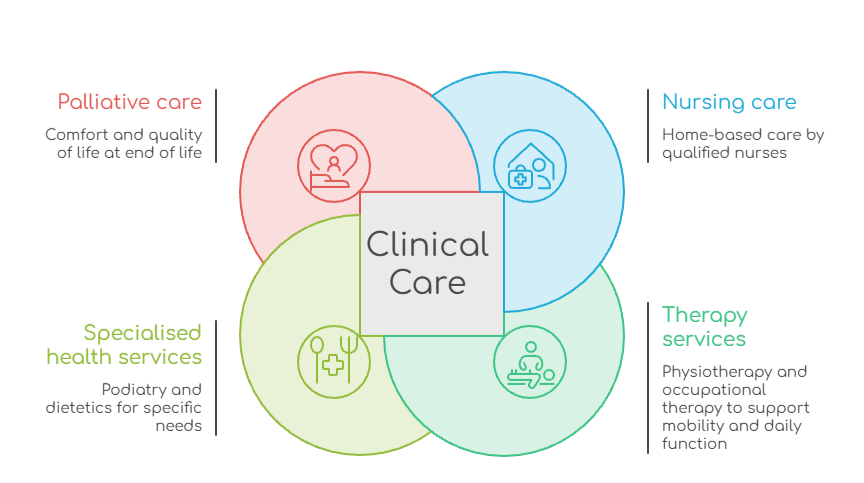
Clinical care supports include:
- Nursing care delivered at home by qualified nurses
- Physiotherapy and occupational therapy to support mobility and daily function
- Podiatry and dietetics for foot health and nutrition
- Palliative care for comfort and quality of life at end of life
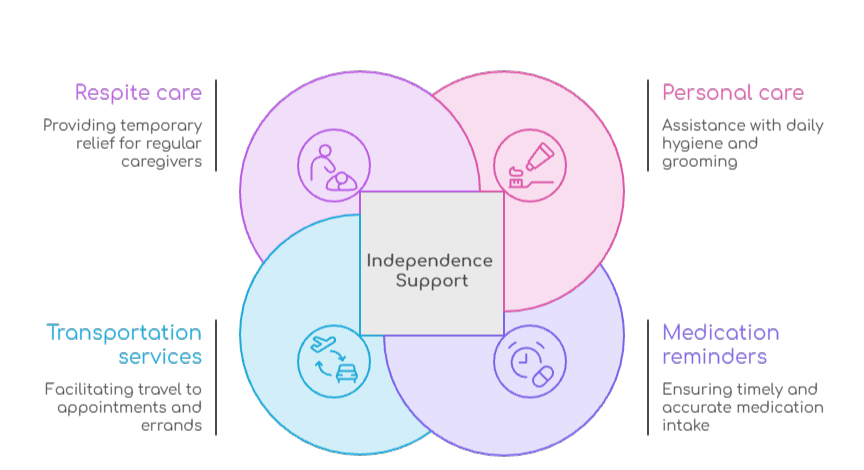
Independence supports include:
- Personal care, covering showering, dressing and grooming
- Medication reminders and self-administration support
- Transport to medical and other appointments
- Respite care to give your regular carer a short break
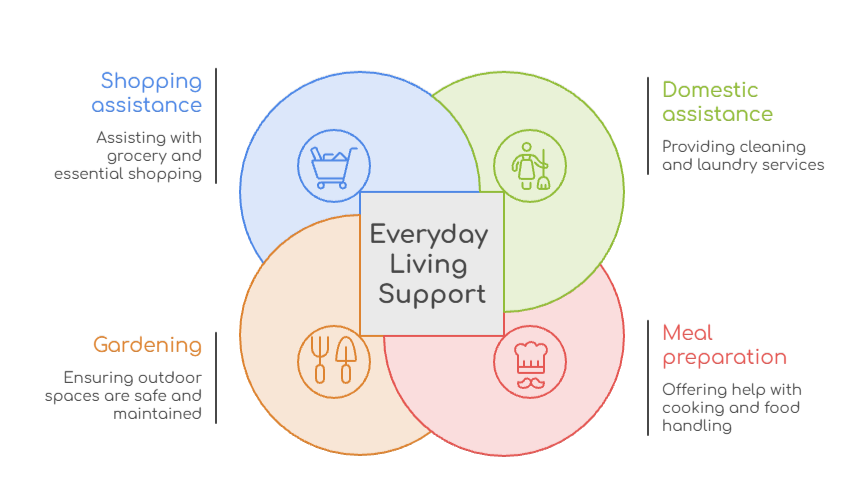
Everyday living supports include:
- Domestic assistance, covering cleaning and laundry
- Meal preparation, including help with cooking and food handling
- Gardening to keep your outdoor spaces safe and maintained
- Shopping assistance for groceries and other essentials
Why did the government replace Home Care Packages?
Support at Home came out of two major reviews, not a decision to rename an existing program.
The Royal Commission into Aged Care Quality and Safety reported in 2021 that people were waiting too long for a Home Care Package. It also found four package levels too blunt to match individual needs.
The Aged Care Taskforce reported in March 2024 and set the principle behind the new contribution tiers. The government should fully fund clinical care because clinical need shouldn't depend on the ability to pay.
Participants contribute more towards everyday living services such as cleaning, gardening, and meals. These are costs people already meet in their own homes.
Support at Home started on 1 November 2025 alongside the new Aged Care Act. The new Act replaced the Aged Care Act 1997 with a single framework built around a statement of rights for older people.
FAQ
Can I switch providers under Support at Home?
You can change providers at any time under Support at Home. Providers cannot lawfully charge exit fees or lock you into minimum service periods under the Aged Care Rules 2025. Contact My Aged Care or your current provider to start the process.
Does Support at Home cover dementia care and palliative care?
Support at Home covers dementia care and palliative care across all three service categories. Clinical supports, including nursing and allied health, are fully government-funded, so you pay nothing for them. Independence and everyday living supports may still attract means-tested contributions.
What if my care needs increase?
If your needs change, your provider can request a reassessment through My Aged Care. You may move to a higher classification, giving you a larger quarterly budget. Short-term pathways are also available for periods of higher need.
What happened to the Commonwealth Home Support Programme?
The Commonwealth Home Support Programme (CHSP) has not been absorbed into Support at Home yet. It has been extended from 1 July 2025 to 30 June 2027.
The bottom line
If you already had a Home Care Package, not much changed day to day. You kept your provider, your funding level and your services.
What's different is the detail. Your budget now comes quarterly instead of yearly. What you pay depends on the type of service.
Nursing is free, and cleaning and gardening cost the most. And there's separate funding for equipment, recovery after hospital, and end-of-life care.
Working out which classification, contribution rate, and cap apply to you is easier with someone who does it every day. Sensible Care can explain what your quarterly budget covers, what you'll pay for each service, and how to make your funding go further.
Get in touch if you want to know more.
These amounts are set by the Australian Government and change at least twice a year. Check health.gov.au for the current amounts before you make a decision.

Take the Next Step in Care
Download our Info Kit or speak to one of our friendly team members today.


Explore More Helpful Reads
More stories, guides, and updates to support you and your family.




Need Help Getting Started?
Reach out on your terms, pick a time that suits you and let’s talk about how we can help.


.webp)