.svg)

Support at home transition guide: What you need to know
Support at Home transition guide: what changed on 1 Nov 2025, who's protected, new funding tiers, costs, and how to switch providers.
Author: Sensible Care

Former Home Care Package and Short-Term Restorative Care recipients automatically transferred to Support at Home when it officially launched on 1 November 2025. There was no need for them to reapply. The program introduces eight needs-based funding classifications, fully funds clinical care, and sets a lifetime cap on non-clinical contributions. Recipients approved on or before 12 September 2024 are protected by a "no worse off" principle. The Commonwealth Home Support Programme won't transition until no earlier than 1 July 2027.
The Support at Home program launched on 1 November 2025. It replaced the Home Care Packages (HCP) Program and the Short-Term Restorative Care Programme.
If you used to receive a Home Care Package, your care and funding transferred automatically. In other words, you did not need to reapply or sign new paperwork.
While any change to your care can feel unsettling, the transition was designed to be smooth. Services continued uninterrupted, so there was nothing you needed to do.
This Support at Home transition guide explains what changed, what didn't, and how to make the most of your funding.
What is the Support at Home program?
Support at Home is the Australian Government's funded home care program for older Australians. It helps people aged 65 and over (or 50 and over for Aboriginal and Torres Strait Islander people) stay living independently at home for longer.
The program replaced the Home Care Packages Program and the Short-Term Restorative Care Programme on 1 November 2025. The Commonwealth Home Support Programme (CHSP) continues to operate separately until no earlier than 1 July 2027.
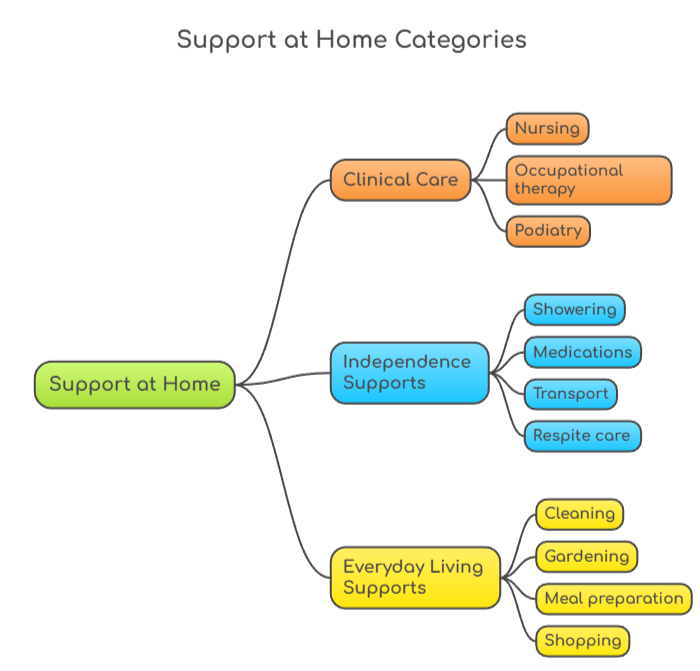
Support at Home covers three categories of care:
- Clinical care supports
- Independence supports
- Everyday living supports
Clinical care covers nursing, occupational therapy, podiatry, and other health services. They are fully funded by the government with no participant contribution.
Independent supports include help with showering, medications, transport, and respite care. Participants pay a moderate contribution toward these supports.
Everyday living supports include cleaning, gardening, meal preparation, and shopping. These carry the highest participant contributions.
As of 31 March 2025, 299,765 people had access to a Home Care Package. This figure is sourced from the Australian Institute of Health and Welfare. All those people transitioned to Support at Home on 1 November 2025.
Do you need to reapply when transitioning to Support at Home?
You do not need to reapply for Support at Home if you already had a Home Care Package. The Department of Health and Aged Care confirmed that all existing HCP recipients transferred automatically on 1 November 2025. The services continued normally without interruption.
Your funding level was kept during the transition. For people who were receiving or approved for a Home Care Package on or before 12 September 2024, the government's "no worse off" principle applies. This means your contributions will be the same or lower under Support at Home.
If you previously paid no income-tested care fee, you will not be asked to pay contributions now. People approved for a package after 12 September 2024 pay standard Support at Home contribution rates.
If you are new to the system, you start by registering through My Aged Care.
The national median time from application to commencement of aged care services is 294 days. This number comes from the Aged Care Act 2024 – Wait Times Report (2026).
For Support at Home specifically, the median wait is approximately 347 days. According to the same report, Victoria has the shortest median wait at 273 days, while Queensland has the longest at 322 days.
How do the new funding classifications work?
Support at Home uses eight funding classifications instead of the previous four Home Care Package levels. This gives a closer match between your assessed needs and the funding you receive.
Annual funding ranges from $11,031.56 at Classification 1 to $80,294.00 at Classification 8. The funding ranges are current as of 1 October 2026, and indexed annually on 1 July.
| Classification | Quarterly budget | Annual amount |
|---|---|---|
| 1 | $2,757.89 | $11,031.56 |
| 2 | $4,120.89 | $16,483.55 |
| 3 | $5,645.23 | $22,580.93 |
| 4 | $7,632.04 | $30,528.15 |
| 5 | $10,202.32 | $40,809.27 |
| 6 | $12,365.48 | $49,461.91 |
| 7 | $14,944.20 | $59,776.80 |
| 8 | $20,073.50 | $80,294.00 |
Source: Department of Health and Aged Care, Funding Classifications for Support at Home, October 2026
Note that 10% of each quarterly budget is set aside for care management. In other words, the amount available for direct services is slightly less than the figures above.
Your classification is set during your aged care assessment. Budgets are allocated quarterly. You can carry over unspent funds of up to $1,000 or 10% of your quarterly budget, whichever is greater, to the following quarter.
What does Support at Home cost you?
Your out-of-pocket costs under Support at Home depend on the type of service and your financial situation. Clinical support services cost you nothing, as the government covers the full amount. Independence and everyday living services involve participant contributions assessed by Services Australia.
The lifetime cap on contributions is $140,652.80, current as of 20 September 2026. This cap is indexed on 20 March and 20 September each year.
National median hourly rates for common services are:
| Service | Median rate | Range |
|---|---|---|
| Nursing care | $150/hr | $125–$179/hr |
| Personal care | $100/hr | $85–$115/hr |
| Domestic assistance | $95/hr | $83–$109/hr |
| Social support | $99/hr | $82–$110/hr |
| Respite care | $99/hr | $85–$112/hr |
| Transport | $70/trip | $40–$97/trip |
| Meal delivery | $15/meal | $11–$22/meal |
Source: Aged Care Decisions (prices correct as of 23 December 2025)
The government had previously announced price caps on Support at Home services from 1 July 2026. However, this implementation has since been paused indefinitely. Providers currently continue to set their own prices.
From 1 October 2026, personal care services will be fully funded by the government. This means you'll pay nothing for personal care, as long as it's in your support plan and you have funding available.
If you cannot afford your contributions, Services Australia manages financial hardship applications. To be eligible, you must have assets valued at no more than $46,835.10, excluding unrealisable assets. This is one of several criteria (there are also gifting limits, assessment requirements, etc.).
What is the Assistive Technology and Home Modifications scheme?
Support at Home also introduced the Assistive Technology and Home Modifications (AT‑HM) scheme. It gives participants a separate pool of funding for assistive technology and home modifications.
This pool sits alongside your regular Support at Home budget. This means you do not have to "save up" from your ongoing quarterly care budget to pay for eligible items under the AT‑HM scheme.
There are three short‑term funding tiers for both assistive technology and home modifications:
| Tier | Assistive technology (AT) | Home modifications (HM) | Standard access period |
|---|---|---|---|
| Low | Up to $500 | Up to $500 | 12 months |
| Medium | Up to $2,000 | Up to $2,000 | 12 months |
| High | Up to $15,000+* | Up to $15,000 (lifetime cap)* | 12 months (see notes) |
* Higher amounts for assistive technology can be approved with evidence. High‑tier home‑modification funding is capped at $15,000 per lifetime.
Source: Department of Health and Aged Care, AT-HM Scheme, 2025
AT‑HM funding is allocated for a fixed period, generally 12 months, and any unspent funds do not roll over. For AT, this 12‑month funding period usually starts from the date you sign your service agreement with your provider.
Older people with specific progressive conditions may be able to access AT funding over a 24‑month period. In some cases, this can be extended up to a total of 48 months when clinically justified.
High‑tier home‑modification funding can be extended from 12 months to a maximum of 24 months. This applies if the modifications are complex and you and your provider can show evidence of progress to Services Australia. For example, quotes obtained and works underway.
What are the short-term pathways under Support at Home?
Support at Home includes two short-term pathways:
- The Restorative Care Pathway for rehabilitation
- The End-of-Life Pathway for people in their final months at home
Restorative care pathway
The Restorative Care Pathway funds rehabilitation and recovery support for up to 16 weeks. Funding is around $6,000, with the potential to increase to $12,000 for eligible participants. This pathway suits people recovering after a hospital stay or a decline in function who want to rebuild independence.
End-of-life pathway
The End‑of‑Life Pathway is a short‑term Support at Home option. It's for older people who have been assessed as having 3 months or less to live and who wish to remain at home.
This pathway provides around $25,000 in funding for home care services over a 12‑week period. It also includes flexibility to keep using any unspent funds for up to 16 weeks in total.
According to the Aged Care Act 2024 – Wait Times Report (2026), the End‑of‑Life Pathway has the fastest access to any Support at Home service type. The median wait time is about 15 days from applying to starting services.
How to switch Support at Home providers
You can change Support at Home providers at any time if you're not happy with your current services or your needs have changed. When you switch, your Support at Home classification, quarterly budget, and unspent funds move with you to the new provider. You cannot be charged an exit fee.
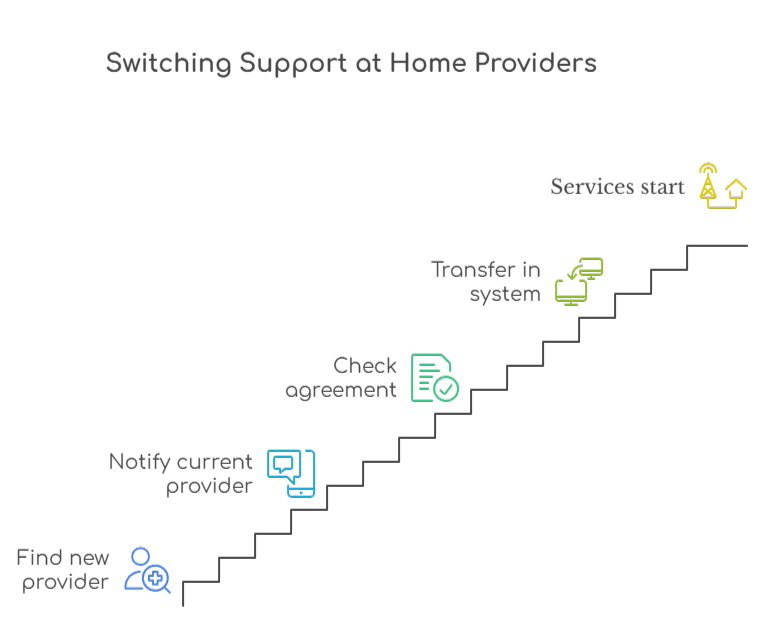
The practical steps to switching Support at Home providers are:
- Find and contact the new provider you want to move to.
- Notify your current provider and agree on an end date.
- Check your service agreement for any notice period.
- Your new provider completes the transfer in the My Aged Care system.
- Services start with your new provider on or after the agreed exit date.
Many providers ask for around 14 days' notice, and some require up to 4 weeks. Always check your agreement rather than assuming a set period.
Some providers will manage almost all of this process for you, so you have very little paperwork to do yourself.
What to check before switching providers
Before switching, compare providers' hourly rates against the government's indicative Support at Home prices in the Costs section. Confirm exactly what services are included in your care plan.
Check that the provider isn't charging for care management beyond the standard 10% of your quarterly budget that's already set aside for it.
Under Support at Home, providers also can't add separate administration or staff‑travel surcharges. These must be built into the unit price for each service, in line with the Department of Health's pricing guidance and consumer‑protection rules.
Self-managed vs care-managed options
Under Support at Home, you choose how hands‑on you want to be. Self‑managed participants have more say over their workers, schedules and budget. Care‑managed participants have a care partner coordinate most services for them.
Either way, your provider must still deliver care‑management activities under the program rules. The Department of Health's guidance reserves 10% of each participant's budget for care management. They require providers to carry out at least one direct care‑management activity per month, even for those who self‑manage.
What does the CHSP transition mean for you?
The Commonwealth Home Support Programme will not transition to Support at Home until no earlier than 1 July 2027. If you currently receive CHSP services, nothing changes yet.
You do not need to apply for Support at Home now unless your needs have increased. Consider applying only if a more coordinated care approach is warranted.
Frequently asked questions
Does switching to Support at Home mean I lose my existing entitlements?
No, your entitlements are protected during the transition. The Department of Health and Aged Care confirmed that anyone receiving or approved for an HCP on or before 12 September 2024 will be no worse off under Support at Home. Your funding level and services stay the same.
Can I keep my current care workers when I switch providers?
It depends on how your care workers are employed and whether they're willing to move. Some support workers are tied to a single provider. Others work for multiple agencies or as independent contractors. Before switching, ask both your new provider and your current workers whether this is possible.
What happens to unspent funds in my Support at Home budget?
You can carry over unspent funds of up to $1,000 or 10% of your quarterly budget (whichever is higher) into the next quarter. Anything above that cap doesn't roll over and returns to the government.
Any unspent Home Care Package funds from before your transition aren't subject to this cap. You can keep using them on top of your quarterly budget, in line with the Support at Home rules.
Is the NDIS affected by the Support at Home transition?
No, the NDIS and Support at Home are separate programs with different eligibility rules. The NDIS funds people with a permanent, significant disability who are under 65 when they first apply, and many stay on it after turning 65. Support at Home is part of the aged‑care system, generally for people aged 65 and over (or 50 and over for Aboriginal and Torres Strait Islander people).
The transition doesn't change how the NDIS works or who qualifies. But as before, you usually can't receive NDIS and aged‑care funding for the same supports at once. So, you may still need to choose which system best suits your needs.
Do I need to pay more under Support at Home than I did under a Home Care Package?
If you were approved for or receiving a Home Care Package before 12 September 2024, the no‑worse‑off principle means you won't pay more than you did under your package. For new participants, contributions depend on the service. None for clinical care, moderate for independence supports, and the highest for everyday living. A combined lifetime cap of $140,652.80 (as of 20 September 2026) applies to non‑clinical contributions across both home‑based and residential aged care. Once you reach it, you pay nothing more.
Making the most of your Support at Home transition
The move to Support at Home is one of the biggest changes to aged care in years, but for most people, it has been smooth.
Existing recipients kept their funding and services automatically. Those approved before 12 September 2024 are protected from paying more.
Knowing how the funding works, what you'll contribute, and your right to switch providers puts you in the best position to make the most of your budget.
Sensible Care supports more than 3,500 clients across Australia. With Sensible Care, you get transparent pricing and no lock-in contracts, daily fees, or exit charges.
If you're switching providers, Sensible Care handles all the paperwork for you. Both self-managed and care-managed options are available. Book a free consultation, or download the free information kit to see what services and funding you can access.
These amounts are set by the Australian Government and change at least twice a year. Check health.gov.au for the current amounts before you make a decision.

Take the Next Step in Care
Download our Info Kit or speak to one of our friendly team members today.


Explore More Helpful Reads
More stories, guides, and updates to support you and your family.




Need Help Getting Started?
Reach out on your terms, pick a time that suits you and let’s talk about how we can help.


.webp)