.svg)

Aged care providers in Australia: How to find the right one for you
Compare aged care providers in Australia: how the system works, what you'll pay under Support at Home, star ratings, and how to switch providers.
Author: Sensible Care

Australia's aged care system runs on three service types. These are entry-level home support (CHSP), Support at Home for ongoing care, and residential aged care. Each is delivered by different providers. When comparing providers, weigh their services, fees, coverage, and quality record. Check the Aged Care Quality and Safety Commission's Provider Register, and for residential homes, read the Star Ratings. Ask for pricing in writing and watch for red flags like exit fees or vague costs. Remember that you can switch providers at any time without penalty.
Aged care providers are organisations approved to deliver government-funded support services. These services are delivered either in the person's own home or in residential care.
As at 30 June 2025, more than 1.3 million Australians were using government-funded aged care. These services span home support, home care, and residential care settings across the country.
This guide explains how the aged care system works, what your funding options are, and what you will pay. It also covers what to look for when comparing aged care providers.
What types of aged care providers are there?
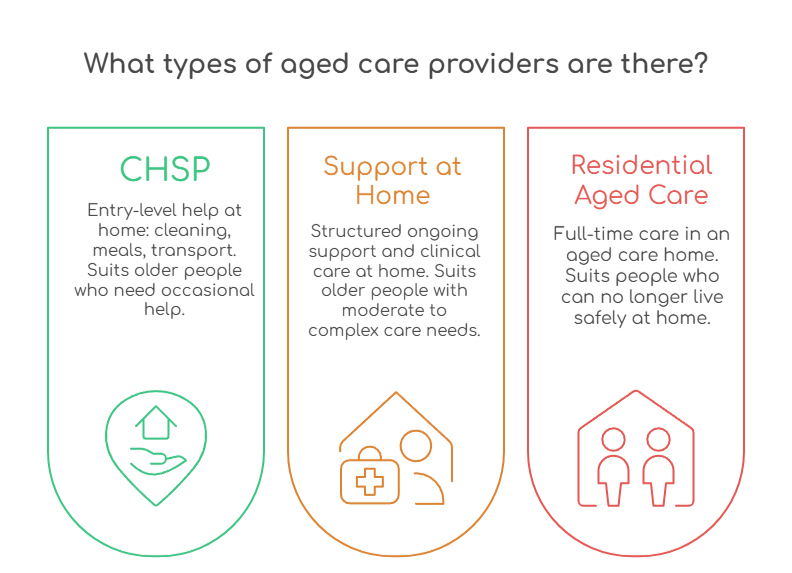
Australia's aged care system has three main service types: the Commonwealth Home Support Programme (CHSP), Support at Home, and residential aged care.
The Commonwealth Home Support Programme (CHSP)
Commonwealth Home Support Programme providers deliver entry-level assistance. For example, domestic help, social support, meals, and transport.
These services are subsidised by the government. They are designed for people who need a small amount of help to stay independent at home.
Note that the Commonwealth Home Support Programme has still not been replaced by Support at Home. It's scheduled to transition to Support at Home no earlier than 1 July 2027.
Home care and Support at Home providers
Support at Home providers deliver more structured, ongoing support. From 1 November 2025, the new Support at Home program replaced the Home Care Packages Program. It also replaced the Short-Term Restorative Care Programme at the same time.
Providers work with you to plan and coordinate services within your quarterly budget, which is held by Services Australia. They can also deliver clinical care, including nursing and allied health support.
Residential aged care providers
Residential providers run aged care homes where staff are available around the clock. They deliver accommodation, meals, personal care, and clinical support, such as nursing, for people who can no longer live at home.
This level of care suits people with higher or more complex needs. It can be arranged on a permanent or short-term basis, including respite stays that give family carers a break.
What is the Support at Home program, and how does it affect you?
Support at Home is Australia's current government-funded home care program. It replaced the Home Care Packages Program on 1 November 2025.
Under Support at Home, you receive a quarterly budget to cover your assessed care needs. Up to $1,000 or 10% of your quarterly budget can be carried over to the next quarter. Your provider helps you plan how to use that budget across your approved services.
Once assessed, you are assigned one of 8 ongoing funding classifications. These determine how much government funding you receive each quarter. Your classification reflects your assessed level of need.
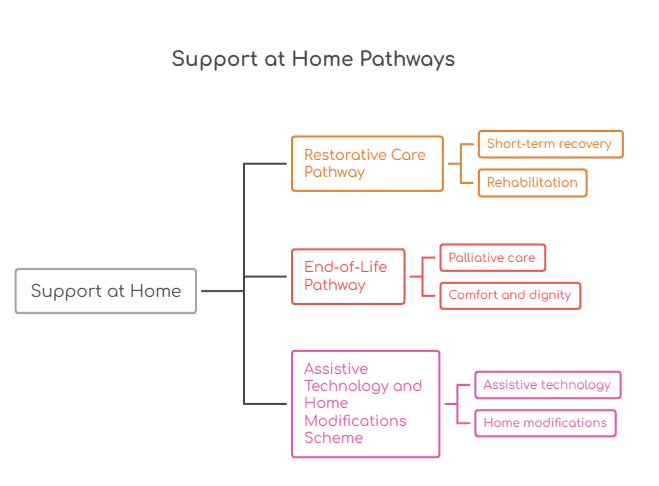
Support at Home includes three short-term pathways:
- The Restorative Care Pathway
- The End-of-Life Pathway
- The Assistive Technology and Home Modifications (AT-HM) scheme.
You can usually be approved for up to two restorative care episodes at $6,000 per episode in a 12‑month period. If an episode is increased to $12,000, you cannot receive a second episode in that period.
What will you pay for aged care services?
What you pay depends on the type of service, your income and assets, and which provider you choose.
What you pay under Support at Home
Support at Home divides services into three categories, and each category has a different contribution rate. Full pensioners pay 0% for clinical supports, 5% for independence services, and 17.5% for everyday living services.
From 1 October 2026, the Australian Government will fully fund personal care services. This means approved personal care will cost you nothing out of pocket.
The Home Care Package lifetime contribution cap of $86,185.23 (indexed annually) carried over to Support at Home. A separate lifetime cap of $135,318.69 applies across both residential aged care and Support at Home contributions.
Based on your income and assets assessment, Services Australia will tell you and your provider how much you need to contribute.
What you pay in residential aged care
Residential aged care involves multiple fee types. The maximum basic daily fee is $66.80 per day, or $24,382 per year. This fee is set at 85% of the single basic Age Pension.
The basic daily fee is indexed on 20 March and 20 September each year.
On top of the basic daily fee, most residents also pay an accommodation payment. You can structure this as a:
- Refundable Accommodation Deposit (RAD)
- Daily Accommodation Payment (DAP)
- Combination of both
You have 28 days after entering care to decide how to pay for your accommodation. You must pay the DAP until the RAD is paid.
The DAP is calculated by applying the maximum permissible interest rate to your agreed room price. The resulting figure is then divided by 365 to produce a daily amount.
If you enter care on or after 1 November 2025, there's a limit on how much you pay towards non-clinical care. This is capped both daily and over your lifetime.
The lifetime cap is currently $135,318.69, the same limit that applies to Support at Home. It rises over time with indexation.
If you cannot afford your care costs, you can apply for financial hardship assistance. The Australian Government will pay some or all of your costs if you are eligible.
How does the NDIS fit with aged care providers?
The NDIS and aged care are separate systems with different rules. A registered aged care provider is not automatically an NDIS provider, and NDIS funds generally cannot pay for aged care services.
Some providers are registered under both systems. But they operate under separate rules and funding streams. Your entitlements under each are assessed independently.
If you receive NDIS supports and turn 65, you can choose to remain on the NDIS or transition to the aged care system. There is no automatic transition. Only people who have not yet accessed the NDIS before turning 65 are directed to aged care instead.
Your NDIS planner or local area coordinator can explain your options.
How do you choose between aged home care providers?
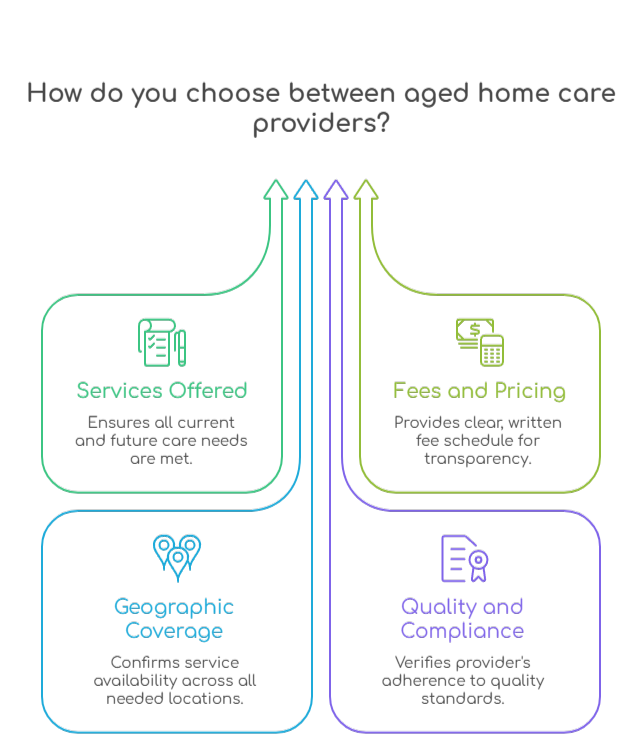
Choosing between aged home care providers comes down to four factors. These include the services they offer, their fees, where they operate, and their quality record.
Services offered
Check that the provider offers every service type you need now, and ask about the clinical services you may need later. Some providers focus on domestic aid and transport. Others offer clinical services such as:
- Community nursing
- Physiotherapy
- Occupational therapy
- Podiatry
- Dietetics
If your needs are likely to change, choose a provider with a broad service range so you do not have to switch later.
Fees and pricing transparency
Each Support at Home provider sets its own prices for services and care management. Ask for a written fee schedule before you sign anything. Make sure it spells out care management and package management charges, not just service prices.
Look for providers who publish their pricing clearly and who charge:
- No exit fees
- No daily administration fees
- No lock-in contracts
It is also worth asking how the provider manages your quarterly Support at Home budget. This includes whether unspent funds (up to $1,000 or 10%) are carried over to the next quarter.
Geographic coverage
Some providers are location-specific. If you travel frequently or live in a regional area, check that your provider can deliver services wherever you need them. Use the My Aged Care 'Find a provider' tool to see which services are available in your area.
Quality and compliance
The Aged Care Quality and Safety Commission keeps a Provider Register that lists all registered aged care providers. The Commission also publishes how each service performs against the Quality Standards. Ask how a provider performs against these standards, and search the register before you shortlist.
How do you read quality indicators and star ratings?
Star Ratings are the government's official quality measure, but they apply only to residential aged care homes. For home care, check the Provider Register and each provider's Quality Standards performance.
If you are comparing residential aged care homes, use the Star Ratings shown in the My Aged Care 'Find a provider' tool.
Introduced in December 2022, the system gives each home an Overall Star Rating from 1 to 5 stars, with more stars meaning higher-quality care.
The overall rating is a weighted blend of four sub-categories, each measuring a different aspect of care.
A few things are worth knowing when you read these ratings. Serious compliance issues will usually drag down a home's Overall Star Rating until they are resolved. So, always look closely at the Compliance sub‑rating.
From 1 October 2025, the Staffing rating was redesigned. Now, homes are assessed against both registered nurse minutes and total care minutes. To achieve a higher Staffing rating, homes need to meet or exceed their targets on both measures.
Treat Star Ratings as a starting point, not a final verdict. A four- or five-star home is a reasonable shortlist candidate.
But look past the headline number to the sub-category breakdown that matters most for your situation. Then visit in person before you decide.
What are the red flags to watch out for?
The clearest warning signs are a lack of transparency, pressure to commit quickly, and fees that are vague, bundled, or hard to compare. Watch out for the following when comparing providers:
- Vague or verbal-only pricing
- Exit fees, lock-in contracts, or high administration charges
- Pressure to sign quickly
- Poor or unexplained quality signals
- No clear complaints process
A provider who will not give you a clear written fee schedule makes it impossible to compare fairly. This can also be said for providers who bundle charges so you cannot see what each service costs.
Under Support at Home, there is no requirement to pay an exit fee, so these charges are a signal to look elsewhere.
Reputable providers give you time to read the agreement and compare options. Urgency and hard-sell tactics are red flags.
For residential care, a low Overall Star Rating warrants close questions. This especially applies to a weak Compliance sub-rating. Persistent non-compliance recorded on the Provider Register is a serious concern.
A provider should be able to explain how you raise concerns. Remember that you can also complain directly to the Aged Care Quality and Safety Commission on 1800 951 822. Doing so does not affect your right to keep receiving services.
If something feels rushed, unclear, or too good to be true, slow down and check the provider against the Provider Register before you proceed.
What funding types do aged care service providers accept?
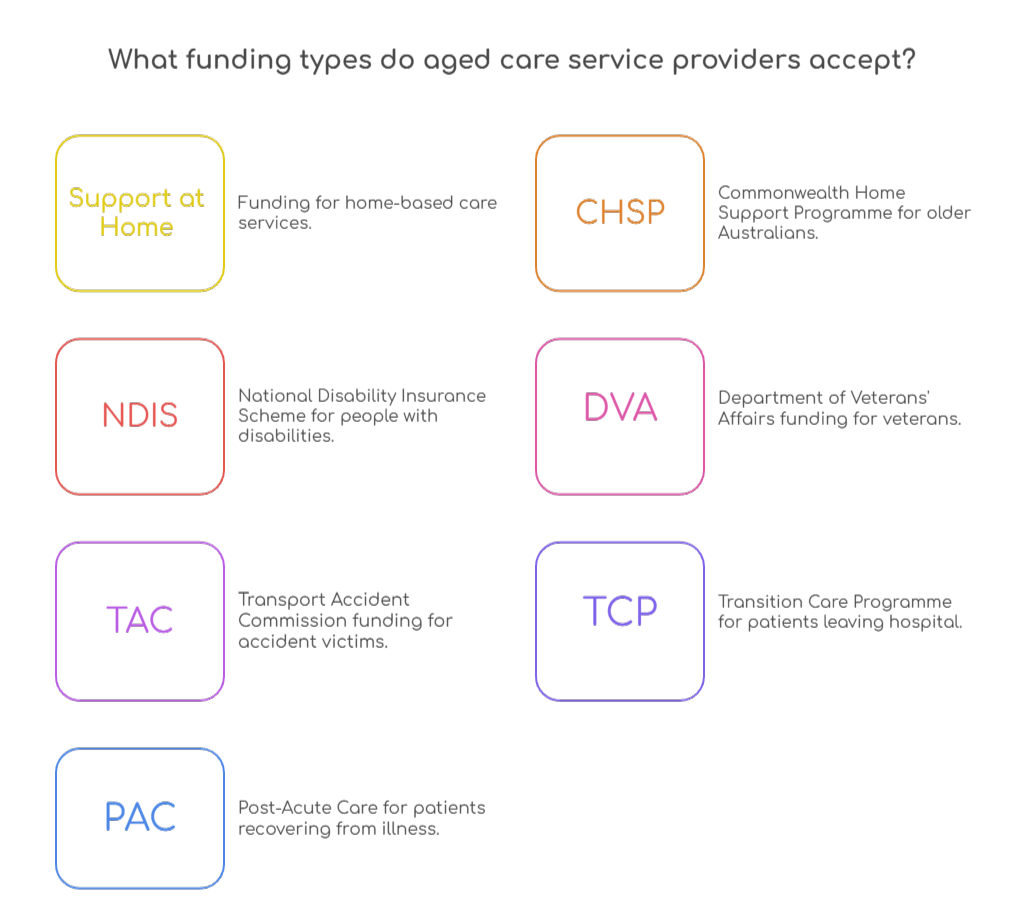
Government-funded aged care providers accept one or more of the following programs: Support at Home, CHSP, DVA, and TCP. Some providers also accept funding from non-aged care schemes such as NDIS, TAC, or PAC. Confirm which types your shortlisted provider accepts before you proceed.
Not all providers accept every funding type. If you hold DVA or TAC funding, confirm acceptance before you make contact.
How do you switch aged care providers?
You can switch aged care providers at any time. The new Aged Care Act, which commenced on 1 November 2025, reinforces your right to choose and change providers without penalty.
To switch, notify your current provider of your intention to leave and agree on an exit date. Your new provider will then accept your referral through the My Aged Care portal. They will work with the outgoing provider to transfer your budget information.
There is no requirement to pay an exit fee under Support at Home.
Unspent funds are generally transferred to your new provider, though the process can take up to 60–70 days to finalise. Ask your new provider to confirm this in writing before the transfer is finalised.
If you need help navigating the switch, call My Aged Care on 1800 200 422 or ask your GP for a referral. Your hospital discharge team can also refer you to the appropriate services.
FAQ
How do I find a list of aged care providers near me?
Search the My Aged Care 'Find a provider' tool and enter your postcode or suburb to filter results by location and service type. The Aged Care Quality and Safety Commission also maintains a Provider Register listing all registered providers.
Do I need to be assessed before I can access a provider?
You must be assessed before you can access government-funded aged care services. Contact My Aged Care on 1800 200 422 to arrange an assessment.
An aged care assessor under the Single Assessment System will determine your eligibility. Based on that, they will recommend the right level of support. Once approved, you are assigned a Support at Home classification or referred to a CHSP provider.
Note that approved participants enter a priority queue. Wait times for ongoing Support at Home funding range from about one month for urgent cases to 10–11 months for standard priority.
How long is the wait for a Support at Home place?
Estimated wait times vary by priority level. Urgent priority places are allocated within one month, and high priority places within one to two months. Medium priority takes six to seven months, while standard priority takes seven to eight months.
As of March 2026, 100,191 people were waiting for an ongoing Support at Home place. Contact My Aged Care as early as possible to start the assessment process.
Making the right choice for your care
Choosing an aged care provider is a significant decision, but it becomes manageable once you know how the system works and what to look for.
After getting assessed through My Aged Care, shortlist providers against the four factors that matter. These factors are services, fees, coverage, and quality. Insist on clear, written pricing before you commit.
And because you can switch at any time without penalty, your first choice never has to be your final one.
Sensible Care makes that choice easier. The team also handles all provider-switching paperwork on your behalf at no cost. Book a free consultation to learn more.

Take the Next Step in Care
Download our Info Kit or speak to one of our friendly team members today.


Explore More Helpful Reads
More stories, guides, and updates to support you and your family.




Need Help Getting Started?
Reach out on your terms, pick a time that suits you and let’s talk about how we can help.


.webp)